About Antedon mediterranea (Lamarck, 1816)
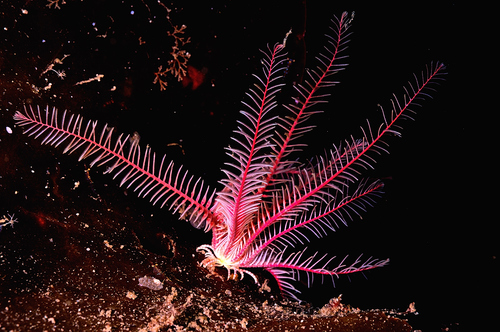
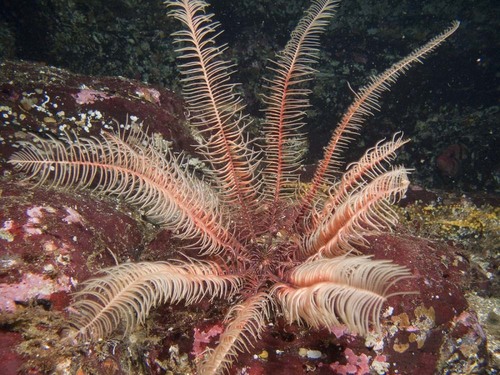
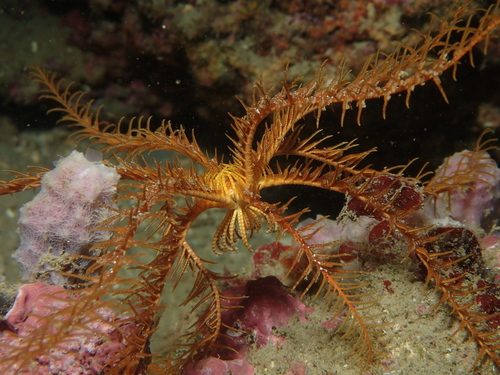
Antedon mediterranea has a vestigial stalk. The base of this stalk holds up to forty articulated, prehensile grasping cirri, which the animal uses to cling to hard surfaces. Above the stalk sits the calyx, a small cup-shaped structure surrounded by five pairs of arms that bear feathery pinnules. When danger approaches, the arms can roll up; when extended for feeding, they reach about 10 cm (4 in) long. The arms are fragile, but the animal can regenerate any arm that breaks off. This crinoid has highly variable colouration, ranging from white, yellow, orange, and red to brown and dark purple, and may sometimes have bands of contrasting colour. Antedon mediterranea is distributed in the Mediterranean and Aegean Seas, ranging west as far as the south coast of Spain and Cape St. Vincent. It occurs at depths down to approximately 80 metres (260 ft), and prefers areas with strong currents that bring plentiful food within reach. It lives on rocky or sandy seabeds that are rich in algae, including encrusting algae, or among the seagrass Posidonia oceanica. This species hides in concealed locations during the day, and emerges at night to move into more exposed areas. It is gregarious, and is often found clinging to sea whips, bryozoans, algae, or seagrasses.