About Antedon bifida (Pennant, 1777)
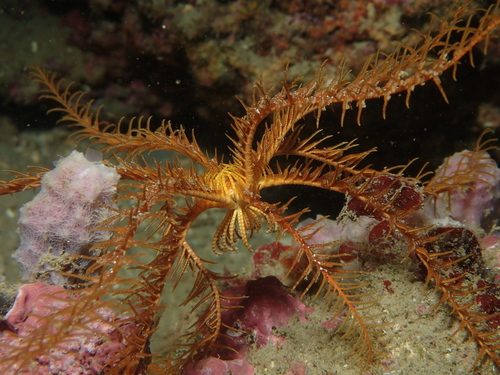
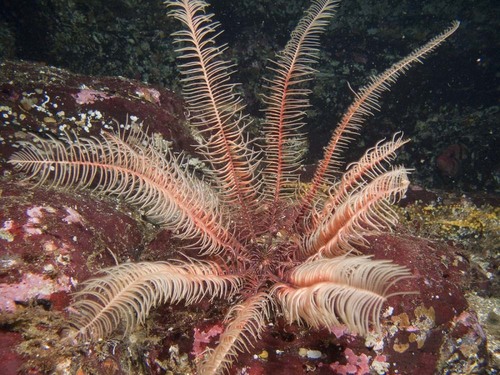
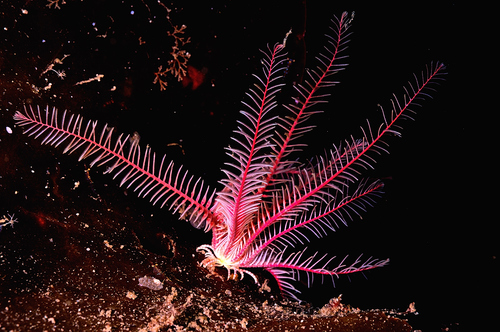
The body of Antedon bifida consists of a concave disc surrounded by ten pinnately divided arms, giving it a fern-like appearance. Its mouth and ambulacral grooves are located on the upper surface of the disc. The arms can reach up to 10 cm (4 in) in length, but are typically shorter than this. The undersides of the arms have prominent transverse ridges, and some arms have modifications specialized for feeding and reproduction. The pinnules are jointed, have approximately 35 segments, and bear tube feet of unequal size arranged in groups of three. The arm color of this species is variable, ranging from yellow or pink to deep purple, and is sometimes spotted or blotched; the pinnules are usually paler or white. There are around twenty short, banded cirri arranged in transverse rows on a central raised ossicle. These cirri curl under and grasp surfaces, allowing the animal to crawl around with great rapidity. It may be confused with the similar species Antedon petasus, but A. petasus is usually larger, has up to fifty cirri, has a neater appearance, and lacks ridges on the undersides of its arms. Antedon bifida is primarily found along the coasts of northwest Europe, with its range extending from the Shetland Islands south to Portugal. It has also been reported from Algeria, Tunisia, West Africa, and Venezuela. Around the British Isles, it occurs on the northeastern and western coasts. It is found from the low tide mark down to a depth of about 200 m (650 ft), and occasionally occurs at much greater depths. It is often associated with other crinoids and bryozoans, and may become the dominant species in its habitat. It travels between locations, clinging to rocks, seaweed, and molluscs using its clawed cirri. It favors areas with strong currents in both sheltered and fairly exposed positions, and is often found in gullies. Antedon bifida has a symbiotic relationship with the marine worm Myzostoma cirriferum. Larvae of this worm are caught by the tube feet of the feather star and processed like regular food particles. The larvae attach in the ambulacral grooves of the pinnules, where they undergo metamorphosis and mature. They hold onto the host using parapodial hooks and can move around on the host's surface.