About Anteaeolidiella lurana (Ev.Marcus & Er.Marcus, 1967)
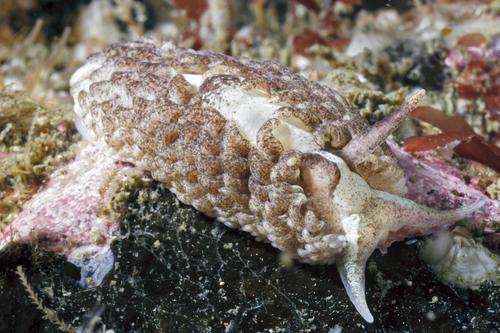
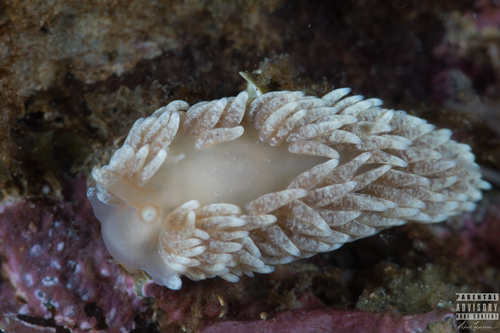
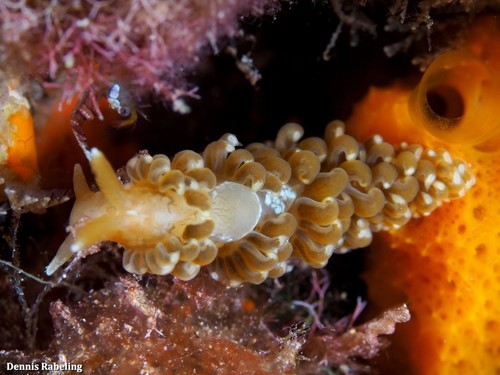
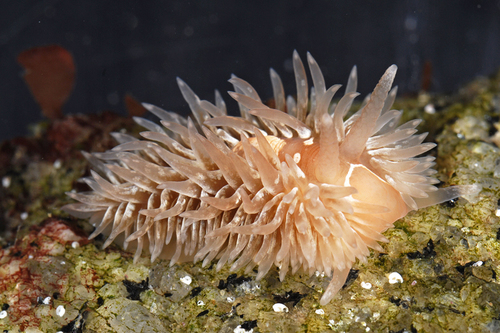
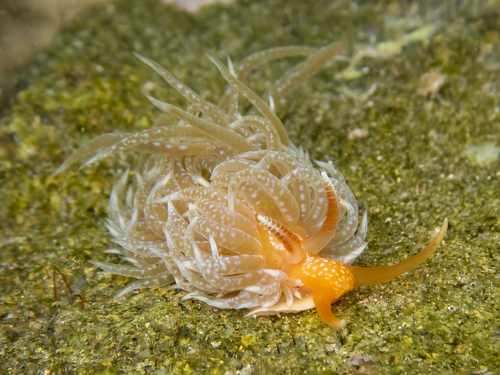
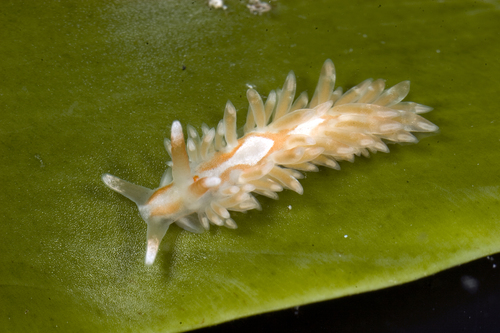
Anteaeolidiella lurana has a translucent white body. On the front of its head, a bracket-shaped orange marking stretches from the rhinophores to the base of the oral tentacles. Faint orange lines run along each side of the head. Behind the rhinophores, there is a diamond-shaped opaque white area surrounded by orange pigment. A second orange diamond filled with white pigment outlines the pericardium. Two thin orange bands extend almost to the tail, and they form teardrop or diamond-shaped marks each time they join. The rhinophores and oral tentacles share the body's translucent white base color. The smooth rhinophores have orange pigment on their proximal two-thirds, and white pigment on their tips. The conical oral tentacles have white pigment on their tips, and may also have orange pigment across their dorsal surface. A pair of black eyes can be seen at the base of the rhinophores. The ceratal epithelium is diffusely covered in orange pigment, broken up by a white subapical band. The digestive gland inside the cerata is orange, and ends in a white cnidosac. The cerata are arranged in up to 23 rows, with between two and nine cerata per row. This species was first described from specimens collected at Urubuqueçaba island, in the Bay of Santos, Brazil. It is reported to have a wide distribution across the Caribbean Sea, Mediterranean Sea, Canary Islands, and Queensland, Australia.