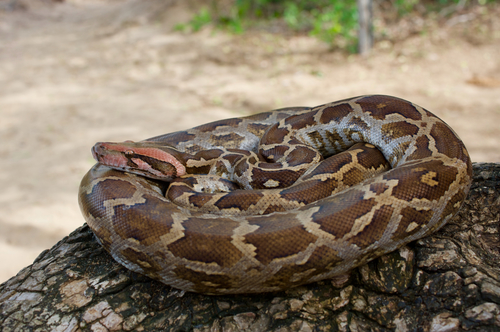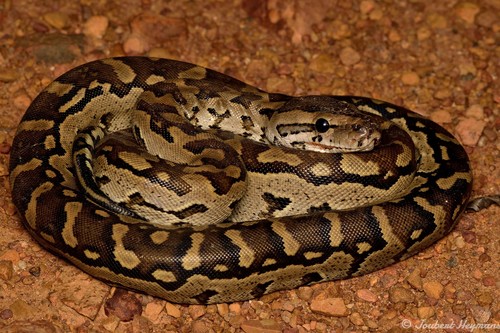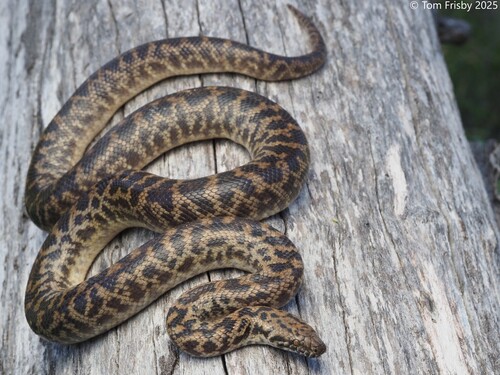
About Antaresia maculosa (Peters, 1873)
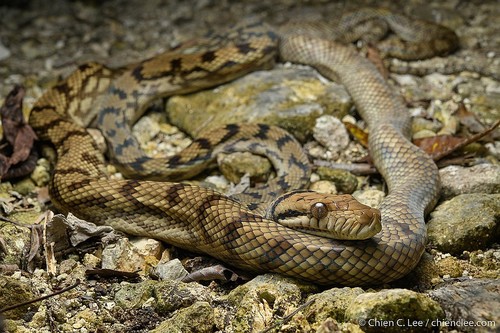
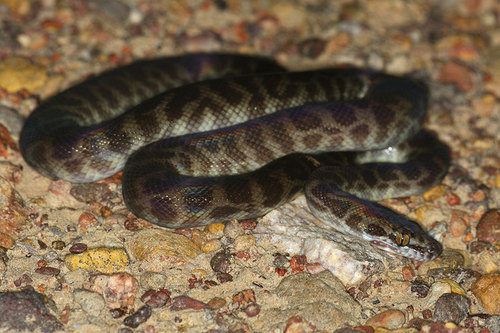
Adults of Antaresia maculosa, the largest species in the genus Antaresia, average 100–140 centimetres (39–55 inches) in length, with a recorded maximum specimen length of 69 inches (180 centimetres). This species retains an irregular, blotched color pattern through all life stages. Blotches have ragged edges because dark pigmentation only covers complete scales. Notably, the largest recorded specimen of this species was a male. This observation suggests that males of this species, and other species in the genus Antaresia, may compete for females. Male combat has never been observed in wild populations, and has only been documented in captive specimens. In recorded captive cases, male combat typically involves constriction, striking, and biting. Antaresia maculosa is primarily nocturnal and semi-arboreal; younger individuals prefer to use elevated hiding spots more than adult individuals. This species is the oldest within the genus Antaresia, having diverged from other genus members 27 million years ago.
Distribution and habitat: This species is found in Australia, ranging from the extreme north of the Cape York Peninsula, south through eastern Queensland to northern New South Wales. It also occurs on many islands off the coast of Queensland. The originally given type locality is "Rockhampton, Port Mackay, Port Bowen [= Port Clinton]" in Queensland, Australia. L.A. Smith restricted this type locality to "Port Mackay" (Mackay, Queensland, at 21° 09'S, 149° 11'E) via lectotype designation in 1985. Antaresia maculosa has also been recorded from the southern Trans-Fly region of Papua New Guinea, specifically at Weam in Western Province. There are concerns that this species may be exploited for the pet trade across the border in Indonesian West New Guinea. It can be found in most habitat types, but prefers rocky hillsides and outcrops that contain crevices and caves. The recorded Papua New Guinea specimen was found behind discarded corrugated tin sheets next to a disused airstrip, in Eucalypt savanna-woodland habitat dotted with many termite mounds.
Reproduction: The spotted python, Antaresia maculosa, is oviparous. Females can lay clutches of up to 15 eggs.