About Anser rossii Cassin, 1861
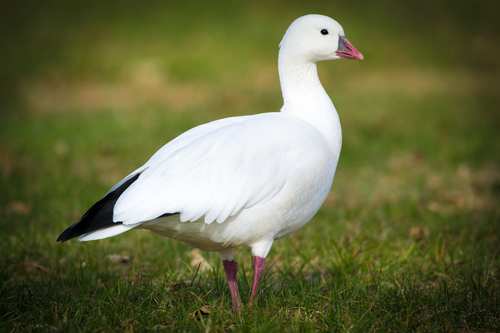
Anser rossii, commonly known as Ross's goose, has a rounded head atop a short neck. Its bill is short and triangular, with a bluish base and warty structures that grow more prominent as the bird ages. Adult Ross's geese can be identified by their entirely white secondary feathers, while juvenile Ross's geese have secondary feathers with dark centers. On average, females are 6% smaller than males. Goslings have olive gray legs, which turn deep red as the geese reach maturity. No geographic variation has been observed, and no subspecies have been identified for this species. It is related to other geese in the genus Anser, particularly the lesser snow goose. The presence of two distinct mtDNA lineages suggests frequent hybridization between the two species. There are two existing hypotheses for the evolution of Ross's goose: the species evolved from a population of snow geese that became isolated either by glacial advance, or in an ice-free glacial refugium. The recorded measurements for this species are as follows. Males have a length of 23.2–25.2 inches (59–64 cm), a weight of 42.3–55.3 ounces (1198–1567 g), and a wingspan of 44.5–45.7 inches (113–116 cm). Females have a length of 22.6–24.4 inches (57.3–62 cm), a weight of 37.6–51.3 ounces (1066–1454 g). Ross's goose inhabits the central Arctic, where the landscape is dominated by flat plains with occasional rock outcrops and drumlins, alongside wet meadows and marshy tundra. The vegetation in this habitat includes patches of dwarf birch, willow, grasses, and sedges, plus low-growing vascular plants such as crowberry, lapland rosebay, and lousewort. Large nesting colonies of Ross's goose can cause extensive plant damage through overgrazing.