About Anser indicus (Latham, 1790)
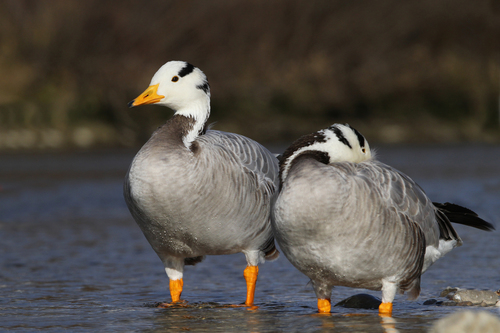
This species, the bar-headed goose, has the scientific name Anser indicus (Latham, 1790). The bird is pale grey, and is easily distinguished from other grey geese in the genus Anser by black bars on its otherwise white head. It is also much paler than other geese in this genus. In flight, it produces a typical goose honking call. It is a mid-sized goose, with a total length of 71–76 cm (28–30 in) and a weight of 1.87–3.2 kg (4.1–7.1 lb).
The main physiological challenge bar-headed geese face is extracting oxygen from hypoxic, low-oxygen air and transporting it to aerobic muscle fibres to sustain flight at high altitudes. Flight at high altitudes is metabolically very costly, because birds need to flap harder in thin air to generate lift. Studies have found that bar-headed geese breathe more deeply and efficiently under low-oxygen conditions, which increases oxygen uptake from the environment. The haemoglobin in their blood has a higher affinity for oxygen than haemoglobin from low-altitude geese; this difference comes from a single amino acid point mutation. This mutation causes a conformational shift in the haemoglobin molecule, changing it from the low-oxygen affinity form to the high-oxygen affinity form. The left ventricle of the heart, which pumps oxygenated blood to the body through systemic circulation, has significantly more capillaries in bar-headed geese than in lowland birds. This maintains oxygenation of cardiac muscle cells, and thus maintains cardiac output. Compared to lowland birds, mitochondria (the main site of oxygen consumption) in the flight muscle of bar-headed geese are located significantly closer to the sarcolemma. This decreases the intracellular diffusion distance that oxygen must travel from capillaries to mitochondria. Bar-headed geese have a slightly larger wing area relative to their weight than other geese, which is believed to help them fly at high altitudes. While this reduces the power output required for flight in thin air, high-altitude bar-headed geese still need to flap harder than lowland birds.
In summer, bar-headed geese inhabit high-altitude lakes in central Asia, where they graze on short grass. The species migrates south from Tibet, Kazakhstan, Mongolia and Russia before crossing the Himalayas. In recent years, this bird has drawn medical science attention as an early victim of highly pathogenic avian influenza (HPAI) at Qinghai. It is preyed on by crows, foxes, ravens, sea eagles, gulls and other animals. Its total population may be increasing, but assessing population trends is complex because the species occurs across an area of more than 2,500,000 km2 (970,000 sq mi).
The bar-headed goose is one of the world's highest-flying birds. It has been heard flying across Mount Makalu, the fifth highest mountain on Earth at 8,481 m (27,825 ft), and has reportedly been seen over Mount Everest (8,848 m (29,029 ft)), though this Everest sighting is an unverified second-hand report. This demanding migration has long puzzled physiologists and naturalists, who have noted that there must be a good explanation for why the birds fly to such extreme altitudes, particularly since lower-altitude Himalayan passes exist and are used by other migrating bird species. For a long time, bar-headed geese were not directly tracked using GPS or satellite logging technology flying higher than 6,540 metres (21,460 ft), and it is now believed that they do use high passes through the mountains.
The challenging northward migration from lowland India to breed on the Tibetan Plateau in summer is completed in stages. The flight across the Himalayas, starting from sea level, can be done non-stop in as little as seven hours. According to 2011 published research, bar-headed geese surprisingly reject predictable tail winds that blow up the Himalayas in the same direction they travel. They wait for these winds to die down overnight, then achieve the highest climbing flight rates ever recorded for a bird, and sustain these climbing rates for hours at a time. This 2011 study recorded the geese reaching a peak altitude of around 6,400 m (21,000 ft).
A 2012 study tagged 91 geese and tracked their migration routes. The study found that the geese spent 95% of their time below 5,784 m (18,976 ft), choosing to take a longer route through the Himalayas to use lower-altitude valleys and passes. Only 10 of the tagged geese were ever recorded above this altitude, and only one exceeded 6,500 m (21,300 ft), reaching 7,290 m (23,920 ft). All but one of these high-altitude flights were recorded at night; night, along with early morning, is the most common time of day for goose migration. The colder, denser air during these times is equivalent to an altitude hundreds of metres lower. The authors of these two studies suspect that stories of geese flying at 8,000 m (26,000 ft) are apocryphal. Bar-headed geese have been observed flying at 7,000 metres (23,000 ft).
The bar-headed goose migrates over the Himalayas to spend the winter in parts of South Asia, ranging from Assam as far south as Tamil Nadu. The species' modern winter habitat is cultivated fields, where it feeds on barley, rice and wheat, and may damage crops. Birds from Kyrgyzstan have been observed stopping over in western Tibet and southern Tajikistan for 20 to 30 days before migrating further south. Some individual birds show high fidelity to their chosen wintering site. They nest mainly on the Tibetan Plateau, extending north to Mongolia. Intraspecific brood parasitism has been observed, where lower-rank females attempt to lay their eggs in the nests of higher-ranking females.