About Anser erythropus (Linnaeus, 1758)
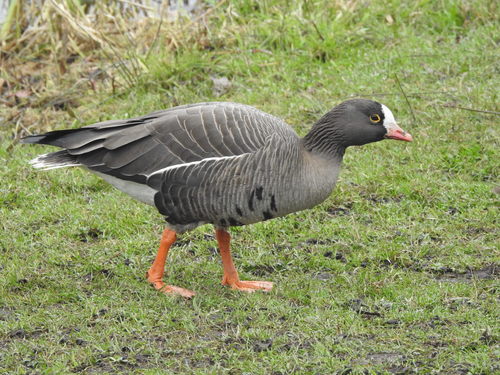
The two species of white-fronted goose differ very little other than in size. The lesser white-fronted goose, Anser erythropus, measures 53–66 cm (21–26 in) in length and has a 120–135 cm (47–53 in) wingspan, making it only slightly larger than a mallard (Anas platyrhynchos). Both white-fronted goose species can be easily told apart from greylag geese by their bright orange legs and mouse-coloured upper wing-coverts. Greylag geese have flesh-coloured bills and legs, and their upper wing-coverts are bluish-grey. Both white-fronted goose species have a very noticeable white patch on the face and broad black bars that cross the belly. In addition to being smaller than greater white-fronted geese, adult lesser white-fronted geese have a clear yellow eye-ring, and the white facial marking extends up to the crown. For distribution and habitat: The lesser white-fronted goose winters further south in Europe, and is a rare winter vagrant to Great Britain and India. In the past, individual birds appeared regularly at WWT Slimbridge in Gloucestershire, England, where they inspired Sir Peter Scott to found The Wildfowl and Wetlands Trust. Modern records of the species are far less frequent, however, which follows the species' population decline on its European breeding grounds. This is an attractive species, so it is widely kept in wildfowl collections. As a result, escaped individuals do occur; any lesser white-fronted geese seen in summer, or seen alongside other feral geese, are likely to be of captive origin.