About Anser cygnoides (Linnaeus, 1758)
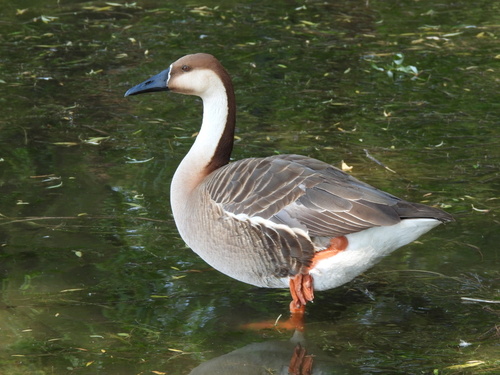
The swan goose (scientific name Anser cygnoides (Linnaeus, 1758)) is a large, long-necked goose within its genus. Wild individuals measure 81–94 cm (32–37 in) in total length, making it the longest species in the genus Anser. They weigh 2.8–3.5 kg (6.2–7.7 lb) or more, making it the second-heaviest Anser goose, after the greylag goose A. anser. The sexes have similar appearance, although males are larger, with proportionally longer bills and necks; the largest females are barely as large as the smallest males. Typical wing measurements are 45–46 cm (18–18 in) for males and 37.5–44 cm (14.8–17.3 in) for females. Bill length is around 8.7–9.8 cm (3.4–3.9 in) for males and 7.5–8.5 cm (3.0–3.3 in) for females. The male tarsus measures around 8.1 cm (3.2 in). Adult swan geese have a wingspan of 160–185 cm (63–73 in).
Their upperparts are greyish-brown, with thin light fringes on the larger feathers, and a maroon hindneck and cap that extends just below the eye. The flight feathers (remiges) are blackish, as is the entire underwing and the white-tipped tail feathers (rectrices). The upper- and undertail coverts are white, and a thin white stripe surrounds the base of the bill. Apart from darker streaks on the belly and flanks, the underside is pale buff, and is particularly light on the lower head and foreneck, which is sharply separated from the maroon upper neck and cap. In flight, the wings appear dark with no conspicuous pattern. Uniquely among its genus, the long, heavy bill is entirely black. Like most of its close relatives, the legs and feet are orange, and the eye irides are maroon. Juveniles are duller in color than adults, and lack the white stripe at the bill base and the dark streaks on the underside.
Its typical call is a loud, drawn-out, ascending honking described as "aang". As a warning call, it gives a similar but more barking honk two or three times in quick succession. The swan goose has a karyotype of 2n=80, made up of four pairs of macrochromosomes, 35 pairs of microchromosomes, and one pair of sex chromosomes. The two largest macrochromosome pairs and the female Z chromosome are submetacentric. The third-largest chromosome pair is acrocentric, and the fourth-largest is metacentric. The W chromosomes are also acrocentric, as are the larger microchromosomes; smaller microchromosomes are probably telocentric. There appears to have been some chromosomal rearrangement on the fourth-largest chromosome pair compared to the greylag goose.
Ecologically, the swan goose inhabits steppe, taiga, and mountain valleys near freshwater. It grazes on plants including sedges (Cyperaceae), grasses (Poaceae), and water plants, and rarely swims. It forms small flocks outside of the breeding season. In winter, it grazes on plains and stubble fields, sometimes far from water. Birds return from their winter grounds around April, and the breeding season begins shortly after arrival. It breeds as single pairs or in loose groups near marshes and other wetlands, with nesting activity starting around May. Clutches usually contain 5–6 eggs, and may sometimes hold up to 8 eggs. Eggs are laid in a shallow plant-built nest placed directly on the ground, often on a small knoll to keep the nest dry. The precocial young hatch after around 28 days of incubation, and reach sexual maturity at 2–3 years of age. Around late August or early September, the birds depart for their winter quarters, where they gather in small groups to moult their worn plumage.
The swan goose was moved from Near Threatened to Vulnerable on the IUCN Red List in 1992, and was further uplisted to Endangered in 2000, as its population was declining due to habitat loss, excessive hunting, and egg collecting, particularly on China's Sanjiang Plain. New research later found the species was not as rare as previously believed, so it was downlisted back to Vulnerable status in 2008. Currently, fewer than 500 breeding pairs may remain in Russia. Population numbers in Mongolia are unknown, though around 1,000 individuals were observed at Ögii Lake in 1977. Important wintering sites in China include Lake Dongting, Lake Poyang, the Yancheng Coastal Wetlands, and other locations around the lower Yangtze River, where around 60,000 individuals may be found each year — this may account for almost the entire global population. Until the 1950s, the species wintered in small numbers (up to around 100 birds per year) in Japan, but habitat destruction has driven the species away from this area.