About Anser canagicus (Sevastianov, 1802)
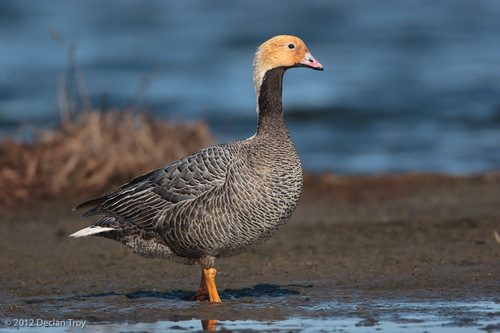
The emperor goose, scientifically known as Anser canagicus (Sevastianov, 1802), has a stout blue-gray body marked with black and white spots that create a distinct "scaled appearance". Its head and the back of its neck are white with an amber-yellow tint; unlike the snow goose, the white coloring does not extend to the front of the neck. Other identifying traits of this species include a black chin and throat, a white tail, a pink bill tipped with white, and yellow-orange legs and feet. The underside of the emperor goose's wings is gray, which differs from snow geese that have black and white underside wing coloring. Adult emperor geese often develop reddish-brown heads during summer, a change caused by feeding in tidal pools that contain iron oxide. Newly hatched young, called goslings, are grayish-white, and unlike adults, they have black bills. Goslings also differ from adults by having gray, brown, or black feet, and they keep a patch of white surrounding the bill for the first three weeks after hatching. Juveniles, which are immature geese older than goslings, are mostly gray with only a small amount of white in their feathers. Younger juveniles have dark heads and necks, with dusty-colored heads that bear white patches. After October, the head and upper neck of juveniles become mostly white, though they still have scattered darker feathers. By their first winter, juveniles have the same coloring and features as fully grown adult emperor geese. During summer, the emperor goose inhabits Arctic and subarctic climates around the Bering Sea, near Alaska and a small portion of northeast Russia. Its summer habitats include freshwater pools, inland lakes, coastal lagoons, and tundra wetlands. Around 90% of all emperor goose individuals nest on the Yukon-Kuskokwim Delta. When winter arrives, the species migrates south and spends the season primarily on the Aleutian Islands, the Alaska Peninsula, and Kodiak Island. It sometimes winters in Canada, and rarely travels as far south as northwestern California. As of 1918, the species has been recorded living at Humboldt Bay, Gridley, Davis, Rio Vista, Colusa County, Ingomar, Modesto, and Dixon in California. In winter, the emperor goose occupies ice-free mudflats and rocky shores. The total estimated extent of occurrence for the species is 775,000 square kilometres (299,000 sq mi).