About Anser caerulescens (Linnaeus, 1758)
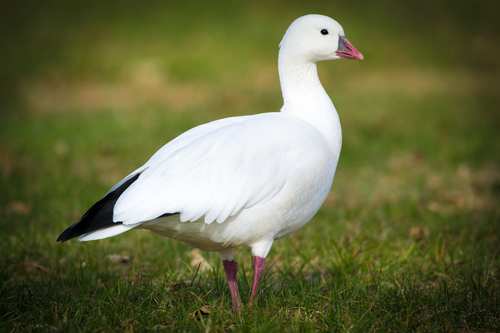
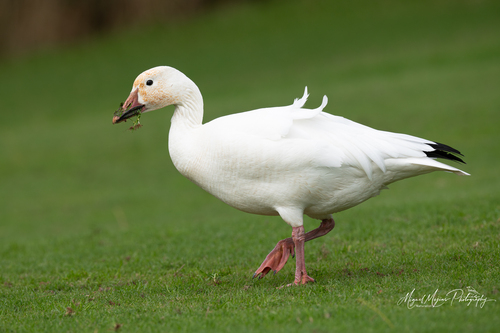
The snow goose, scientifically named Anser caerulescens (Linnaeus, 1758), has two distinct plumage color morphs: the common white (snow) morph and the gray/blue (blue) morph. White-morph snow geese are entirely white except for black wing tips, while blue-morph geese have bluish-gray plumage in all areas except the head, neck, and tail tip. Immature blue-phase geese have drab or slate-gray plumage, with little to no white on the head, neck, or belly. Both morphs have rose-red feet and legs, and pink bills with black cutting edges called tomia, which create a visible black "grin patch". These marking and color features distinguish snow geese from white domestic geese. Immature snow geese have duller coloration on their feet, legs, and bills. The head can become stained rusty-brown from minerals present in the soil where the geese feed. Snow geese are very vocal, and their calls can often be heard from more than a mile away. White-morph and blue-morph snow geese interbreed, and their offspring may be of either morph. Originally, the two color forms were considered separate species, but they are now recognized as two color phases of the same single species because they interbreed and occur together across their entire ranges. The color phases are genetically controlled: the dark blue phase comes from a single dominant gene, while the white phase is homozygous recessive. When choosing a mate, young snow geese most often select a mate that matches the coloring of their parents. If young geese hatched from a mixed-color pair of parents, they will mate with individuals of either color phase. The species is split into two subspecies distinguished by size and geographic range, though some scientists question this division due to overlapping size ranges. The smaller subspecies is the lesser snow goose (A. c. caerulescens), which ranges from central northern Canada to the Bering Straits area. Lesser snow geese stand 64 to 79 cm (25 to 31 in) tall and weigh 2.05 to 2.7 kg (4.5 to 6.0 lb). The larger subspecies is the greater snow goose (A. c. atlanticus), which nests in northeastern Canada. Greater snow geese average around 3.2 kg (7.1 lb) in weight and 79 cm (31 in) in height, and can reach up to 4.5 kg (9.9 lb). The wingspan of both subspecies ranges from 135 to 165 cm (53 to 65 in). Outside of the nesting season, snow geese usually feed in flocks. In winter, they feed on leftover grain in agricultural fields. They migrate in large flocks, and often stop at traditional stopover habitats in very large numbers. Snow geese frequently travel and feed alongside greater white-fronted geese, but they tend to avoid traveling and feeding alongside heavier Canada geese. The greater snow goose population declined at the start of the 20th century, but has since recovered to sustainable levels. Overall snow goose populations across North America have grown enough to cause severe degradation of their Arctic tundra breeding areas and saltmarsh wintering grounds, which negatively impacts other species that share these habitats. Major predators of snow goose nests include Arctic foxes and skuas. The highest risk to snow goose reproduction occurs during the first couple of weeks after eggs are laid, and just after hatching. Eggs and young chicks are vulnerable to these nest predators, but adult snow geese are generally safe. Snow geese have been observed nesting near snowy owl nests, an adaptation that likely reduces nest predation. Nesting success is much lower when snowy owls are absent, leading scientists to conclude that predatory snowy owls keep other competing predators away from snow goose nests. A similar protective association has been observed between nesting snow geese and rough-legged hawks. Other reported nest predators include wolves, coyotes, and all three North American bear species. Few predators regularly hunt adult snow geese outside of the nesting season, but bald eagles will readily attack wintering snow geese, and golden eagles may also do so.