About Ansellia africana Lindl.
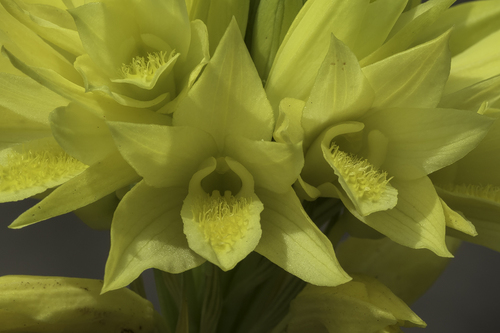
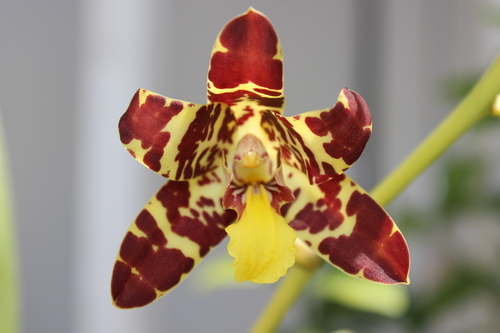
Ansellia africana Lindl. is a large perennial orchid that is usually epiphytic, though it occasionally grows as a terrestrial plant. It often forms spectacular clumps when attached to the branches of tall trees. This orchid is identifiable by its characteristic white, needle-like aerial roots that grow upward to form a basket-like structure around the plant's tall, many-noded, fusiform, cane-shaped yellow pseudobulbs. This basket catches decaying leaves and detritus, which the plant uses for nutrition. Pseudobulbs of this species can grow up to 60 cm (24 in) long, reaching a gigantic size. The entire robust plant can grow extremely large, sometimes reaching an estimated weight of over one tonne. Large clumps of this orchid have even been recorded as nesting sites for eagle owls (Bubo bubo). Roots that penetrate the growing substrate become very thick and cord-like, to support the plant's heavy weight. These substrate-penetrating roots have a very different form from the aerial roots that make up the trash basket; the aerial roots are non-absorbing. Nutrient breakdown and absorption from the detritus collected in the trash basket is carried out by the plant's fungal symbionts and its active absorbing roots. Each pseudobulb grows 6 to 7 narrowly ligulate-lanceolate, acute, plicate, leathery leaves at its top. Pseudobulbs produce a paniculate inflorescence that can reach up to 85 cm (33 in) long. This inflorescence holds between 10 and 100 delicately scented flowers, each about 6 cm (2.4 in) across. The flower's three-lobed lip develops into three yellow projections. Tepals are yellow or greenish yellow, with light to heavy brown spotting. The flowers are short-lived, seldom lasting more than 10 days, but the plant produces them in abundance if it receives high light levels throughout the year. This orchid is native to tropical and southern Africa. It grows in tree canopies near coasts and rivers, most commonly at elevations below 700 m (2,300 ft), though it occasionally occurs as high as 2,200 m (7,200 ft). Ansellia africana is an easy species to cultivate. In cultivation, plants usually bloom via a terminal inflorescence growing from older pseudobulbs, though some individuals produce flowers from newer pseudobulbs in occasional years. Cultivated plants do not bloom easily unless they receive very bright light (around 2000 foot candles) and a 6-week dry rest period in the fall. In their native habitat, these plants can survive for several months without water, making them very drought tolerant, but they perform better if kept evenly moist year-round. Leaves will develop a yellowish color when the plant receives enough light, which is normal for this species, as it uses CAM photosynthesis. Dark green leaves indicate the plant is not receiving enough light. This species tends to host and cultivate mycorrhizal fungi picked up from the environment, both in cultivation and in the wild. As a trash basket orchid that forms interlocked airborne roots to collect leaf litter in nature, it breaks down its growing medium more rapidly than other orchid species. Unlike most epiphytic orchids, the roots of Ansellia africana are not meaningfully photosynthetic. They are white and pale, resembling the roots of terrestrial and mycoheterotrophic orchids. If the plant does not get enough nitrogen, it will grow a trash basket of numerous upward-growing non-absorbing roots. It will not produce this structure if it receives regular sufficient nitrogen. In the wild, plants usually bloom at the end of dry spells, but this species has an unusual habit: when grown in high light and exposed to short 4–6 week dry spells every 6 months, it can bloom at any time of year, and even bloom multiple times per year. There is wide natural variability in flower shape, color, and markings across the species' widespread range in Africa.