About Anredera cordifolia (Ten.) Steenis
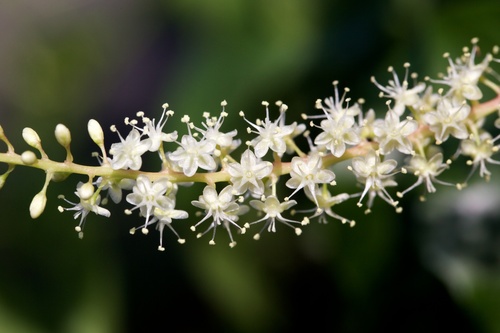
Anredera cordifolia is an evergreen climbing plant that grows from fleshy rhizomes. It produces bright green, heart-shaped, fleshy, shiny leaves that measure 4–13 centimetres (1.6–5.1 in) in length. Wart-like tubers form on the plant’s aerial stems, and these are a key identifying feature of the species. From late summer through autumn, it produces large quantities of small, cream-coloured, fragrant flowers that have a scent similar to cardamom. These flowers grow on hanging racemes that can reach up to 30 cm (12 in) in length. The plant spreads via these easily detaching tubers. Anredera cordifolia is native to the South American countries of Bolivia, Brazil, Paraguay, Uruguay and Argentina. It has been introduced to Africa, the Australasia–Pacific region, southern Europe, and North America, and is considered an invasive species in many tropical and subtropical locations. In East Africa, it is an invasive species in parts of Kenya and Uganda, and is confirmed to be present in Tanzania. It is also an invasive species in South Africa. In Australia, it is a major invasive problem in the tropical and subtropical regions of Queensland and New South Wales, including Sydney and areas south to the Illawarra region. It has been declared a noxious weed in both of these states. Small but expanding infestations have also become naturalised in Victoria, Tasmania, South Australia and Western Australia, and the plant is also present on Norfolk Island and Lord Howe Island. In New Zealand, it grows on the North Island from North Auckland south to Hawkes Bay and the Manawatu; on the South Island it is found in Port Hills near Christchurch, and it also occurs in the Kermadec Islands. It has naturalised on most of the islands of Hawaii, where it is classified as a noxious weed. Anredera cordifolia can reproduce through the spread of tubers and from broken fragments of rhizomes. While this species produces both male and female flowers, it rarely reproduces sexually to produce seed. It most often spreads through its own vegetative growth, but its plant fragments are easily moved by human activities. If fragments enter waterways, they can be easily carried to new locations this way. From 1988 onwards, seedlings of Anredera cordifolia have been found far away from human habitation, roads and streams in Australia, which has led to the conclusion that the species does produce viable seeds in this region. The leaves of Anredera cordifolia, also called Madeira vine, can be cooked as a vegetable by frying with olive oil or sesame oil and garlic, and can be added to soups. Leaves and stems can be eaten either raw or boiled. The plant’s rhizomes are also edible. Its bulbils are not edible, but have been used medicinally to reduce inflammation, improve ulcers, and support liver health.