About Anorrhinus austeni Jerdon, 1872
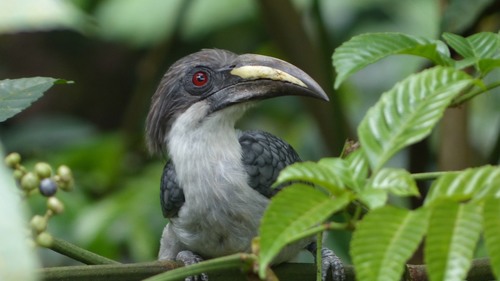
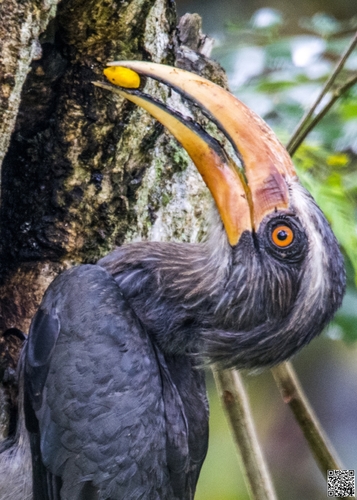
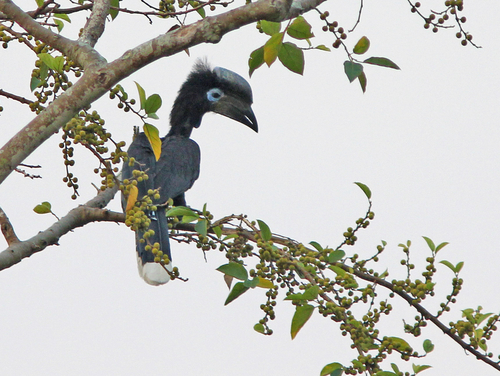
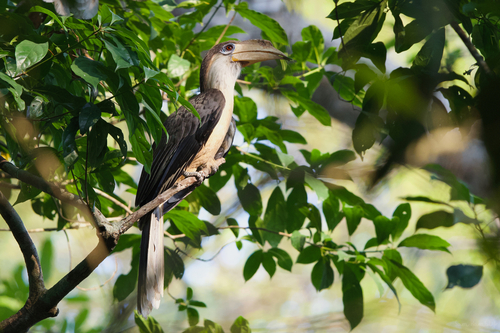
Austen's brown hornbill (Anorrhinus austeni Jerdon, 1872) has dark brown upperparts, including the back, wings, and tail, with lighter-colored belly, cheeks, and throat. Its tail and wings have white tips, and it has blue bare skin surrounding the eyes. This species is sexually dimorphic. Females have ivory white bills and casques, while males have cream-colored bills and casques. Females have grey-brown throats, bellies, and cheeks; males have whitish throats and cheeks paired with a reddish belly. Females also have a yellow wash of color below the eye. Juveniles resemble adult males, but have short yellow bills, orange skin around the eyes, and pale-brown feather tips. Adult males weigh 710–900 g (25–32 oz) and measure 73–80 cm (29–31 in) in length; females are smaller in size. Austen's brown hornbill is distributed across northeastern India, central and northern Thailand, Myanmar, Laos, Vietnam, and Cambodia. It was historically found in China, but no recent reports of the species there exist. It is rare across most of its range, and occurs mainly in protected forests within national parks and sanctuaries, such as Patkai Wildlife Sanctuary and Namdapha Tiger Reserve. It is common in Laos, though its population in the country is declining. The species lives primarily in dense lowland and foothill evergreen forests, and occurs less commonly in deciduous forests. It has been recorded up to 1,000 m (3,300 ft) in India, 1,500 m (4,900 ft) in Southeast Asia, and 1,800 m (5,900 ft) in Tibet. It moves through forest at or below the canopy level, but uses all canopy layers equally. Austen's brown hornbill is a monogamous cooperative breeder. A dominant breeding pair has an average of two non-breeding helpers, though the number of helpers can range from zero to five. Helpers are the pair's own non-breeding offspring, and are mostly adult males, but sometimes juveniles. Helpers bring food to the nesting female and chicks, and defend the nest from predators, conspecifics, and other closely related hornbill species. Food is delivered to the nest via regurgitation. This hornbill nests in natural tree cavities or abandoned woodpecker holes, located around 5–7 m (16–23 ft) above the ground, and sometimes as high as 27 m (89 ft). Tree species used for nesting include magnolia, hollong, Anthoshorea assamica, and Artocarpus chama. Breeding activity begins between February and March depending on location, usually before the monsoon season. The main breeding season lines up with the peak availability of non-fig fruits. Like other hornbills, the female seals herself inside the nesting cavity and moults her flight feathers during nesting. The average clutch size is two eggs, and rarely reaches up to five. The incubation period lasts 24–30 days, and the nesting period lasts 57–62 days. The female and chicks all fledge at the same time, between May and July depending on location. The full nesting cycle lasts 73–112 days.