About Anopterus macleayanus F.Muell.
Anopterus macleayanus, commonly called Queensland laurel or Macleay laurel, is a shrub or small tree belonging to the Escalloniaceae family. It is native to Queensland and New South Wales, Australia. This species is one of two species in the genus Anopterus. It was formally described in 1859 by botanist Ferdinand von Mueller, after being collected from the summit of Mt Lindesay, and was named in honour of Sir William Macleay.
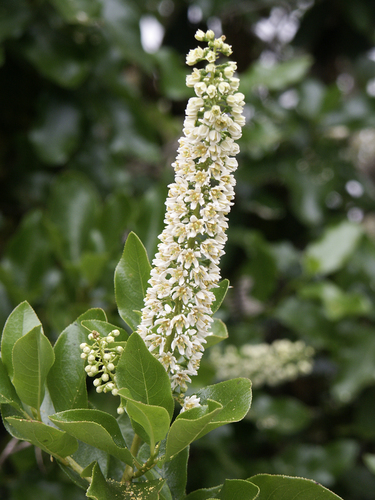
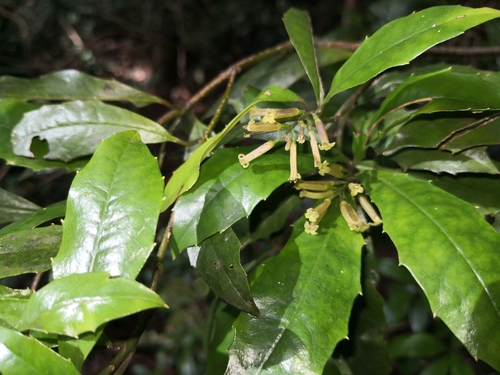
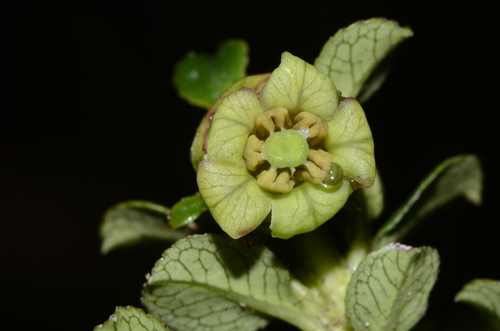
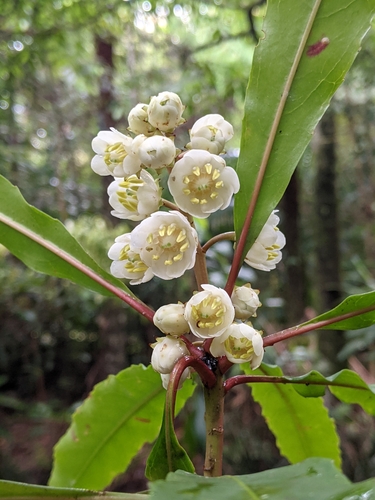
A. macleayanus can reach up to 15 metres (50 ft) in height. It produces oblanceolate, spear-shaped leaves that measure 10 to 30 cm (3.9 to 11.8 in) long and 2 to 4 cm (0.79 to 1.57 in) wide, with bluntly serrated margins. Juvenile leaves are often considerably larger than mature leaves, and both the leaf petioles and bases are tinged red. In its native range, white flowers grow in racemes between October and December, which is mid-spring to early summer.
This species grows naturally in warm-temperate and subtropical rainforest, ranging from the Comboyne Plateau in New South Wales northward into Queensland. The thrips species Thrips setipennis has been collected from the flowers of A. macleayanus, which suggests this thrips may be a pollinator for the plant. Thanks to its long leaves with wavy margins and red-pink highlights, it has horticultural potential. In garden cultivation, A. macleayanus grows best in partially shaded positions with well-drained soil, and requires additional water during summer. As it naturally occurs as a rainforest floor plant, it needs a sheltered location while becoming established. It is resilient, but can be slow-growing. It can also be grown in containers, and even kept as an indoor plant.