About Anopterus glandulosus Labill.
Anopterus glandulosus Labill. most commonly grows as a small understorey shrub, reaching 2 to 4 metres in height and 2 to 3 metres in width. It can also be grown as a small canopy tree up to 10 metres tall. In shaded understorey conditions, it often has a straggly growth habit, with branches forming layers that lead to coppiced growth.
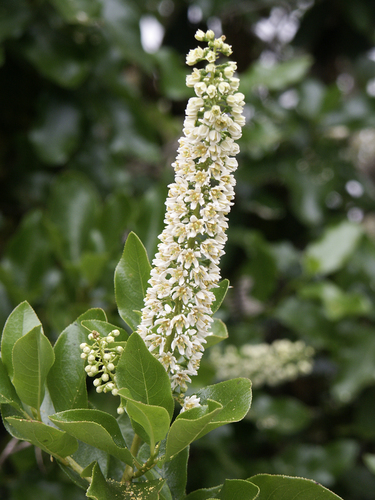
Its leaves are large, measuring 7 to 17 cm long and 2 to 4 cm wide. They are thick, dark green, glossy, and have a glabrous surface. Leaf margins are serrated, with each serration ending in a blunt tip and a black gland at its apex. Leaf shapes range from lanceolate elliptical to oblanceolate, with an acute apex and a base that narrows into a short petiole.
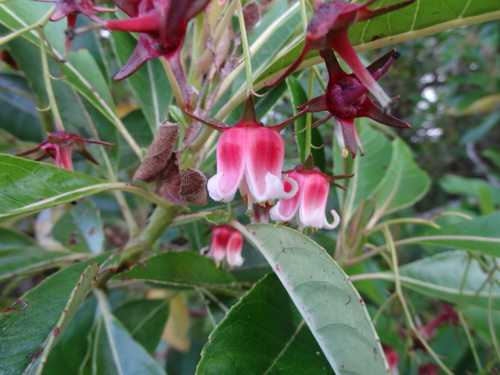
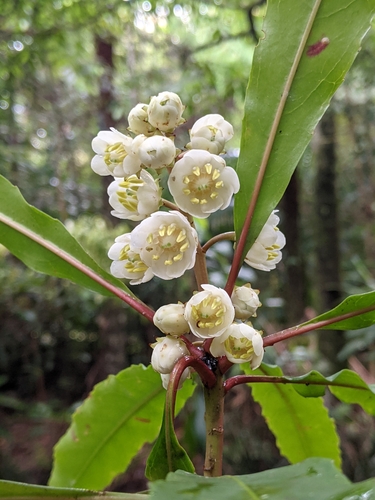
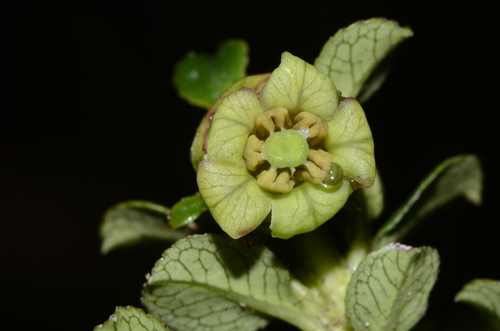
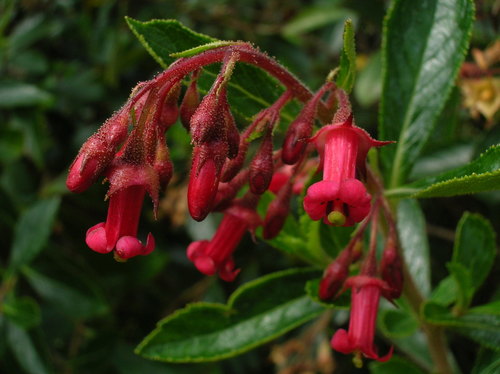
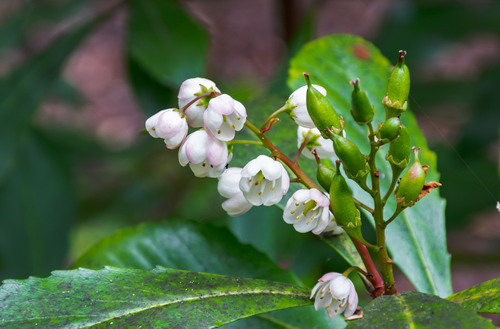
Flowering occurs in late spring, and often a second time in autumn. Its flower heads, called inflorescences, grow as terminal racemes that are roughly the same length as the leaves. The flowers are bell-shaped, around 2 cm in diameter, and borne on slender, often recurved pedicels. Each flower has six overlapping ovate petals 10 to 12 mm long, which are white or pink-flushed. It usually has six sepals joined at the base with spreading lobes. Six filamentous stamens sit opposite the sepals, and are shorter than the petals. Each flower contains two large, joined, bright green carpels. The ovary is superior and conical, tapering to a short style and a bifid stigma.
Anopterus glandulosus is a slow-growing shrub to small tree that grows in wet sclerophyll forest and rainforests in southern and western Tasmania, at elevations below 1200 m. It prefers cool, moist, partly shaded sites with well-drained soils, ranging from loamy to sandy to highly organic soils. More of its seedlings germinate and grow on rotting fallen logs than in mineral soil. It most often grows as an understorey shrub beneath a canopy of Nothofagus cunninghamii (myrtle beech).
It is susceptible to the plant disease Phytophthora cinnamomi, which causes root rot or dieback, and cannot tolerate excess phosphorus. Despite this, the species is highly adaptable and tolerates harsh conditions including frost and snow. As a species adapted to rainforest habitats, it is suited for continuous regeneration, and regrows well after disturbance; it often undergoes rapid regrowth to form thickets after mechanical damage. Its attractive, strongly scented flowers produce large volumes of nectar, which attracts insects and birds such as honeyeaters that feed on both nectar and insects.
In cultivation, Anopterus glandulosus is an attractive, easily grown plant that is well-suited for garden use. It can be successfully cultivated by germinating fresh seed, or propagating from semi-hardwood cuttings taken in March or April. Seed germination takes 4 to 5 months and requires constant moisture. This species tolerates full sun to full shade, grows easily in semi-protected locations such as against a wall or fence, and does particularly well as a container plant. It needs ample water in summer, and benefits from applications of non-phosphate based organic fertilisers, manure, and mulch. It responds well to annual pruning, and its attractive evergreen foliage can be harvested for floriculture.