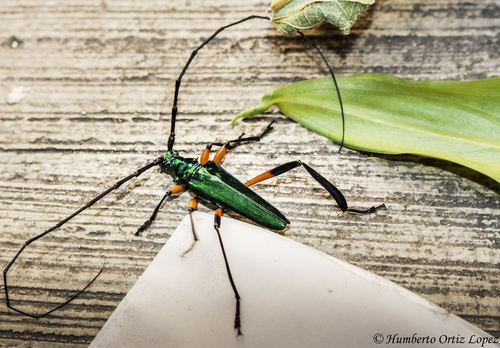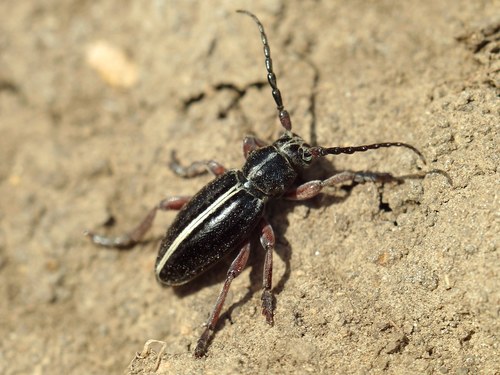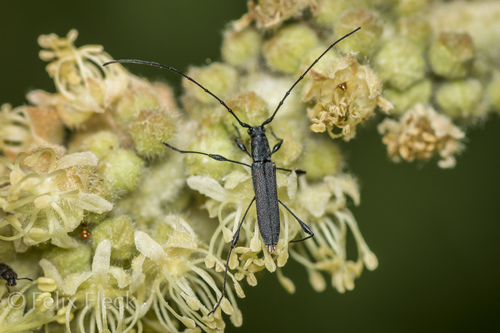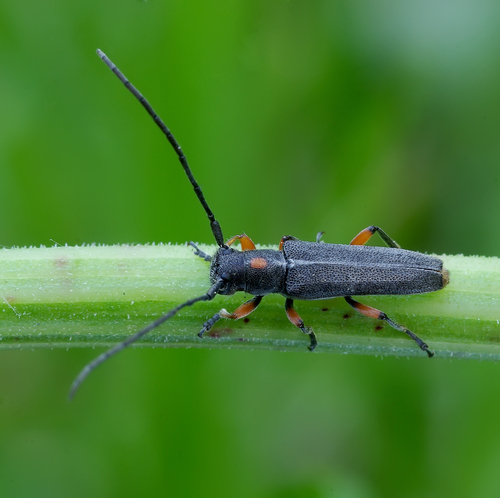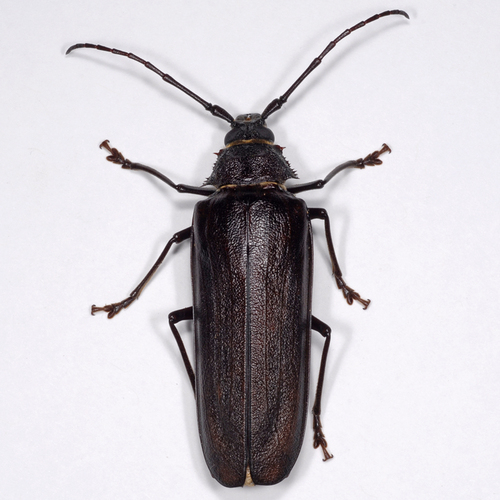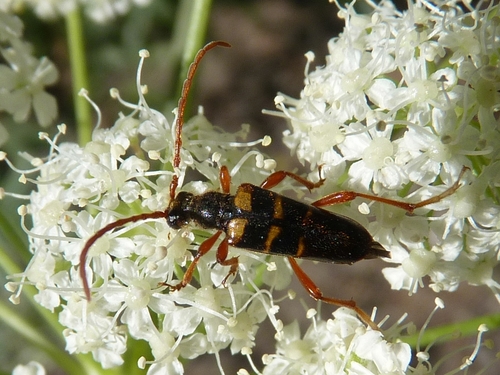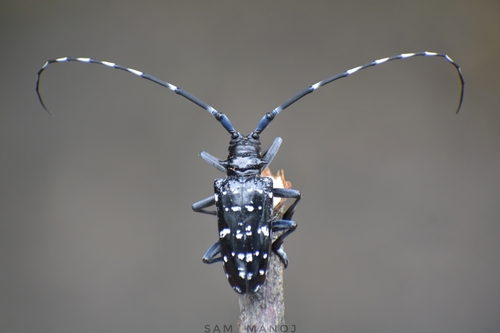
About Anoplophora chinensis (Forster, 1771)
Anoplophora chinensis, commonly called the citrus long-horned beetle, is also listed in many sources under the synonym Anoplophora malasiaca. It is a long-horned beetle native to Japan, China, Korea, Taiwan, and Southeast Asia, where it is considered a serious pest. This species has invaded several European countries: Italy, Switzerland, Turkey, France, Germany, and Croatia. Infestations of this beetle can kill many types of hardwood trees, including Citrus, pecan, apple, Australian pine, Hibiscus, sycamore, willow, pear, mulberry, chinaberry, poplar, Litchi, kumquat, Japanese red cedar, oak, and Ficus.
A. chinensis generally prefers warm, temperate climates rather than excessively hot climates. Temperate regions around the world are more likely to be colonized by invasive A. chinensis subspecies; for example, the temperate climates of the U.S. states of Florida and California are at higher risk of infestation than other U.S. states. A. chinensis is likely made up of two subspecies, with the other being Anoplophora malasiaca. Multiple studies confirm that the Chinese subspecies prefers optimal growth and development temperatures approximately 3 °C to 7 °C lower than the Italian population. The exact preferred temperature range can also vary depending on the A. chinensis population of a given region or country.
Anoplophora chinensis lives within plants, and lays its eggs in the roots of plants and trees. It inhabits over 100 different plant species from 19 families, around half of which are native to China, the species' native range. Though it lives in many types of trees, citrus trees are commonly used for burrowing, and for larvae maturation and feeding. Temperatures in plant roots are more stable throughout the day and year, and the lack of drastic temperature fluctuation lets more offspring pupate and grow into adulthood. However, studies have found that some temperature fluctuation is necessary for survival to adulthood. In these studies, temperature fluctuations of at most 20 °C to 30 °C demonstrated that mild temperature change, not fluctuation covering all seasonal extremes, was required. This confirms that mild temperature fluctuation is needed for growth to adulthood, while extreme heat and extreme cold prevent offspring from pupating and surviving to adulthood. For example, temperatures at or above 40 °C stop growth and development entirely.
At different larval developmental stages, the beetle prefers different regions of the wood of its host plant. The surrounding environment is approximately 2 °C warmer than the plant phloem in the same area, and temperature varies slightly between different parts of the plant. Deeper wood within a plant is slightly warmer than wood closer to the plant's exterior, and more developed larvae move deeper into the host plant to feed on deeper wood, compared to less developed larvae.
The citrus long-horned beetle has a total life cycle of approximately one to two years. Adult beetles are active from April to December, and are most active between May and July. After developing through all larval instar stages, the beetle enters the pupal stage, where it stays for 4 to 6 weeks. Once it reaches the adult stage, it is first classified as a pre-adult and takes 1 to 2 weeks to fully mature. Adult beetles feed on twigs, petioles, and leaf veins for 10 to 15 days before oviposition.
Citrus long-horned beetles locate mates using contact cues and short-range pheromones. The larval host plant directly impacts adult longevity and fecundity. Females lay individual eggs in tree bark, specifically on the lower trunk, root collar region, and exposed roots. Females chew through bark to create a T-shaped oviposition site in bark tissue, then lay a single egg inside. Eggs laid in summer hatch in 1 to 2 weeks. After hatching, the larva chews into the tree to form a tunnel, which it later uses for pupation. The full process from egg laying to adult emergence takes one to two years.