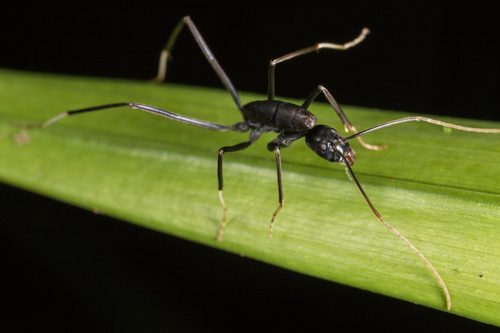
About Anoplolepis gracilipes (Smith, 1857)
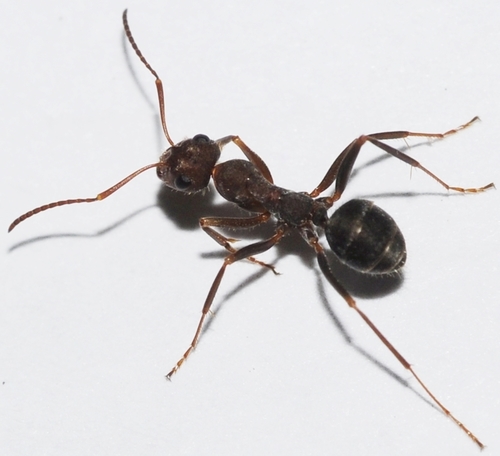
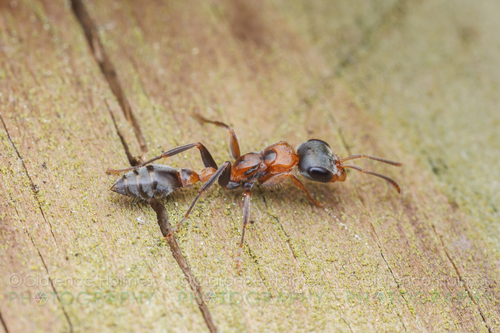
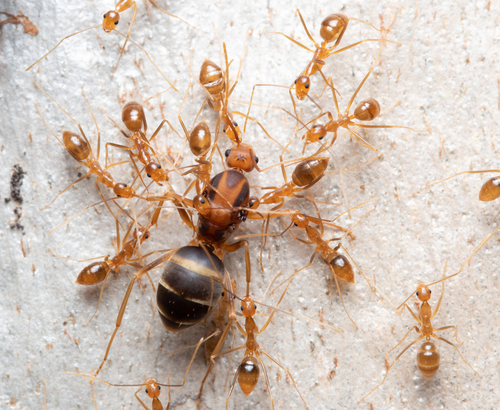
The yellow crazy ant, whose scientific name is Anoplolepis gracilipes, also goes by the common names long-legged ant and Maldive ant. This ant species is thought to be originally native to Asia, and has been accidentally introduced to many tropical regions across the globe. The term "crazy" in its common name refers to the erratic movements the ant makes when disturbed. Thanks to its long legs and antennae, it ranks among the largest invasive ant species in the world. Like other well-known invasive ants such as red imported fire ant (Solenopsis invicta), big-headed ant (Pheidole megacephala), little fire ant (Wasmannia auropunctata), and Argentine ant (Linepithema humile), the yellow crazy ant is classified as a "tramp ant". Tramp ant species easily establish populations and become dominant in new habitats, due to traits including aggression toward other ant species, low aggression toward members of their own species, efficient resource recruitment, and large colony sizes. The yellow crazy ant is included on the International Union for Conservation of Nature (IUCN) list of "one hundred of the world's worst invasive species". It has invaded ecosystems ranging from Hawaii to the Seychelles, and has formed supercolonies on Christmas Island in the Indian Ocean. In 2023, a scientific article proposed that A. gracilipes has a unique reproductive cycle, which suggests that males of this species are obligate chimeras. The yellow crazy ant's native natural habitats are the moist tropical lowlands of Southeast Asia, along with surrounding areas and islands in the Indian and Pacific Oceans. It has been introduced to a wide range of tropical and subtropical environments, including northern Australia, several Caribbean islands, multiple Indian Ocean islands (Seychelles, Madagascar, Mauritius, Réunion, the Cocos Islands, and the Christmas Islands), and several Pacific islands (New Caledonia, Hawaii, French Polynesia, Okinawa, Vanuatu, Micronesia, Johnston Atoll, and the Galapagos archipelago). This species is known to live in agricultural systems including cinnamon, citrus, coffee, and coconut plantations. Because yellow crazy ants have general nesting habits, they can spread to new areas via trucks, boats, and other forms of human transport. Naturally, yellow crazy ant colonies disperse through a process called budding, where mated queens and workers leave the original nest to start a new nest. Dispersal through flight by female winged reproductive individuals only occurs rarely. Colonies that disperse via budding generally have a lower natural dispersal rate, so they require human activity to reach distant locations. In the Seychelles, A. gracilipes has been recorded moving up to 400 m (1,300 ft) per year. A survey on Christmas Island recorded an average spreading speed of 3 meters (9.8 ft) per day, equal to one kilometer (0.6 mi) per year. Like other ant species, the queen yellow crazy ant produces eggs that are fertilized by male sperm stored in the queen's sperm storage organs. When an egg is fertilized, three distinct outcomes can occur: (i) the resulting diploid organism develops into a queen if the egg is fertilized by an R sperm, or (ii) it develops into an infertile diploid worker if the egg is fertilized by a W sperm. A 2023 scientific study has described a third outcome: (iii) the egg is fertilized by a W sperm, but the parental nuclei do not fuse, and instead divide separately within the same egg. This produces a haploid male that is chimeric, with some cells carrying the W genome and others carrying the R genome. The proportion of the two cell lines is not equal across all tissues: sperm cells mostly carry the W genome, giving W alleles a fitness advantage. This is the first recorded case of obligate chimerism in any animal.