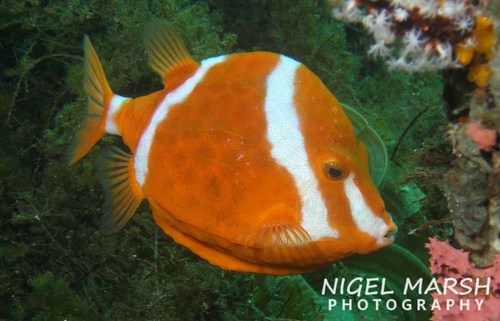
About Anoplocapros lenticularis (Richardson, 1841)
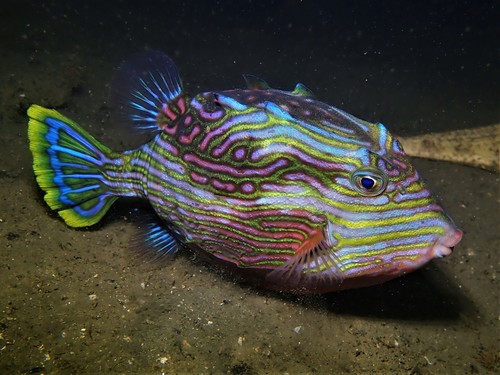
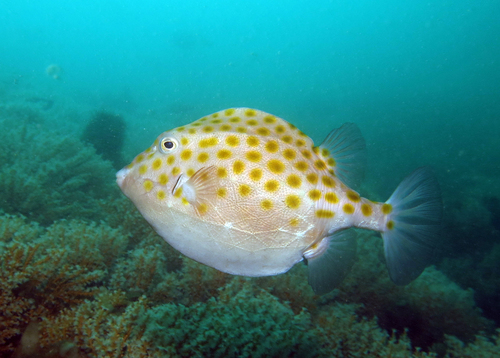
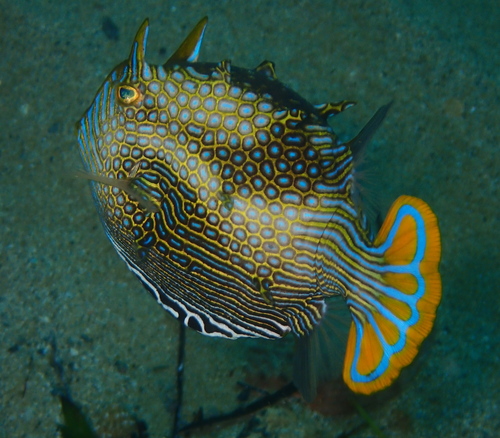
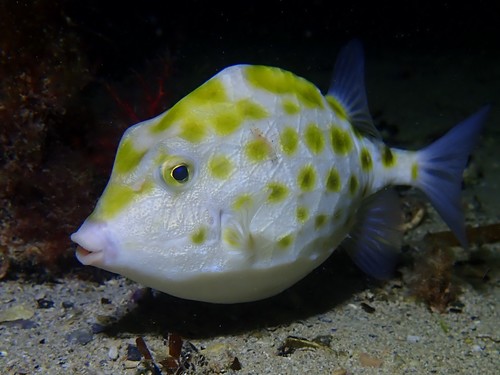
Anoplocapros lenticularis (Richardson, 1841), commonly called the white-barred boxfish, has 9 to 11 soft rays in its dorsal fin, 10 or 11 in its anal fin, 12 in its pectoral fin, and 11 in its caudal fin. It has a deep body that is armoured with a bony carapace formed from plate-like scales. There are two series of bony plate-like scale rings surrounding the caudal peduncle: the front ring is broken, while the rear ring is complete. Both rings have rough, plate-like scales covered in tubercles. Adults have a concave snout, with eyes positioned high on the head. Both the back and belly are keeled, and the dorsal profile of males is higher than that of females. Small juveniles have a more rounded body shape. The overall body colour of adult males ranges from yellowish-orange to brownish-orange or reddish, with wide light grey to whitish bands on the flank: one runs from the eye to the lips, a second runs from the top of the dorsal keel to the cheek, and a third runs along the rear edge of the bony carapace. Females have a similar base pattern but are lighter in overall colour, and have irregular black lines and spots on their upper body. Juveniles resemble females, but have a greater number of spots. The maximum published total length of this species is 33 cm (13 in). Anoplocapros lenticularis is endemic to the waters off western and southern Australia, where it occurs from the Houtman Abrolhos in Western Australia to Western Port in Victoria. It can be found at depths down to 250 m (820 ft), on offshore reefs and around jetties.