About Anolis stratulus Cope, 1861
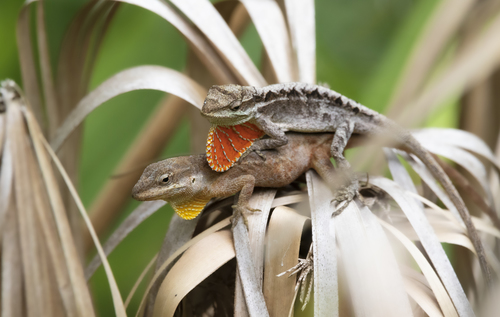
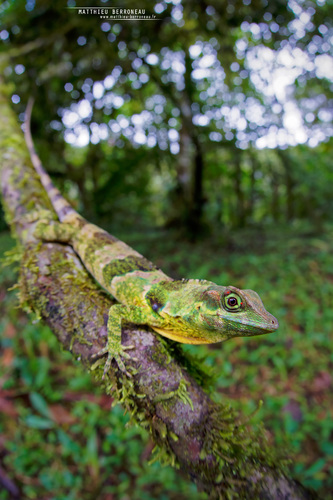
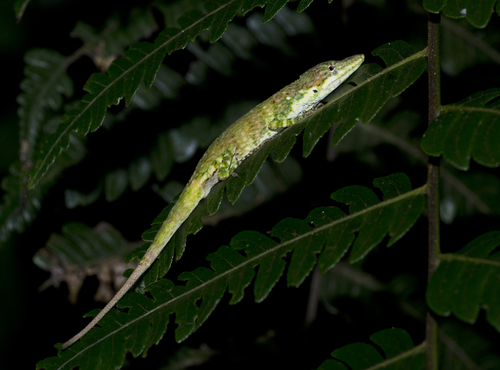
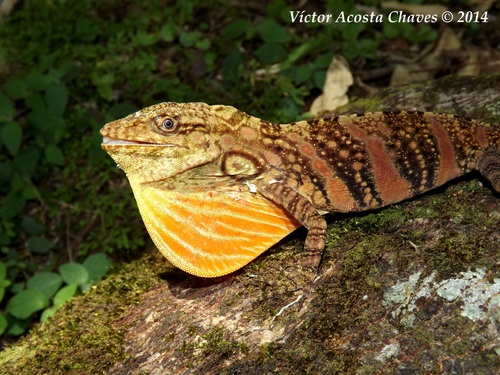
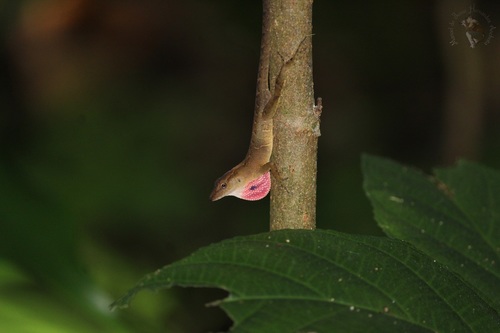
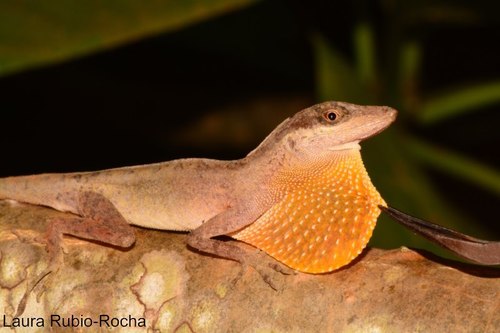
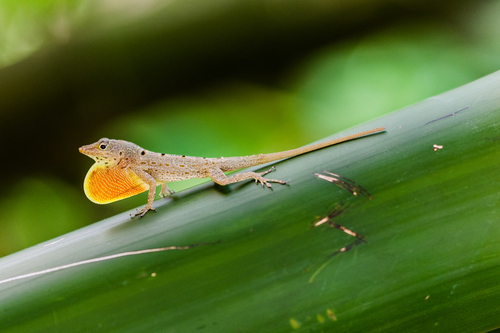
Anolis stratulus Cope, 1861, commonly called the barred anole, is a small to moderately-sized anole lizard. Adult males measure 40 to 44 mm (1.6 to 1.7 in) from snout to vent, while adult females reach up to 46 mm (1.8 in); tail length ranges from 51 to 75 mm (2.0 to 3.0 in). Males of this species lack the dorsal crest or tail fin common to many Puerto Rican anole lizards. Their base coloration ranges from gray to brownish gray. They have pale, hourglass-shaped spots running from the nape of the neck to the tail, plus a black crescent-shaped patch behind the eye. Distinct black or darker markings run down the nape and back, which are more noticeable on males. Their flanks are marked with small dark spots. The throat has raised brown ridges, and the dewlap is quite large: male dewlaps are orange with light yellow scales, or bright orange and yellow toward the margins. Female dewlaps are much smaller than male dewlaps, colored gray with pale orange near the center of the throat. Unlike many other anole species, juvenile Anolis stratulus share the same coloration and patterning as adults. The tail is slightly compressed, with eight or nine vertical rows of weakly keeled scales arranged in a clear whorled (verticillate) pattern, and the upper edge of the tail is strongly toothed. Scalation details include: four or five rows of loreal scales; zero to one scales between the supraorbital ridges; one to three scales between the interparietal and supraorbital semicircular area; six postrostral scales and six postmental scales; subocular scales that are in broad contact with the supralabial scales; and supradigital scales that are unicarinate (have only a single keel). Reinhardt and Lütken published a comparison table of male and female anatomical dimensions for this species, which reported females are slightly smaller in all measured characteristics, matching the size ranges given above. This species has one of the widest natural distributions of any anole in Puerto Rico, including many surrounding Puerto Rican islands such as Vieques, Culebra, Cayo Santiago (Humacao), and Isla Piñeros. In Puerto Rico itself, it is common in Maricao State Forest, Guánica State Forest, the Luquillo Mountains, and is very common in Los Tres Picachos State Forest, where it is more abundant than the common anole Anolis cristatellus. It is the most abundant anole at mid-elevations across Puerto Rico, but is less common in northwestern Puerto Rico. On Cayo Santiago and nearby southern coastal Puerto Rico, including the city of Ponce, it is also less common than A. cristatellus. It occurs in lower numbers in the coffee plantations of the barrios Sabana Grande, Vivi Arriba, and Mameye, and has also been recorded in the municipality of Utuado, and the barrios Cialito and Pozas in Ciales. Outside of Puerto Rico, this species is found in the British Virgin Islands, where it has been recorded on Anegada, Beef Island, Fallen Jerusalem Island, Ginger Island, Great Camanoe, Great Thatch, Guana Island, Jost van Dyke, Little Jost Van Dyke, Little Thatch, Marina Cay, Mosquito Island, Necker Island, Norman Island, Peter Island, Prickly Pear Island, Saba Rock, Salt Island, Scrub Island, Tortola, and Virgin Gorda. It is commonly observed in the northern United States Virgin Islands, specifically on the north side of St. Thomas, and has additionally been recorded on Bovoni Cay, Cas Cay, Congo Cay, Flanagan Island, Great St. James, Inner Brass, Leduck Island, Little St. James, Lovango Cay, Mingo Cay, Outer Brass, Patricia Cay, Prickly Pear Cay, Saba Island, Savana Island, St. John, Stephen Cay, Thatch Cay, Trunk Cay, Water Island, and Whistling Cay. It is not found on Saint Croix, the largest island in the US Virgin Islands territory, which lies to the south. This lizard is an arboreal trunk-crown ecomorph (also called a trunk-crown dwarf) anole, most often seen on tree trunks and in tree canopies, and occasionally found in grasses. It is most frequently found on trees starting 2 m (6.6 ft) above ground up to the canopy, where it reaches its highest abundance. It can occur in both shaded and sunny areas, but it is more often found in shaded areas than A. cristatellus where the two species co-occur. It is especially common along roadsides and trails within forests. It prefers xerophytic and mesophytic environments over wet forests with high precipitation. Its altitude range extends from sea level to 365 m (1,198 ft), but it has been recorded as high as 945 m (3,100 ft) in Los Tres Picachos State Forest, 370 m (1,200 ft) northwest of Lares, Puerto Rico, and up to 460 m (1,500 ft). In Puerto Rico's El Yunque National Forest, individuals of this species generally occupy the canopy of tabonuco (Dacryodes excelsa) trees, which grow 10 to 20 meters above ground. Even though this species is extremely numerous here, it can be difficult for forest visitors to spot because it lives high in the canopy and is well-camouflaged. After hurricanes pass through the region and destroy much of the canopy, leaving mostly upright but completely denuded trees, these lizards become very easy to observe in great abundance, as they live among fallen branches and foliage that can be up to five meters thick. On the terrain of the large Sabana Seca navy base on Puerto Rico's northern coast, which was still owned by the US Navy as of 2020 but closed in 2003, this species is abundant across all local forested habitats: mangrove forests, wooded karst hilltops and valleys, and the high, seasonally semi-flooded palo de pollo (Pterocarpus officinalis) forests.