About Anolis sagrei Duméril & Bibron, 1837
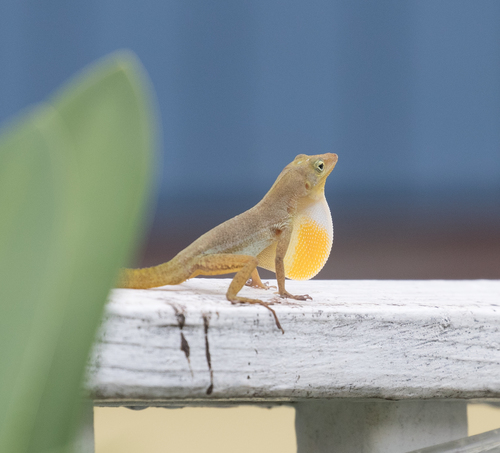
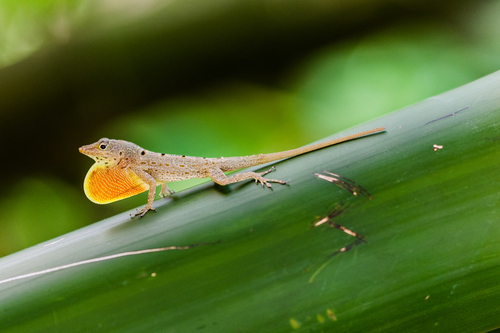
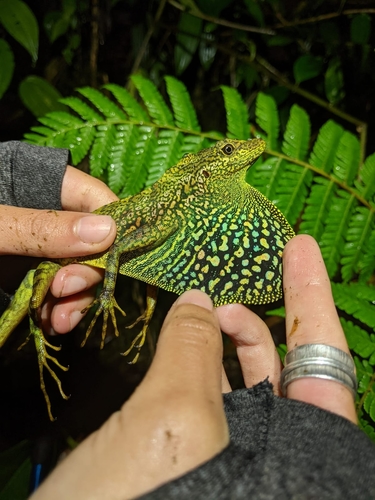
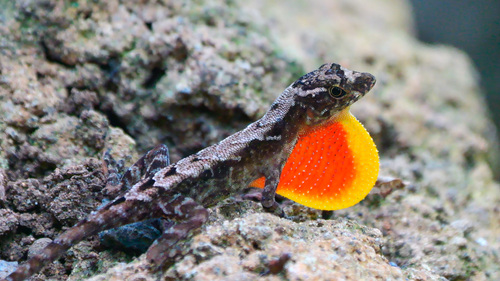
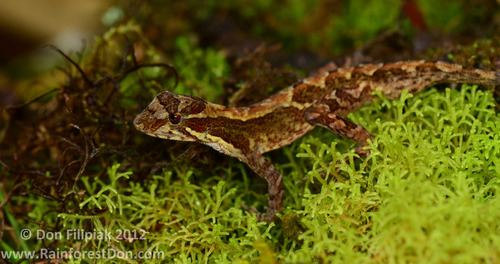
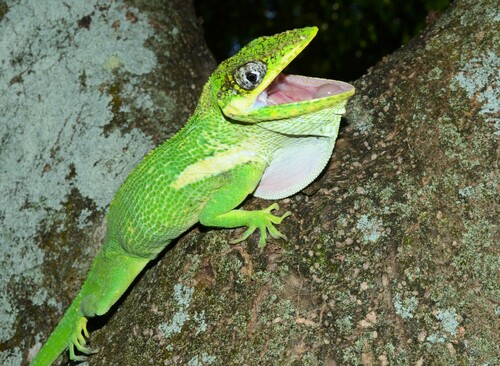
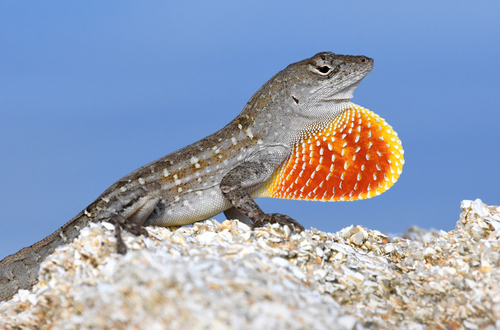
Anolis sagrei, commonly called the brown anole, is typically light brown with darker brown to black markings on its back, and multiple tan to light-colored lines along its sides. Like other anole species, it can change its overall body color to shades of brown, black, or gray, and some individuals develop yellowish dots when excited. These color shifts can happen quickly in response to threats. The species' dewlap ranges in color from yellow to orange-red. Brown anoles generally measure 5.0 to 8.5 inches in total length. Males reach a similar maximum size to male Carolina anoles, growing around 17.8–20.3 cm (7.0–8.0 in) long, with some individuals exceeding 22.9 cm (9.0 in). Females are also similar in size to female Carolina anoles, ranging from 7.6–15 cm (3.0–5.9 in) long. The male brown anole has a smaller head than the male Carolina anole, and the brown anole has a ridge along its tail that extends all the way up to behind the head – a trait the Carolina anole does not have. Female brown anoles have heritable polymorphism in their dorsal patterning. A study conducted in Gainesville, Florida found that one-third of female A. sagrei had a male-like chevron dorsal pattern, while the remaining females had a striped dorsal pattern with continuous variation. The native range of the brown anole covers most of the Caribbean, including Cuba, Jamaica, the Cayman Islands, and other Caribbean regions. As of 1985, the species was recognized as an invasive species in parts of Florida in the United States, including the Florida Keys, Dade County, Broward County, and Palm Beach County. Today, its introduced range has expanded as far north as Georgia, and through Texas into parts of Mexico, and the species is also established in parts of Honduras. It is thought that brown anoles were brought to North America unintentionally in Caribbean cargo shipments, and that around 100 individuals were intentionally released in 1941. Brown anoles typically live on the ground, avoid trees, and prefer to occupy smaller plants and shrubs. They can be found in both urban and suburban areas. In warm weather, they can be found basking, while they seek out sheltered areas when it is cold. They are less arboreal than green anoles, which are often found in trees, on the ground, or in low vegetation. After its initial introduction to southern Florida from the Caribbean, the brown anole has continued to move north, and has now been recorded in southern and coastal Georgia; researchers expect this northward expansion to continue in future years. Due to its invasiveness, the brown anole is often the dominant reptile species in the environments it invades. Under specific conditions, brown anoles leave their current territory to migrate to a new one. Males migrate to new territories in response to male-male competition, and smaller males are more likely to migrate than larger males. A male's migration distance is negatively correlated with his size relative to other males: large males travel shorter distances to reach new territories, while small males travel longer distances. There is no link between female size and either the probability of migration or migration distance for female brown anoles. Instead, females in territories with a high density of other females are more likely to move to territories with lower female densities. In general, individuals of both sexes prefer to stay in their original territory, because migration carries both increased predation risk and energetic costs. Female brown anoles reproduce during the warm portion of the year in their habitats. A female lays only one egg per brood, which she deposits in a damp environment. Females lay eggs approximately every two weeks, producing a total of 15 to 18 eggs over a single breeding season. The female breeding season is slightly longer than the male's, because females can store sperm for a short period of time. Juvenile brown anoles hatch completely independent of their parents, usually in June. Both males and females reach sexual maturation within one year of hatching, so individuals can breed in the mating season following their birth. When a female is ready to mate, she first makes herself visible to the male whose territory she occupies. Before mating, the female bends her neck to make it more visible and accessible to the male – a signal that she is ready to reproduce, since mating involves the male grabbing the back of the female's neck with his mouth. If the male chooses to mate, the pair will copulate, which usually takes 30 to 60 minutes. Males signal their availability to mate by extending their dewlap and bobbing their head.