About Anolis oculatus (Cope, 1879)
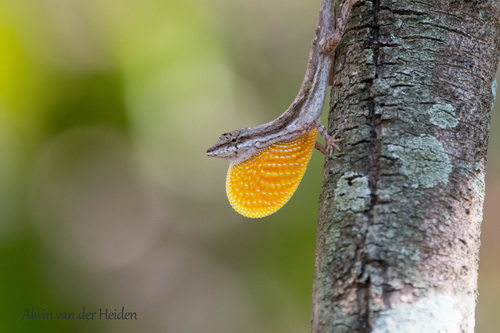
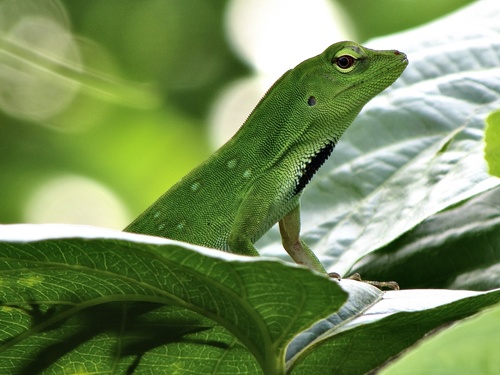
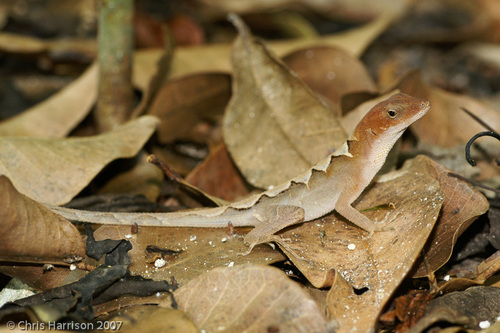
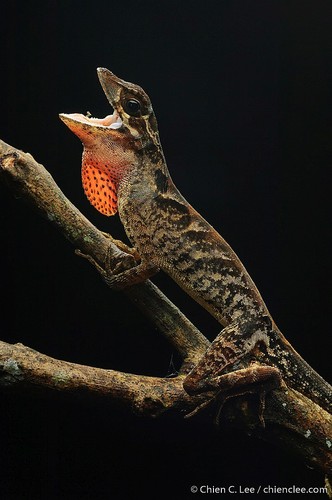
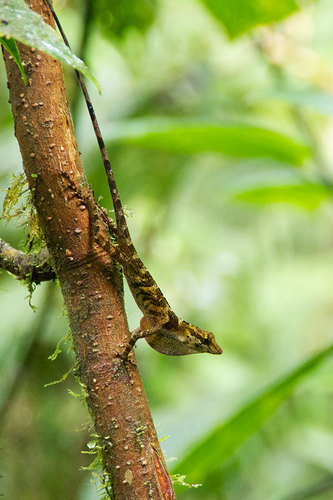
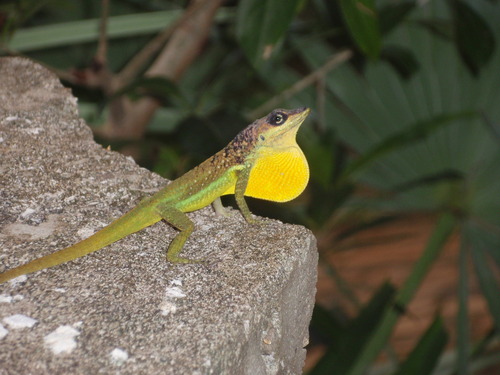
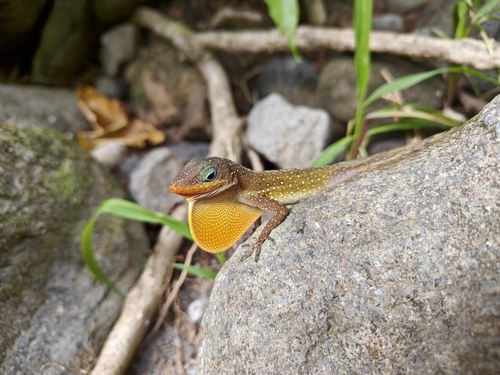
The Dominican anole, whose scientific name is Anolis oculatus (Cope, 1879), is a medium-sized anole. Maximum snout-vent-length (SVL) for males ranges from 61–98 mm (2.4–3.9 in) across different populations, with larger males found at higher altitudes; their tails are at least as long as their snout-vent length, and females are smaller in every population. Adult males have a tail crest and a prominent, extensible throat fan that is often bright yellow or orange. Females only have a rudimentary, less brightly colored throat fan. Some Dominican anoles have bright blue eyes. This species can change color slightly, but is less capable of major color change than some other anole species. Their base ground color ranges from pale tan or ash gray to deep brown or green, and body markings also vary widely across individuals. All populations of adult males have some combination of white or light-colored spotting across most of their bodies. In different populations, this spotting appears as small, evenly distributed spots; scattered groups of white scales; or merged streaks that create a marbled appearance. In some populations, males also have larger lateral spots surrounded by irregular black splotches. Markings on females and juveniles are significantly lighter or less distinct, and black spots are very rare in these groups. Females and juveniles may also have lateral streaks or mid-dorsal stripes. The variability of this anole has been the focus of extensive study. Its morphological traits vary independently of one another, meaning the presence of one trait does not predict the presence of another. Some traits vary with altitude, others vary with longitude, and some may correlate with ecological factors such as rainfall and vegetation type. Populations in drier habitats tend to be paler with marbled or blotched markings, while populations in wetter habitats are deeper green, which led Malhotra et al. to use the term "ecotype" for these variants. This same pattern of variation is also seen in the highly variable A. marmoratus on Guadeloupe, a neighboring island group with a range of habitats similar to Dominica. The Dominican anole is found only on the island of Dominica, which is one of the few Lesser Antillean islands that has retained its original reptile and amphibian fauna over the past 200 years. It is one of two lizard species endemic to Dominica; the other is the Dominican ground lizard, and it is the only native anole species on the island. It occurs in all habitats and areas of the island up to approximately 900 m elevation, and is generally abundant. However, it is becoming locally extinct in the southwestern coastal region due to an invasive anole species. Dominica's coastal woodlands are noted as unusually favorable habitat for reptiles, with some of the highest biomass recorded for terrestrial reptile populations; in this environment, Dominican anoles have an estimated mean density of 2148 individuals per hectare. Dominican anoles are semi-arboreal, and they mainly forage for food on the ground. Their diet consists primarily of insects, but varies based on habitat, season, available food, and individual body size. They may also eat fruit and even small vertebrates. In xeric woodland habitats along Dominica's Caribbean coast, they feed mainly on tiny ants, termites, springtails, and barklice. Larger-sized montane populations rely more on larger prey such as earthworms (Oligochaeta) and crickets and grasshoppers (Orthoptera), though smaller adults and juveniles in rainforest environments still feed mainly on ants. The main predators of Dominican anoles are the racer snake Alsophis antillensis, and birds including the mangrove cuckoo, thrashers, and kingbirds; all of these predators are found mainly in coastal regions. Compared to mainland anole species, Dominican anoles are relatively long-lived and mature later. Males reach maturity at 35 mm SVL, and females reach maturity at 40 mm SVL, a size they typically attain at an age of two to three months old. They breed year-round, with a breeding peak at the end of the dry season, especially in areas like the north Caribbean coast that have greater seasonal variation in rainfall. Females are oviparous, and lay multiple clutches of eggs each year with a short interval between clutches. Captive females have been recorded producing eggs every 14 days. Most clutches contain only one egg, though two-egg clutches occasionally occur with no clear relationship to season, location, or female size. Egg production alternates between the two ovaries and has overlapping cycles, with one ovary finishing its cycle after the opposite ovary has already started its cycle. Eggs are laid in sheltered spots under ground litter such as rocks or leaves.