About Anolis gingivinus Cope, 1864
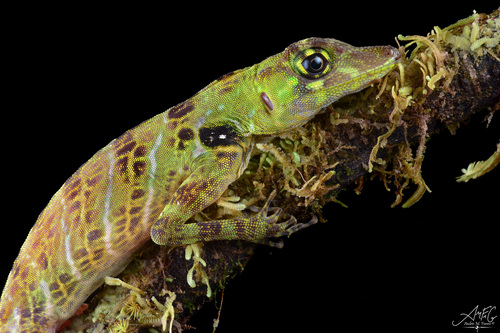
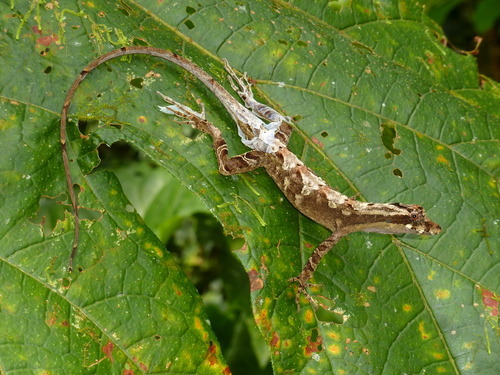
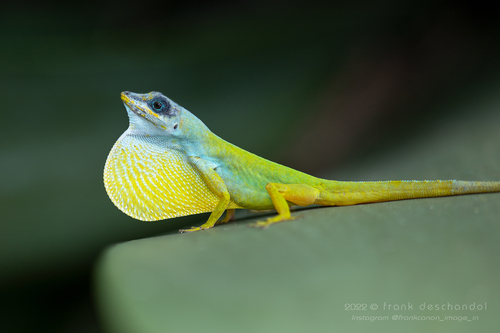
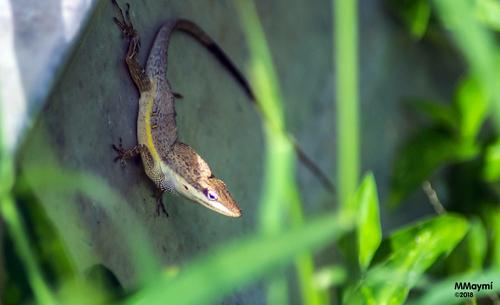
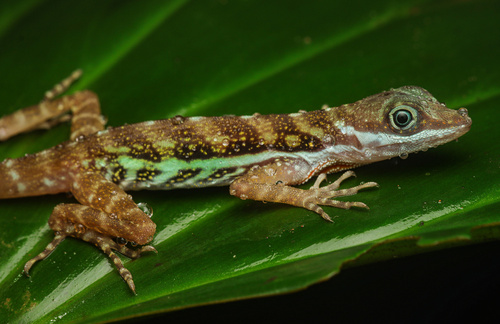
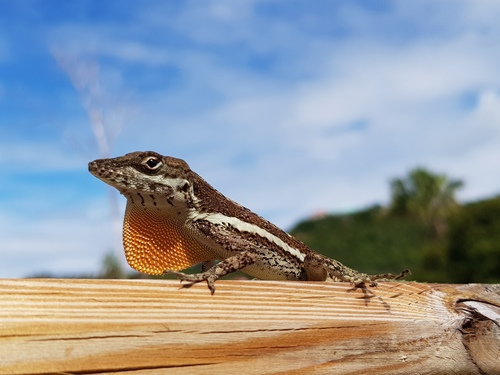
Anolis gingivinus males have an average snout-vent length of 72 mm (2.8 in), while females have an average snout-vent length around 53 mm (2.1 in). Their overall body color ranges from olive to light gray, with a vivid orange dewlap (chinflap), bold stripes running along the back that become paler on the sides. Individuals sometimes have green coloration on their lower bodies, and males may display dark marbled spotting along their bodies. This species, commonly called the Anguilla Bank tree anole, is found in the northern Lesser Antilles, occurring on Anguilla, Saint Barthélemy, Saint Martin, Sint Maarten, and their satellite islands. It is a highly adaptable lizard that occurs in habitats from mesic to xeric, including woods, coastal scrub, and overgrown fields, where it lives both in trees and on the ground. It does not inhabit grassland, which causes it to have a localized distribution on Sint Maarten/St. Maarten and St. Barthélemy. Anolis gingivinus is widespread and common on Anguilla and many of its satellite islands, though it is heavily preyed on there by American kestrels. It was the only anole species present on Anguilla and across most of its range until the recent introduction of A. carolinensis to Anguilla. A. gingivinus coexists with A. pogus on Saint Martin. Their distributions on the island do not completely overlap, and in areas where both species occur, they fill different ecological niches; for example, A. gingivinus prefers higher, more exposed perches.