About Anolis cristatellus Duméril & Bibron, 1837
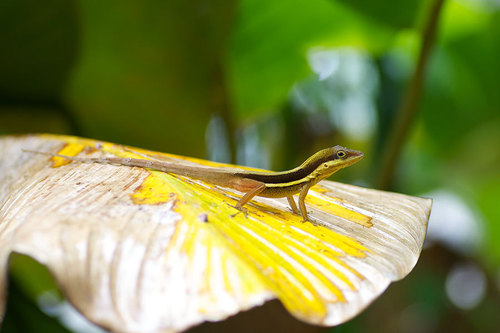
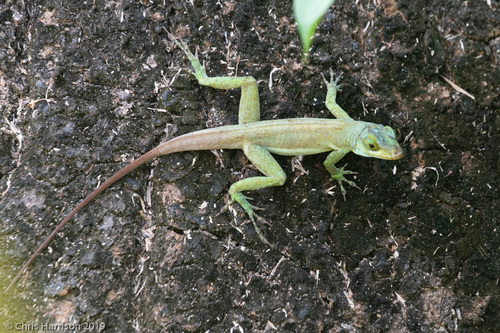
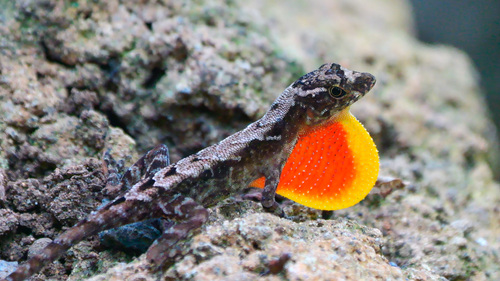
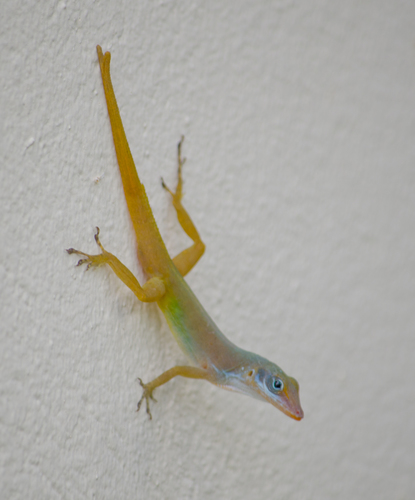
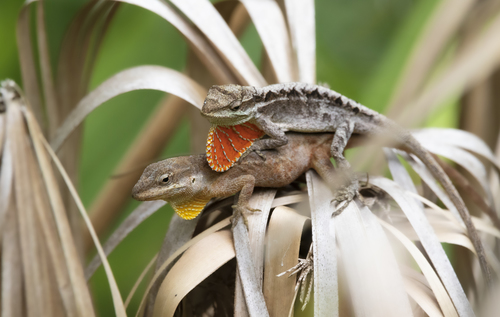
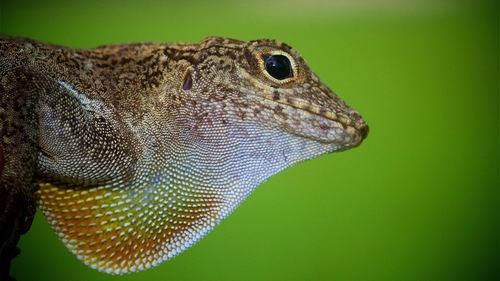
Compared to many other anoles, this species is stocky, muscular, and aggressive. It is small when compared to Central American anoles, and moderately-sized when compared to insular Caribbean anoles. 2015 measurements found that males can reach a maximum snout-vent length (SVL) of 75 mm (3.0 in), while females can reach up to 73 mm (2.9 in); most females are much smaller. This species is sexually dimorphic, with males larger and more ornate than females. Juvenile lizards also have different colouration than adults. Males are easily recognizable by their permanently erect caudal crests, a high sail- or fin-like structure running along the top of the tail, supported anatomically by bony extensions of the vertebrae. The crest is very short along the lizard's back, and becomes higher again on the nape of the neck. The tail is compressed in cross-section. Overall colour is variable: the head and body range from bronze to greenish grey, with faint, irregular brownish spots; the belly is greenish-yellow and the throat is whitish. The iris is dark brown. Male dewlaps are coloured mustard or greenish yellow, with a burnt-orange, reddish-orange to reddish band along the margin. Females have a well developed but smaller dewlap and a low caudal crest. When preserved, juveniles show transverse brown banding, with purplish-brown dots on the throat and crotch, and often have a light mid-dorsal stripe that some females retain into adulthood. This species can change its colour significantly, shifting from very light grey to reddish-brown and dark black, and can change colour in response to its behavioural state. Because of this colour-changing ability, it is often called 'chameleon' in many local areas, though it is not related to true chameleons. This anole occurs in almost all habitats across Puerto Rico and the Virgin Islands, from open fields to rainforest. It is absent from some high altitude elfin forests in the mountainous regions of Puerto Rico. The species is found from sea level upward, and becomes less abundant at higher elevations. As of 1988, the maximum recorded altitude for the species was 850 m (2,800 ft) in Reserva Forestal de Maricao; a 2000 record documents individuals up to 980 m (3,220 ft) in Los Tres Picachos State Forest. The introduced population in Costa Rica appears to prefer urban habitats, occurring mostly on tree trunks or buildings in towns and cities, and is rarely found in more rural areas or forests. Introduced populations on Dominica appear to have similar habitat preferences. In general, introduced populations strongly prefer or are restricted to urban and other disturbed areas. Individuals of this species from urban habitats in Puerto Rican cities lose and regrow their tails more often than individuals from natural forests. This may be caused by a higher density of urban predators such as house cats, fewer places to escape predators, or it may indicate that urban predators are less successful at actually catching their prey. In some parks, such as Los Tres Picachos State Forest, this species may be less common than related species including A. cuvieri, A. evermanni, A. gundlachi and A. stratulus. This species is categorized as a "ground-trunk anole", an Anolis ecomorph, meaning it spends most of its time on the bottom two meters of tree trunks, but will travel to the ground to forage and lay eggs.