About Anolis auratus Daudin, 1802
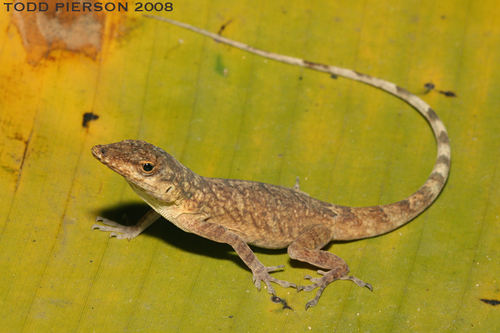
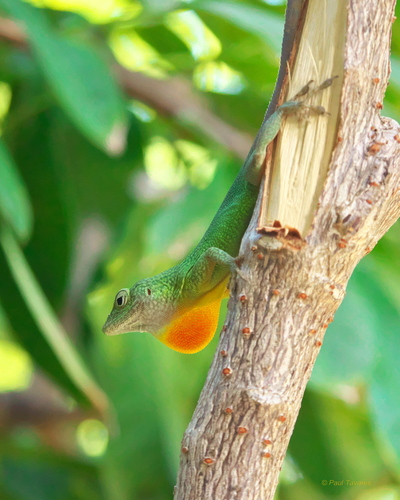
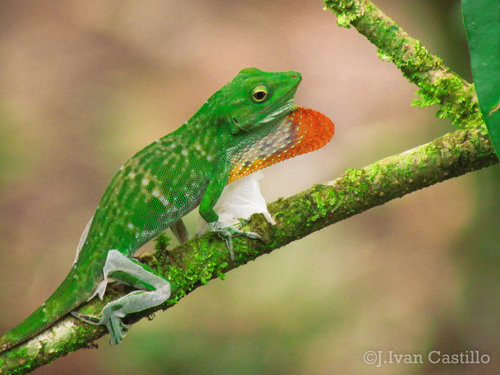
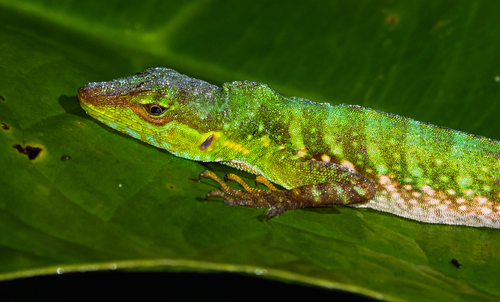
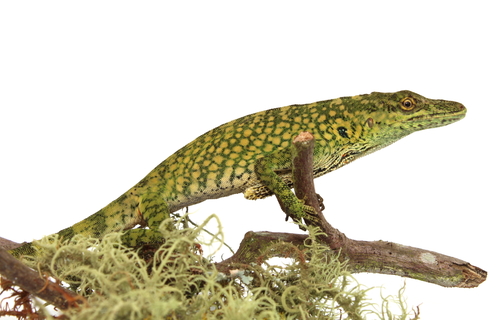
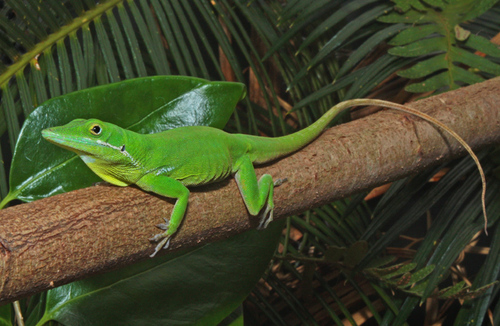
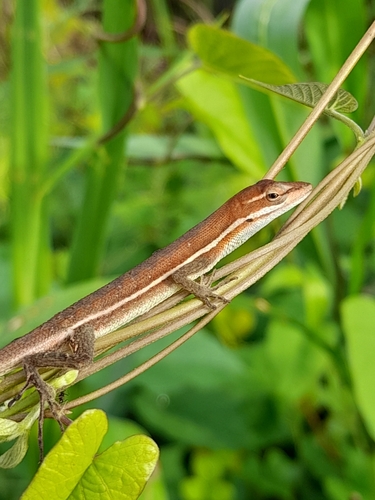
Anolis auratus Daudin, 1802 varies in physical traits based on geographic location, maturity, and sex, but it shares consistent core characteristics. It has a tan back with cream or dark brown to black lateral stripes, copper orange spots on the posterior thigh, a bright orange tongue, an overall tan tail with light gray or black streaks, blotches, or stripes on the dorsal tail surface, and orange coloration on the underside of the tail. Females have a smaller dewlap with gray to blue skin between cream scales, while males have a larger dewlap with the same skin color as females, but yellow scales at the center and base of the dewlap. The species is sexually dimorphic, with consistent size differences between males and females: females have larger pelvises and longer trunks, and males have larger heads. Females’ larger trunks and wider pelvises support their reproductive role, allowing them to carry more eggs and lay larger, heavier eggs. Males’ larger head size is linked to male-male competition for mates, resources, and territories; heads function as a weapon during combat, and larger head size correlates with greater jaw strength and stronger bite force, which affects dominance, territorial success, overall fitness, and mating success. Anolis auratus is widely distributed across Central America and northern South America, ranging from Costa Rica through most of Colombia, Venezuela, Brazil, Surinam, and the Guyanas, and it is mainly found in Panama. Unlike other Anolis species, it lives in moderately grassy grasslands rather than arboreal branchy environments. It prefers habitats including fields, roadsides, and river edge marshes, and avoids shaded, brushy, and second growth regions. These grassy habitats are short-lived: they form after area disturbances such as flooding, burning, or human clearing, and eventually become uninhabitable as they grow into secondary forests. Because of this, the grass anole does not stay in one permanent territory over its lifetime; it constantly moves between new habitats, relocating when its previous habitat is destroyed by disturbance or transitions naturally into forest. In its grassland habitat, vegetation is dense near the ground, and tall grass stalks grow upward, leaving elevated perches (which males primarily use for assertion displays) fully exposed. Grassy habitats also receive more direct sun exposure than arboreal habitats, so Anolis auratus has adapted to tolerate and prefer higher temperatures.