About Anodorhynchus hyacinthinus (Latham, 1790)
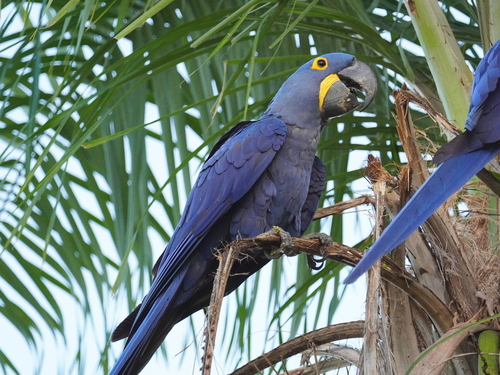
The hyacinth macaw, whose scientific name is Anodorhynchus hyacinthinus (Latham, 1790), is the world's largest parrot by length. It measures 1 m (3 ft 3 in) from the tip of its tail to the top of its head, weighs 1.2–1.7 kg (2 lb 10 oz – 3 lb 12 oz), and has wings that are 38.8–42.5 cm (15+1⁄4–16+3⁄4 in) long. It has a long, pointed tail. Its plumage is mostly blue, lighter on the upper body; neck feathers may occasionally be slightly grey, and large sections of its underwings and undertail are black. The skin ring around its eyes and the area directly under its beak is bright, vivid yellow. Currently, the hyacinth macaw is found across three main regions in South America: the Pantanal region of Brazil, plus adjacent eastern Bolivia and northeastern Paraguay; the cerrado regions of eastern inland Brazil (covering Maranhão, Piauí, Bahia, Tocantins, Goiás, Mato Grosso, Mato Grosso do Sul, and Minas Gerais); and relatively open areas along the Tocantins River, Xingu River, Tapajós River, and Marajó Island in the eastern Amazon Basin of Brazil. Smaller, fragmented populations may exist in other locations. The species' known range in Bolivia has expanded over recent decades. It is well documented in far southeastern Bolivia near the tri-border with Brazil and Paraguay, where it is an emblematic regional symbol, and local people often feed the macaws maize similar to how they keep chickens. In the early 1990s, the species was confirmed to also occur in the remote Noel Kempff Mercado National Park, located a few hundred kilometers further north. Most of Bolivia's hyacinth macaw population is thought to live in the San Matías Integrated Management Natural Area, which holds extensive Pantanal swamp habitat. Censuses carried out in 2008, 2009, 2011 and 2014 recorded stable population counts of 231, 107, 134, and 166 respectively. Bird counts in this swampy, hard-to-navigate terrain are inherently inaccurate. The censuses only visited sites with prior reported sightings, researchers could not always access all sites, and survey coverage varied between counts. For this reason, the earlier estimated population of around 300 birds in the area was still considered largely accurate in 2011. A 2014 study that correlated sightings to habitat and extrapolated results across a larger area found the birds occupy the northern section of the Natural Area, and a population of similar size likely also occurs in an equally sized area just north of the Natural Area, outside its boundaries. In a 2018 Mongabay Latam article, park rangers shared anecdotal evidence that the population is increasing and expanding, as more sightings are reported by local people, and the bird has now been confirmed for the first time in multiple adjacent municipalities. Hyacinth macaws have escaped or been deliberately released into Florida in the United States, but there is no evidence this population breeds, and it likely only persists through ongoing escapes and releases. The species prefers semi-open, lightly wooded habitats, and usually avoids dense humid forest. In regions dominated by dense humid forest, it is generally restricted to forest edges or relatively open areas such as along major rivers. Across different parts of its range, it can be found in savannah grasslands, dry thorn forest called caatinga, palm stands, and swamps, particularly stands of moriche palm (Mauritia flexuosa). A 2014 Bolivian study conducted in San Matías Integrated Management Natural Area that correlated sightings to habitat found that presence of the macaws was most strongly indicated by habitats including seasonally inundated savannas, wetlands, and anthropogenic areas mixed into a savanna mosaic. The most strongly preferred habitat overall was anthropogenic land, primarily extensive cattle ranching grazing lands in this area. The study authors did not place high confidence in these results, however, and warned that the study methodology may have been flawed. Hyacinth macaws most often nest in Manduvi trees (Sterculia apetala). Manduvi trees rely on the toco toucan to disperse 83.3% of their seeds. The toco toucan also preys on 53% of hyacinth macaw eggs. Hyacinth macaw eggs are also regularly preyed on by corvids including jays and crows, opossums, skunks, and coatis. Hyacinth macaw chicks are parasitized by fly larvae of the genus Philornis. Nesting occurs between July and December. Nests are built in tree cavities or cliff faces, depending on the local habitat. In the Pantanal region, 90% of nests are built in manduvi trees. Hyacinth macaws depend on toco toucans for their survival: toco toucans are responsible for most seed dispersal of the manduvi trees that hyacinth macaws need for nesting and reproduction. Hollows large enough to use for nests only form in trees that are 60 years old or older, so competition for nest sites is fierce. Hyacinth macaws enlarge existing hollows and then partially fill them with wood chips. A clutch contains one or two eggs; usually only one chick survives to fledging, because the second egg hatches several days after the first, and the smaller second chick cannot compete with the older firstborn for food. This pattern is potentially explained by the "insurance hypothesis": hyacinth macaws lay more eggs than they can normally raise to compensate if an earlier egg fails to hatch or a firstborn chick does not survive. The incubation period lasts around one month. While the female incubates the eggs, the male provides for her. Chicks fledge (leave the nest) around 110 days after hatching, and remain dependent on their parents until they reach six months of age. They reach sexual maturity and begin breeding at seven years old. Most of the hyacinth macaw's diet consists of nuts from specific palm species, including acuri and bocaiuva palms. They have extremely strong beaks that allow them to access the kernels of hard nuts and seeds; their beaks are strong enough to crack coconuts, large Brazil nut pods, and macadamia nuts. They also have a dry, smooth tongue with a bone inside it that works as an effective tool to access fruit flesh. The acuri nut is so hard that parrots cannot eat it until it has passed through the digestive system of cattle. In addition to palm nuts, they eat fruits and other vegetable matter, including nectar and various types of seeds. They travel over large areas to reach the ripest available food. In the Pantanal, hyacinth macaws feed almost exclusively on the nuts of Acrocomia aculeata and Attalea phalerata palm trees. This feeding behavior was recorded by English naturalist Henry Walter Bates in his 1863 book The Naturalist on the River Amazons, where he wrote: "It flies in pairs, and feeds on the hard nuts of several palms, but especially of the Mucuja (Acrocomia lasiospatha). These nuts, which are so hard as to be difficult to break with a heavy hammer, are crushed to a pulp by the powerful beak of this macaw." Charles Darwin commented on Bates's account of the species, calling it a "splendid bird" with an "enormous beak" capable of feeding on these palm nuts. In captivity, the native palm nuts from the hyacinth macaw's natural range are often not easily available. In these cases, macadamia nuts (native to Australia) are a suitable, nutritious alternative that the macaws readily accept. Coincidentally, the hyacinth macaw is one of the only bird species with enough jaw strength to open a macadamia nut, whose shell requires 300 psi of pressure to crack. Limited tool use has been observed in both wild and captive hyacinth macaws. Reported observations of tool use in wild hyacinth macaws date back as early as 1863. Observed examples of tool use usually involve chewed leaves or pieces of wood. Macaws typically use these items when feeding on harder nuts: holding the items in place keeps the nut from slipping while the macaw gnaws into it. It is unknown whether this behavior is learned social behavior or an innate trait, but observations of captive macaws show that hand-raised macaws also exhibit this behavior. Comparisons have found that older macaws are able to open seeds more efficiently than younger individuals.