About Annulohypoxylon annulatum (Schwein.) Y.M.Ju, J.D.Rogers & H.M.Hsieh
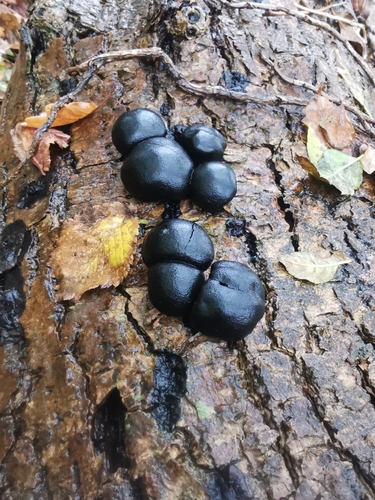
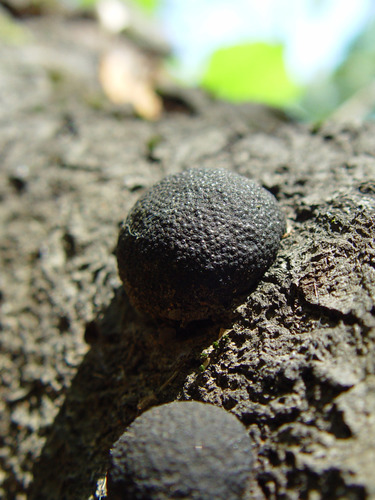
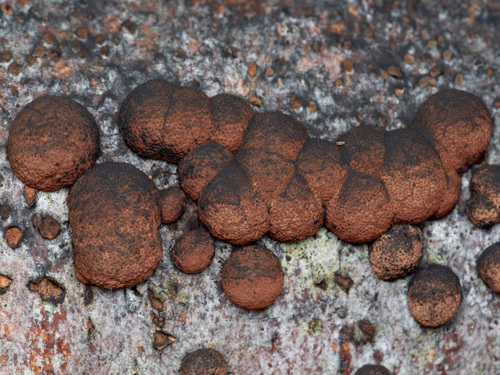
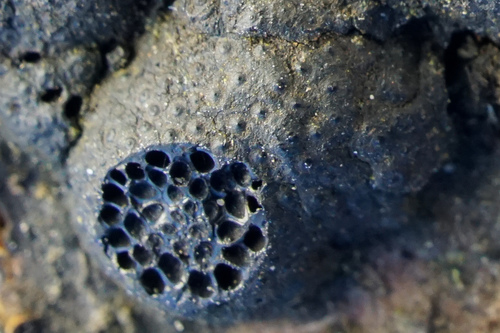
Annulohypoxylon annulatum is a pyrenomycete, a type of carbonaceous fungus. It produces ascospores inside flask-shaped structures called perithecia, then releases the spores through an opening called the ostiole. The genus Annulohypoxylon was split from the older genus Hypoxylon in 2005. It is distinguished by flat, disk-shaped rings that encircle each ostiole, which is the source of the genus's "annulo-" prefix. The fruiting bodies (stromata) of A. annulatum are semi-globose to cushion-shaped, and black in color. Their surfaces are covered in ostioles that look like small pimples, each surrounded by a flat disc-shaped area. A hand lens is often required to see this characteristic. This species most commonly grows on oak. When its tissue is crushed and mixed with potassium hydroxide, it produces an olive green pigment. Under microscopic examination, its ascospores appear brown to dark brown, ellipsoid-inequilateral, measuring 7.5–12 × 3.5–5 μm, with a straight germ slit that runs the full length of the spore.