About Annona squamosa L.
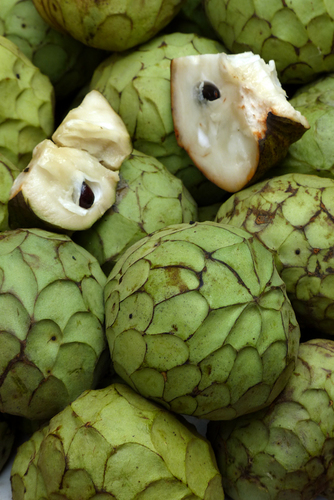
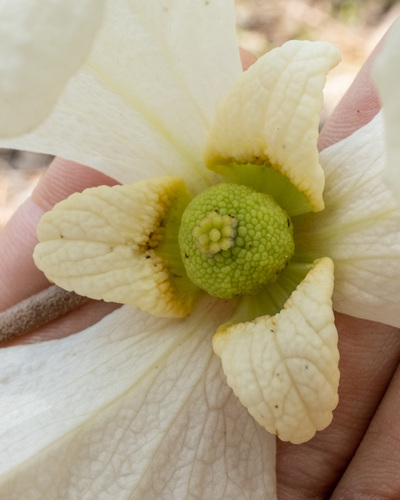
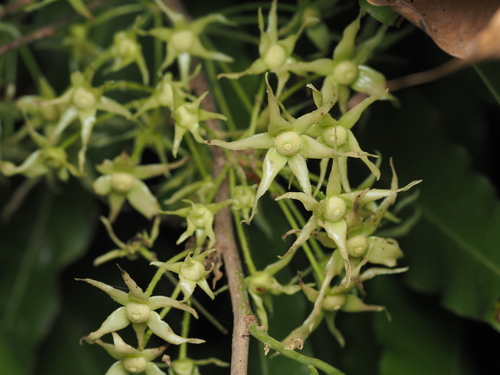
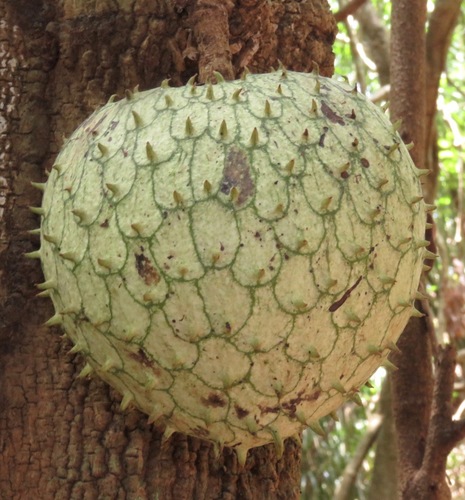
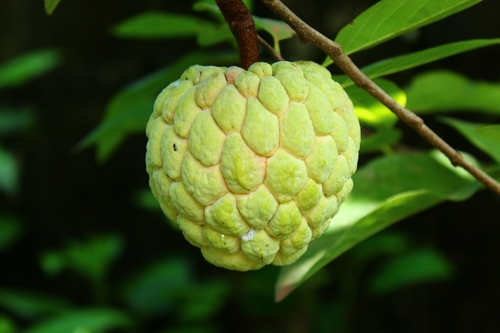
Annona squamosa L., commonly called sugar-apple, produces fruit with sweet, whitish pulp that is popular in tropical markets. This species is native to tropical Americas, though its exact original origin is unknown. It is currently the most widely cultivated species in the Annona genus, grown for its edible fruit throughout the tropics and warmer subtropics, including locations such as India, Indonesia, Thailand, Taiwan, and China reaching as far north as Suzhou. It was introduced to southern Asia before 1590. It has become naturalized as far north as Cuba and south Florida, and as far south as Bahia, Brazil, and it is classified as an invasive species in some areas. Its native range falls within the Neotropics: in North America it is native to Mexico; in Central America it is native to Costa Rica, El Salvador, Guatemala, Honduras, Nicaragua, and Panama; in South America it is native to Colombia. Documented naturalized ranges include: the Pacific islands of Samoa and Tonga; Florida in North America; many Caribbean nations and territories including Antigua and Barbuda, Bahamas, Barbados, Cuba, Dominica, Dominican Republic, Grenada, Guadeloupe, Haiti, Jamaica, Martinique, Montserrat, Netherlands Antilles, Puerto Rico, St Kitts and Nevis, St Lucia, St Vincent and the Grenadines, Suriname, Trinidad and Tobago, and the Virgin Islands; South America including Suriname, French Guiana, Guyana, Venezuela, Bolivia, Ecuador, Peru, Argentina, Brazil, Chile, Paraguay, and Uruguay; the Afrotropic region including Angola, Namibia, Saudi Arabia, Sudan, Tanzania, Uganda, and Yemen; Australasia including Australia, Fiji, New Zealand, Papua New Guinea, and Solomon Islands; Indomalaya including Bangladesh, Cambodia, China, India, Indonesia, Laos, Malaysia, Nepal, Pakistan, Philippines, Sri Lanka, Taiwan, Thailand, Myanmar, and Vietnam; and the Palearctic region including Cyprus, Greece, Lebanon, Malta, and Israel. Fruits ripen 3 to 4 months after flowering. These soft aggregate fruits develop from a flower's numerous, loosely connected pistils, which enlarge and mature into a fruit structure distinct from other species in the Annona genus, and more similar to a giant raspberry. Mature ripe aggregate fruit is round or heart-shaped, greenish yellow, and hangs from a thickened stalk. It measures 5 to 10 cm (2 to 3 7⁄8 inches) in diameter, has many round protuberances across its surface, and is covered in a powdery bloom. Fruits are made up of loosely cohering or nearly separate carpels, which are the matured pistils. The edible pulp is white tinged with yellow, and has a sweet aroma. Each carpel holds one oblong, shiny, smooth seed, colored dark brown to black, that measures 1.3 to 1.6 cm (1⁄2 to 5⁄8 inches) long. Ecologically, Annona squamosa acts as a host plant for larvae of the butterfly Graphium agamemnon, the tailed jay. In the Philippines, the fruit is commonly eaten by the Philippine fruit bat, called kabag or kabog, which spreads the plant's seeds between islands. Nutritionally, sugar-apple is high in energy, it is an excellent source of vitamin C and manganese, a good source of thiamine and vitamin B6, and it provides fair quantities of vitamin B2, B3, B5, B9, iron, magnesium, phosphorus, and potassium. Like most Annona species, it requires a tropical or subtropical climate with summer temperatures between 25 °C (77 °F) and 41 °C (106 °F), and mean winter temperatures above 15 °C (59 °F). It is sensitive to cold and frost: it becomes defoliated at temperatures below 10 °C (50 °F), and is killed by temperatures a few degrees below freezing. It is only moderately drought-tolerant, requiring at least 700 millimeters (28 inches) of annual rainfall, and does not produce good fruit during droughts. It can grow from sea level up to 2,000 meters (6,600 feet) in elevation and thrives in hot dry climates, differing in its tolerance of lowland tropics from many other fruit-bearing species in the Annona family. It is a very prolific fruit bearer, and can produce fruit as early as two to three years after planting. A five-year-old tree can produce up to 50 sugar apples. Poor fruit production has been reported in Florida, due to a lack of natural pollinators; honeybees struggle to penetrate the species' tightly closed female flowers. Hand pollination using a natural fiber brush effectively increases crop yield. Natural pollinators of Annona squamosa include beetles in the families Nitidulidae, Staphylinidae, Chrysomelidae, Curculionidae, and Scarabaeidae. For uses, in traditional Indian, Thai, and Native American medicines, the leaves are boiled in water, sometimes mixed with other specific botanicals, to make a decoction used to treat dysentery and urinary tract infections. In traditional Indian medicine, leaves are also crushed to make a poultice that is applied to wounds. In Mexico, leaves are rubbed onto floors and placed in hens' nests to repel lice. Plant extracts are used in ethnomedicine. In Haiti, where the fruit is called cachiman, it is used simply to make juice.