About Annona senegalensis Pers.
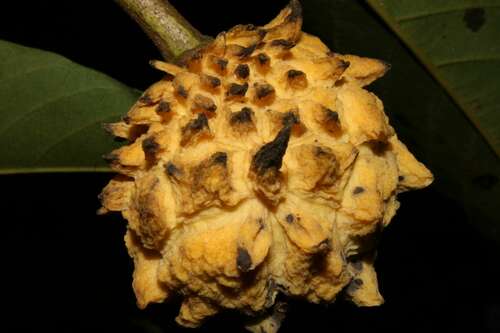
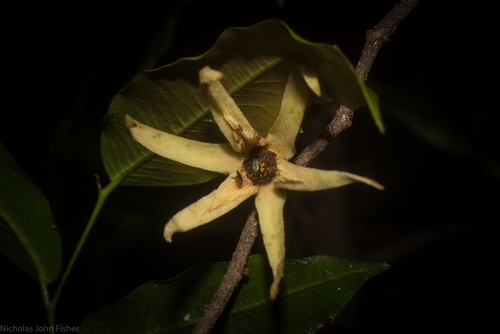
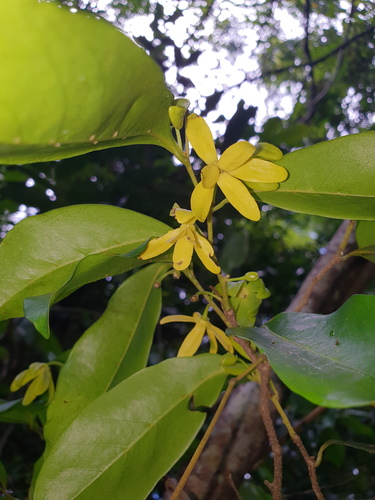
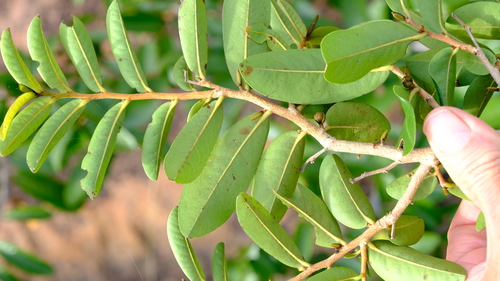
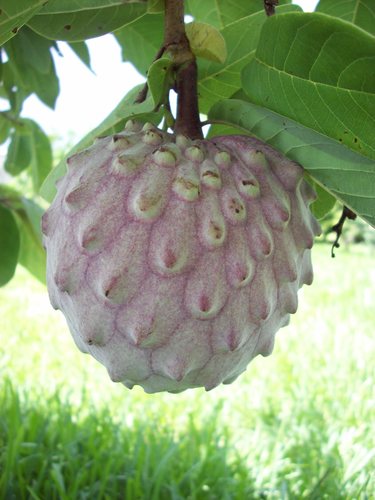
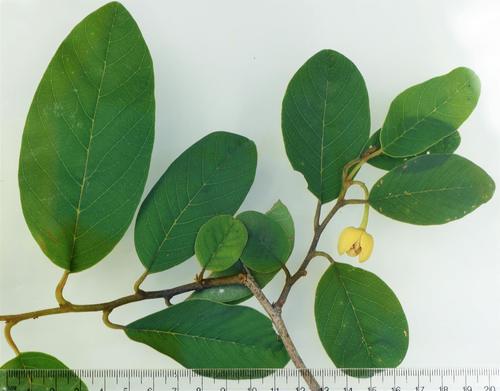
Annona senegalensis Pers. grows as either a shrub or small tree, reaching 2 to 6 meters in height, and occasionally growing as tall as 11 meters. Its bark has a smooth or coarse texture, and ranges in color from gray-silver to gray-brown. It is marked by leaf scars, with near-circular flaking that reveals lighter patches of underbark. New branches have a thick, gray, brown or yellow fuzzy covering, which is shed as the branches age. The leaves are alternate, simple, oblong to ovate to elliptic, and range from green to blue-green. They measure 6–18.5 cm long by 2.5–11.5 cm wide; the upper leaf surface is nearly hairless, while the undersides are often hairy and green to reddish. Veins are visible on both surfaces, leaf apices are rounded to slightly notched, the base is squared or barely rounded, and the leaf margin is entire. Stout petioles are 0.5–2.5 cm long. Mature flowers grow up to 3 cm in diameter on 2 cm stalks, and are borne singly or in groups of two to four, emerging from leaf axils. Six thick petals, colored creamy or yellow, are arranged in double whorls; petals are green on the outside, and creamy or blood-red inside. Each petal measures roughly 0.8–1.5 by 0.9–1.1 cm (0.31–0.59 by 0.35–0.43 in), and is hairless or somewhat fuzzy. The inner whorl of petals curves over the plant's stamens and ovary. There are three loose, oval-shaped sepals that are smaller than the petals, measuring 3–4 by 4–5 mm. Stamens are between 1.7 and 2.5 mm (0.067 to 0.098 in) long. This species typically flowers from April through June. Its pollen is released as permanent tetrads. Fruits form from many fused, fleshy, bumpy, ovoid or globular carpels, and measure about 2.5–5 by 2.5–4 cm (0.98–1.97 by 0.98–1.57 in). Fruits are green when young, ripening first to yellow and eventually to orange, and contain numerous burnt-orange, oblong, cylindrical seeds. The fruit stalk is 1.5–5 cm (0.59–1.97 in) long. A. senegalensis is generally pollinated by several beetle species, but can be hand pollinated when grown as a crop plant. Seed viability typically lasts no longer than six months. A. senegalensis most often grows in semiarid to subhumid coastal regions, frequently (though not exclusively) on coral-based rock with mostly sandy, loamy soil. It grows from sea level up to 2400 meters, in areas with mean annual temperatures between 17 and 30 °C, and mean annual rainfall between 700 and 2500 millimeters (28 and 98 in). It often occurs as a solitary plant in the understory of woodland savannah, and is also frequently found in swamp forests, along riverbanks, or on former cropland left fallow for an extended period. This species is native to tropical east Africa, northeast Africa, west Africa, west-central Africa, southern Africa, southern subtropical Africa, and islands in the western Indian Ocean. Within South Africa, it is found in KwaZulu-Natal, Limpopo, and Mpumalanga. In Zimbabwe, it is widespread in the Bikita district. A. senegalensis has become naturalized in parts of India, and is also found in the Maldives islands. The primary use of this versatile plant is food, but it is used in many areas of human activity, and every part of the plant has unique properties and uses. The flowers, leaves and fruit are all edible and used in cooking: the white fruit pulp has a mild, pineapple-like flavor. Flowers are added to meals as spice or garnish; leaves are eaten as vegetables by humans, or grazed by livestock. Leaves are also part of the diet of the West African giraffe. Leaves are additionally used to make a general health tonic, to treat pneumonia, and as stuffing for mattresses and pillows. In Sudan specifically, leaves are boiled to make perfume. Bark can be processed to produce a yellow-brown dye, an insecticide, or medicine to treat a wide range of ailments, including intestinal or flesh parasites (notably guinea worms), diarrhea, gastroenteritis, lung infections, toothaches, and snakebites. Natural gum from the bark is used to close open wounds. Roots are also used medicinally to treat a wide variety of conditions, from dizziness and indigestion to chest colds to venereal diseases. Suckering shoots produce binding fibers, and the malleable pale brown to white wood is used to carve tool handles or make poles. Wood ash is mixed into chewing tobacco and snuff, and is also used as a solvent in soap production. The essential oils from the fruits and leaves are valued for their organic chemical constituents: car-3-ene (found in fruit) and linalool (found in leaves). Some parts of A. senegalensis are used to treat skin or eye disorders. Many South Africans believe the roots can cure insanity. Some Mozambicans feed roots to infants to wean them from breast milk.