About Annona muricata L.
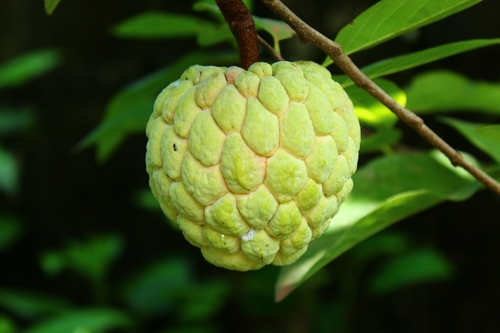
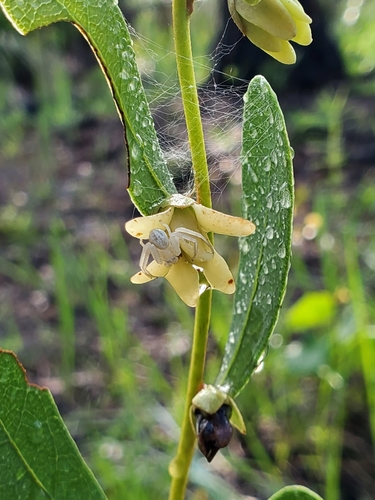
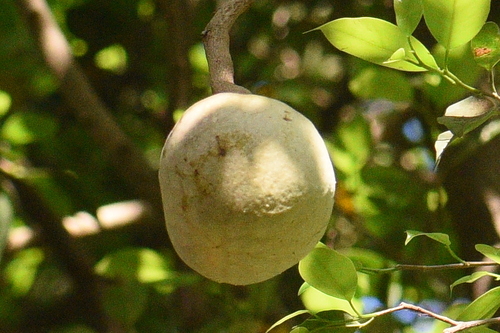
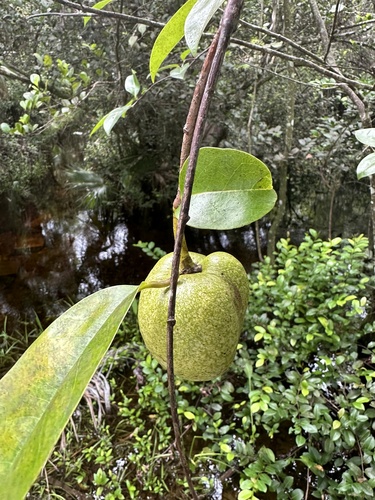
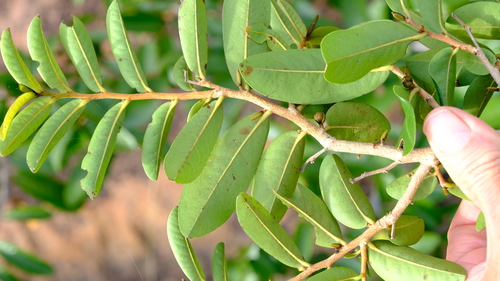
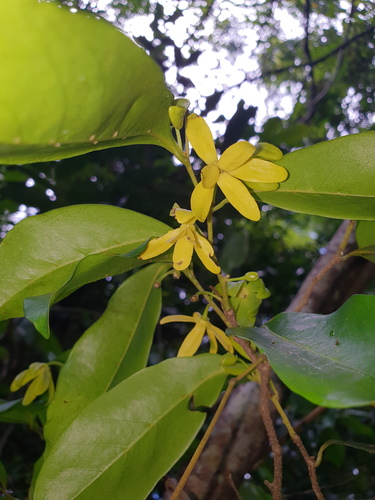
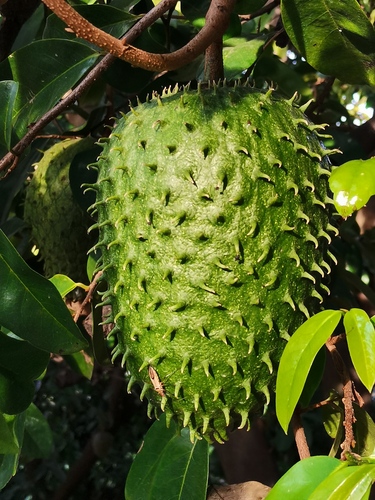
Annona muricata L. is a small, upright evergreen tree that can reach approximately 10 meters (33 feet) in height. Its young branches have a hairy covering. The leaves range from oblong to oval in shape, measuring 8 to 16 cm (3.1 to 6.3 in) long and 3 to 7 cm (1.2 to 2.8 in) wide. The upper leaf surface is glossy dark green and hairless, while the lower surface is paler, ranging from minutely hairy to hairless. Leaf stalks are 4 to 13 mm (0.16 to 0.51 in) long and hairless. Flower stalks (peduncles) are 2 to 5 mm (0.079 to 0.197 in) long, woody, and grow opposite leaves or emerge as extra structures near leaf stalks. Each peduncle holds one to two flowers, and occasionally a third. Stalks for individual flowers (pedicels) are stout, woody, and range from minutely hairy to hairless, measuring 15 to 20 mm (0.59 to 0.79 in) long. Small, densely hairy bractlets are located closer to the base of each pedicel. The petals are thick and yellowish. Outer petals do not overlap and meet at their edges; they are broadly ovate, 2.8 to 3.3 cm (1.1 to 1.3 in) by 2.1 to 2.5 cm (0.83 to 0.98 in), tapering to a point with a heart-shaped base. Outer petals are evenly thick, covered with long, slender, soft hairs on the exterior, and lined with fine matted soft hairs on the interior. Inner petals are oval-shaped and overlapping, measuring roughly 2.5 to 2.8 cm (0.98 to 1.10 in) by 2 cm (0.79 in). They are sharply angled and taper toward the base, with comparatively thin margins, and bear fine matted soft hairs on both sides. The receptacle is conical and hairy. Stamens are 4.5 mm (0.18 in) long and narrowly wedge-shaped. The connective tip ends abruptly, and anther hollows are unequal. Sepals are quite thick and do not overlap. Carpels are linear and grow basally from a single common base. Ovaries are covered in dense reddish-brown hairs, contain one ovule each, and have short styles and truncate stigmas. Pollen from this species is released as permanent tetrads. The fruit is oval, dark green when immature, with a leathery, inedible skin that turns yellow-green as the fruit matures. Fruits grow 10–35 cm (3.9–13.8 in) long, have a moderately firm texture, and typically weigh around 4 kg (8.8 lb), with a maximum recorded weight of 10 kg (22 lb). The fruit flesh is juicy, acidic, whitish, and aromatic; it is somewhat similar to pineapple in scent, with an added distinct earthy aroma. Most segments in immature fruits are seedless, while mature fruits can contain up to 200 seeds. Annona muricata tolerates poor soil and prefers lowland habitats at altitudes between 0 and 1,200 m (3,900 ft). Its exact origin is unknown, but it is native to tropical regions of continental Americas and is widely propagated. It is an introduced species on all temperate continents, particularly in subtropical areas. This plant is cultivated for its 10–35 cm (3.9–13.8 in) long, prickly green fruit, which can weigh up to 10 kg (22 lb), making it the largest fruit among species in the genus Annona, though it is smaller than the fruit of the related junglesop Anonidium mannii. Outside its native range, limited production occurs as far north as southern Florida within USDA Zone 10; most of these plants are garden plantings grown for local consumption. Annona muricata is also grown in parts of China and Southeast Asia, and grows abundantly on the island of Mauritius. The main commercial suppliers of soursop fruit are Mexico, followed by Peru, Brazil, Ecuador, Guatemala, and Haiti. In 2021, the complete genome of Annona muricata was sequenced to support soursop breeding work and further the development of genomic resources for this globally important plant family.