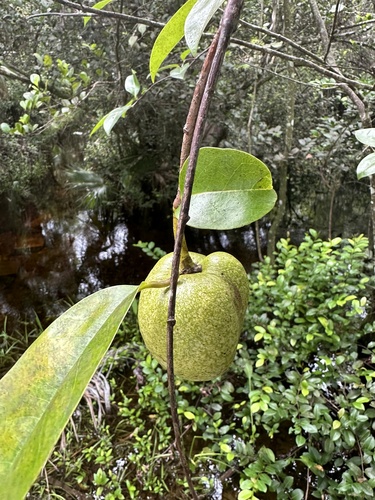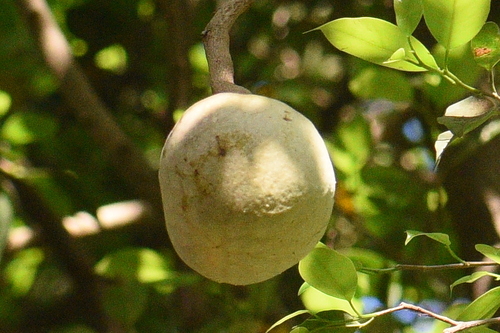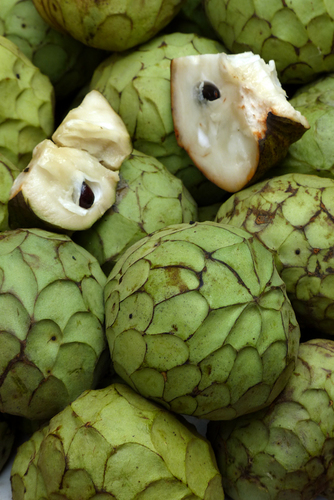
About Annona cherimola Mill.
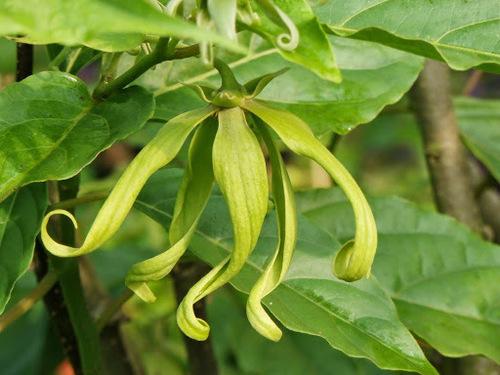
Annona cherimola Mill. is a fairly dense, fast-growing woody plant that grows as a low-branched, spreading tree or shrub, reaching 5 to 9 m (16 to 30 ft) in height. It is briefly deciduous but remains mostly evergreen. Mature branches are sappy and woody, while young branches and twigs are covered in a mat of short, fine, rust-colored hairs. Its leathery leaves measure 5–25 cm (2.0–9.8 in) long and 3–10 cm (1.2–3.9 in) wide, and are mostly elliptic in shape, pointed at the tips and rounded near the leaf stalk. When young, leaves are covered in soft, fine, tangled rust-colored hairs; when mature, they only hold hairs along the veins on their undersurface. The upper leaf surface is hairless, dull medium green with paler veins, while the lower surface is velvety, dull grey-green with raised pale green veins. New leaves are whitish on their lower surface. Leaves are single and alternate, dark green, and slightly hairy on the upper surface, and attach to branches via stout, 6–10 mm (0.24–0.39 in) long leaf stalks that are densely hairy. Cherimoya trees produce very pale green, fleshy flowers that are 3 cm (1.2 in) long and emit a very strong, fruity odor. Each flower has three outer, greenish, fleshy, oblong, downy petals, and three smaller, pinkish inner petals. The outer surface of the inner petals has yellow or brown, finely matted hairs, while the inner surface is whitish with purple spots and holds many stamens. Flowers grow on branches opposite the leaves, occurring singly, in pairs, or in groups of three, on 8–12 millimetres (0.31–0.47 in) long flower stalks that are densely covered in fine rust-colored hairs. Flower buds are 15–18 mm (0.59–0.71 in) long and 5–8 mm (0.20–0.31 in) wide at the base, and the pollen of A. cherimola is shed as permanent tetrads.
While A. cherimola is now widely cultivated, it is believed to have originated in the Andes of South America at altitudes of 700 to 2,400 m (2,300 to 7,900 ft). An alternative hypothesis instead names Central America as its origin, since many of the plant's wild relatives grow in this area. Europeans carried the species from its native range to various parts of the tropics. Unlike other Annona species, A. cherimola has not successfully naturalized in West Africa. It is native to the Neotropic ecozone in western South America (Ecuador and Peru). Its current confirmed range (including both naturalized and native occurrences) includes: Neotropic: Caribbean (Florida, Cuba, Dominican Republic, Haiti, Jamaica, Puerto Rico), Central America (Belize, Costa Rica, El Salvador, Guatemala, Honduras, Nicaragua, Panama), Northern South America (Guyana, Venezuela), Southern North America (Mexico), Western South America (Bolivia, Colombia, Ecuador, Peru), Southern South America (Chile, Brazil); Palearctic: Algeria, Egypt, Libya, France, Italy, Spain, Madeira, Azores; Afrotropic: Eritrea, Somalia, Tanzania; Indomalaya: India, Singapore, Thailand. A. cherimola is not native to Chile; its introduction date there is unknown, but it likely occurred in pre-Hispanic times, and it has traditionally been cultivated in northern Chilean valleys and oases, as far south as the Aconcagua Valley.
The flowers of A. cherimola are hermaphroditic and have a mechanism to avoid self-pollination. These short-lived flowers open first in the female stage, then progress to the male stage a matter of hours later. This requires a pollinator that can collect pollen from flowers in the male stage and deposit it into flowers in the female stage. Because the genus Annona includes subtropical species highly valued for human food and ecosystem services, their pollinators have been well studied. A 2017 publication identifies small nitidulid sap beetles as the key pollinators of A. cherimola. Beetles arrive at flowers with pollen covering their bodies, and pollen grains are transferred to stigmas while the beetles forage on nutritious tissues at the base of the petals. When the anthers dehisce, pollen is retained within the floral chamber, and the bodies of visiting beetles become covered with new pollen, which they carry to newly opened flowers to continue the pollination cycle. Because these beetle pollinators are not strong fliers, their entire lifecycle must be supported on site in both orchard and forest restoration settings. The flower itself acts as an ideal copulation chamber after beetles enter it during the earliest, female stage. At the inner base of the petals are nutritious tissues called "power bodies" that the beetles feed on until the male stage peaks. When beetles exit the flower at this point, pollen attaches to their bodies, and they carry it to another flower that is in its female stage, where another round of feeding and possible copulation occurs. Abundant leaves, rotting fruit, and other organic material on the ground beneath or near flowering Annona species are crucial for the beetle's larval stage. Beetles lay their eggs in this organic material, where larvae hatch and feed on decaying matter, then dig downward into the soil to pupate. Adult beetles emerge when flowering begins the following year. In orchards located far from wild habitat, hand pollination may be necessary. Growers use a small paintbrush to collect pollen from flowers in the male stage and transfer it to flowers in the female stage. Another approach is to encourage sap beetles to complete their full life cycles, primarily by allowing leaf litter to accumulate and leaving some fallen fruits under the trees.