About Anisotremus virginicus (Linnaeus, 1758)
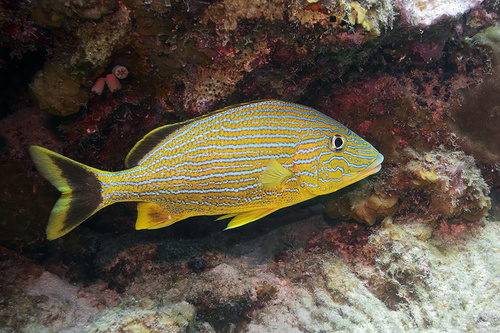
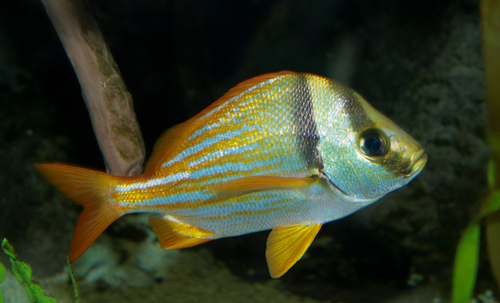
Anisotremus virginicus, first described by Linnaeus in 1758, has a deep, compressed body with a very high back and a short, blunt head. Its mouth is positioned low on the head, held horizontally, and has fleshy lips. Both jaws have bands of teeth, with the outer band made up of conical-shaped teeth. The flanks are marked with alternating yellow and silver stripes. One black bar runs diagonally from over the eye to the upper lip, and a second vertical black bar runs from the front of the dorsal fin to the base of the pectoral fin. All fins are yellow, and the caudal fin is deeply forked. Juveniles of this species do not have the two adult black bars; instead, they have two horizontal black stripes along the middle of the flanks, a black blotch near the base of the caudal fin, and a vivid yellow head. The dorsal fin has 12 spines and 16 to 18 soft rays, while the anal fin has three spines and 9 soft rays. This species reaches a maximum total length of 40.6 cm (16.0 in), with 25 cm (9.8 in) being a more typical size, and the maximum published weight is 930 g (33 oz).
Anisotremus virginicus is native to the western Atlantic Ocean, ranging from northeastern Florida south along the Atlantic coast to the Bahamas, then west into the Gulf of Mexico from the Florida Keys north to New Port Richey on Florida's Gulf Coast. Within the Gulf of Mexico, it occurs at the Flower Garden Banks, along the Mexican coast as far south as the northern Yucatan Peninsula, and around northwestern Cuba. Its range extends south through the Caribbean Sea to South America, reaching as far south as Rio de Janeiro, and it is also found at Fernando de Noronha and Atoll das Rocas. It has been introduced to and is found at Bermuda.
This species inhabits reefs and rock substrate areas in shallow inshore waters at depths between 2.0 m and 20 m (6.6 ft to 65.6 ft), while juveniles live in sea grass beds. It is a nocturnal species that often moves in large schools, and occasionally swims alongside white grunts. Like all grunt species, it can produce a grunting sound by grinding its teeth together. It feeds mainly on benthic invertebrates including molluscs, crustaceans, echinoderms, polychaetes, and annelids. Juvenile A. virginicus act as cleaner fish, removing parasites from the skin and scales of other fish species.
Anisotremus virginicus is of minor importance to commercial fisheries and is caught with a variety of fishing methods. It is a popular target for recreational sportfishing, is sold in the aquarium trade, and has been successfully bred in captivity.