About Anisotremus surinamensis (Bloch, 1791)
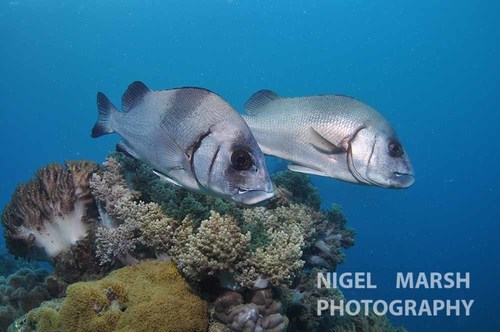
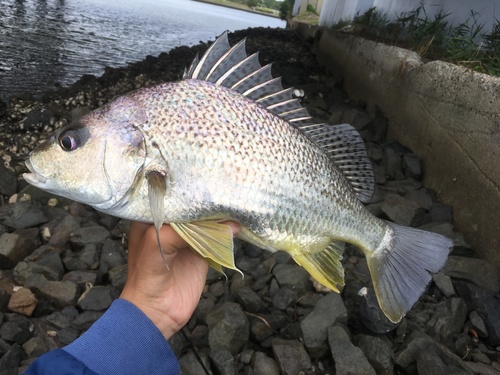
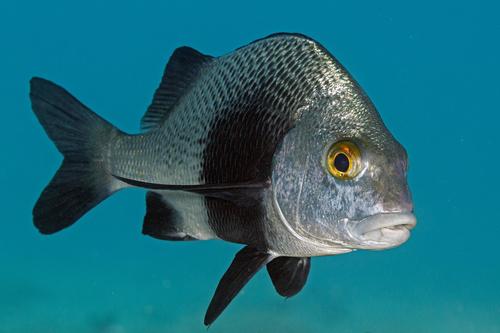
The black margate (Anisotremus surinamensis) has a deep, compressed body with a high back and a short, blunt head. Its mouth is positioned low on the head, held horizontally, and has fleshy lips. Bands of teeth are present on both jaws, with the outer band of teeth having a conical shape. Its body is greyish-silver, with the anterior half being darker than the posterior half. The dorsal scales have black centers, and all fins are dark grey, with the pelvic and anal fins being the darkest. A darker patch occurs on the rear of the pectoral fins. Juvenile black margates have a black stripe along the lateral line, a second black stripe along the upper back, and a large black spot at the base of the tail fin. The dorsal fin has 12 spines and 18 soft rays, while the anal fin has 3 spines and 9 soft rays. There is a deep notch in the dorsal fin; the fourth dorsal spine is longer than all other dorsal spines, and the second anal spine is also very large. This species reaches a maximum total length of 76 cm (30 in), though a total length of 45 cm (18 in) is more typical. The heaviest recorded specimen weighed 5.8 kg (13 lb). Black margate are found in the warmer regions of the Western Atlantic Ocean. In Florida, they range from Cape Canaveral south through the Florida Keys into the Gulf of Mexico, including the Flower Garden Banks. They are also found from Rockport, Texas, along the Mexican coast to the northern Yucatan Peninsula, and at northwestern Cuba. They occur throughout the Caribbean Sea, and along the northern and eastern coasts of South America as far south as Rio de Janeiro, Brazil. They also live at Fernando de Noronha and Trindade Island. This species prefers steep, sloping rock substrates or rock reefs in inshore waters, found down to depths of 20 m (66 ft). They frequently shelter in caves, under ledges, and inside wrecks, and are most often encountered as individuals or in small groups. Black margate are nocturnal feeders; their diet includes crustaceans, molluscs, smaller fish, and urchins, with sea urchins of the genus Diadema being a frequent food item. They may gather in spawning aggregations; off Jamaica, breeding adults have been recorded between April and August. Larvae and young juveniles have been observed settling on rocky seabeds off Florida. Black margate are occasionally caught and sold by fisheries. However, consuming the flesh of larger individuals has been linked to cases of ciguatera poisoning. They are also available in the aquarium trade.