About Anisotremus interruptus (Gill, 1862)
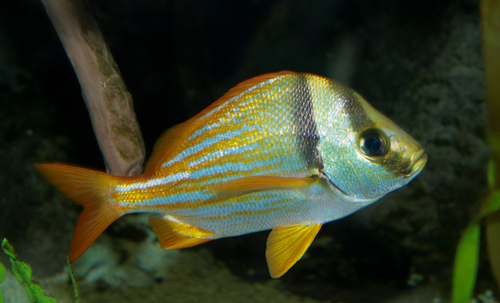
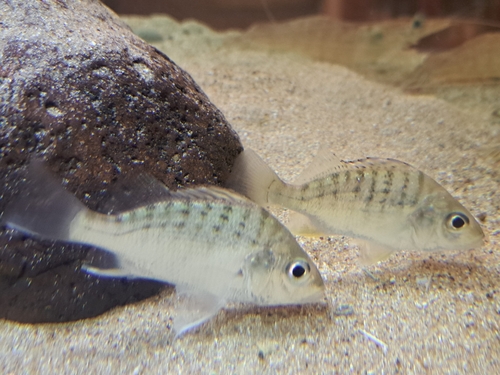
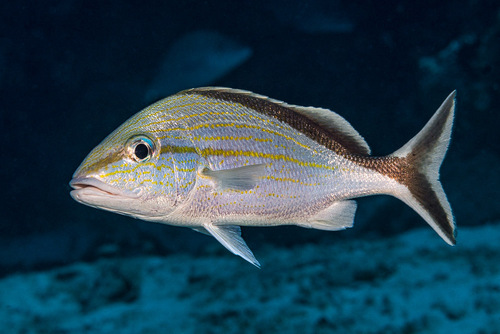
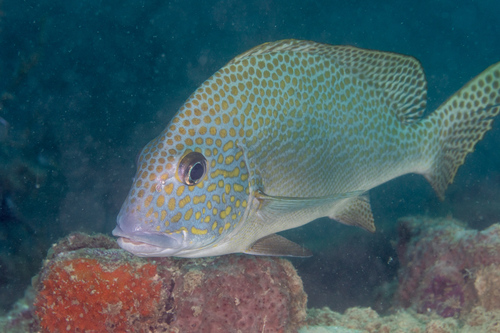
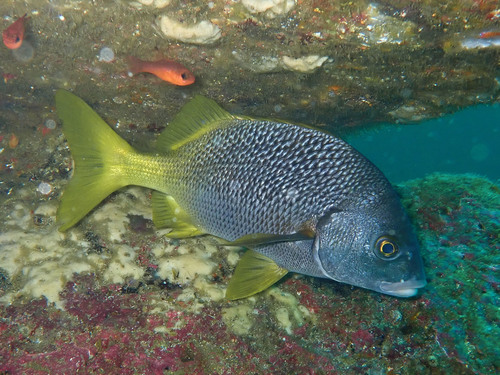
Anisotremus interruptus, commonly called the burrito grunt, has a deep, compressed body with a high back. Its head is short and blunt, with a small, low, horizontal mouth that has fleshy lips. Jaws of this fish bear bands of teeth, where the outer band consists of conical-shaped teeth. The back is silvery yellowish-brown, fading to cream or white on the underparts. The scales on the flanks have dark centers, which create a spotted pattern, and the fins are yellowish. The dorsal fin is continuous but has a deep notch; it has 12 to 13 spines (the fourth is longer than the rest) and 16 to 17 rays. The anal fin contains 3 spines (the second is notably robust and long) and 8 to 9 soft rays. The pectoral fins are long, reaching all the way to the origin of the anal fin, and the caudal fin is forked. This species reaches a maximum total length of 51 cm (20 inches), with 30 cm (12 inches) being a more common size. The heaviest recorded specimen weighed 4.53 kg (10.0 lb).
The burrito grunt is distributed in the eastern Pacific Ocean, ranging from central Baja California and the Gulf of California to Peru. It also occurs around the Galapagos Islands, Cocos Island, Malpelo Island, and the Revillagigedo Islands, but it is not found at Clipperton Island.
This species inhabits reefs at depths between 3 m and 30 m (9.8 ft to 98.4 ft), and most individuals do not live below 12 m (39 ft). Shoals of burrito grunt hide in crevices or caves during the day, and emerge at night to feed. Their diet consists mainly of benthic invertebrates.