About Anisoplaca achyrota (Meyrick, 1885)
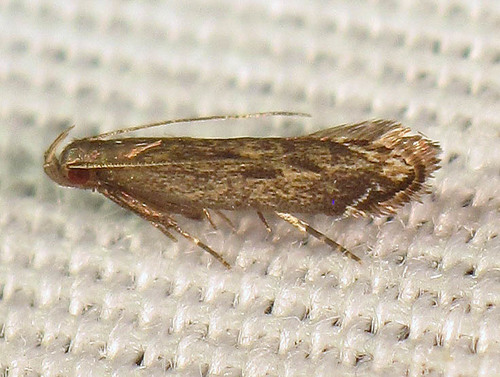
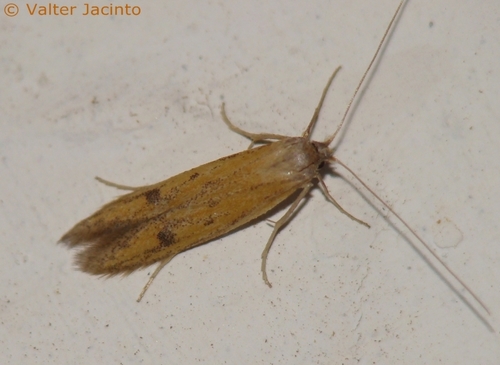
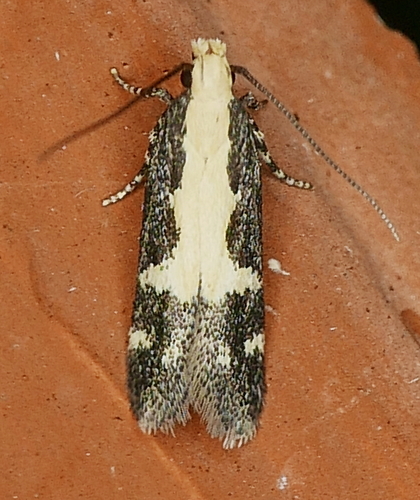
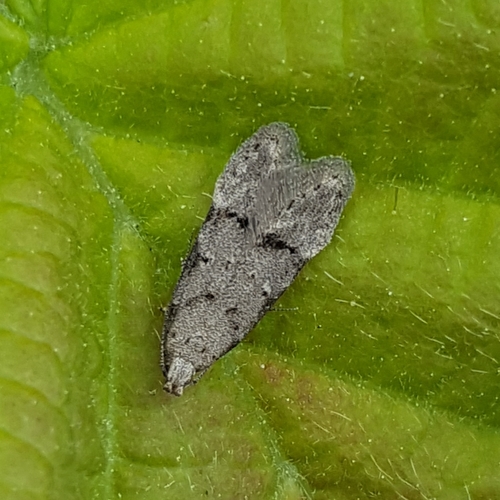
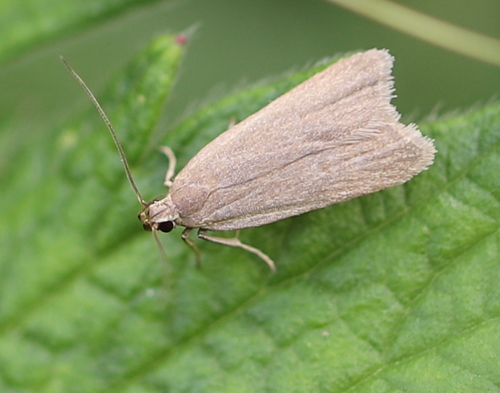
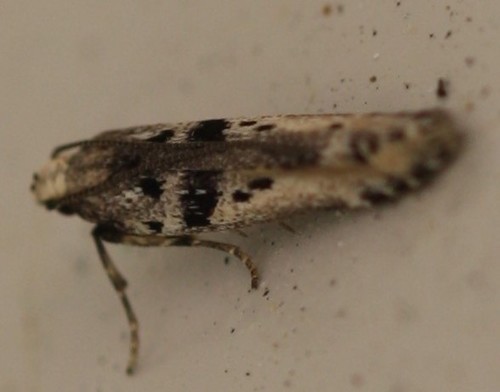
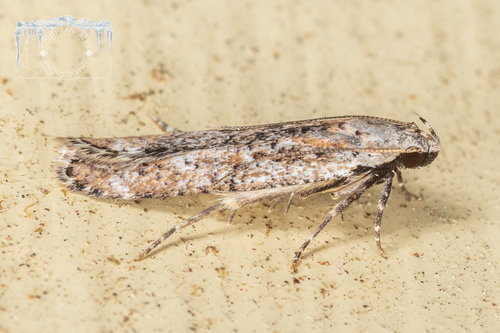
The wingspan of Anisoplaca achyrota is 17–18 mm. Its forewings are light brownish-ochreous, irregularly mixed with whitish and blackish scales. The anterior half of the costa is suffused with whitish and dotted with blackish. The inner margin between one-fourth and two-thirds is suffused with blackish; there is a small black spot on the base of the costa, along with four small black discal spots surrounded by whitish rings. The first of these spots is in the disc before the middle, the second is on the fold rather before the first, and their rings are confluent. The third and fourth are dot-like, transversely placed and close together in the disc at three-fifths. A cloudy whitish fascia runs from four-fifths of the costa to the anal angle, and is dentate outwards in the middle. There is also a cloudy black hindmarginal line. The hindwings are grey, and paler towards the base. George Hudson described this species as rather dull looking. J.S. Dugdale pointed out that both Hudson and Philpott confused this species with another undescribed species in their published work. This species is very similar in appearance to A. cosmia, but the two can be distinguished by the coloration of the labial palpus: in A. cosmia, the labial palpus is fuscous-black all the way to the top of the underside of the second segment, while in A. achyrota, it is only fuscous-black on the bottom two thirds.
This species is endemic to New Zealand, and can be found in both the North and South Islands, including Hawkes Bay, the West Coast, and South Canterbury. It inhabits native forests, and its larvae feed on the green seeds of Hoheria angustifolia. This species is regarded as an indicator species of mature native forest, because its larvae feed on the seeds of native trees found at mature sites. Hudson hypothesised that this species was also associated with Hoheria populnea, as specimens of the moth had been collected in the vicinity of these trees.