About Aniseia martinicensis (Jacq.) Choisy
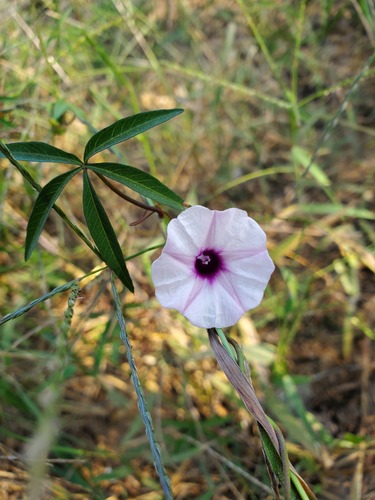
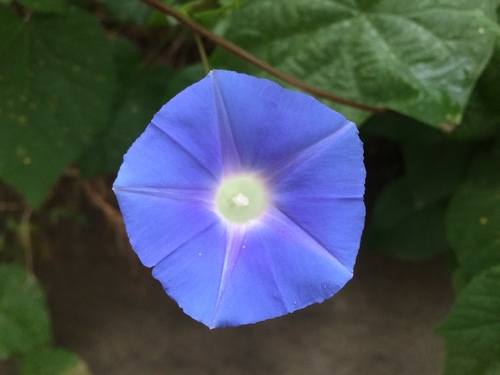
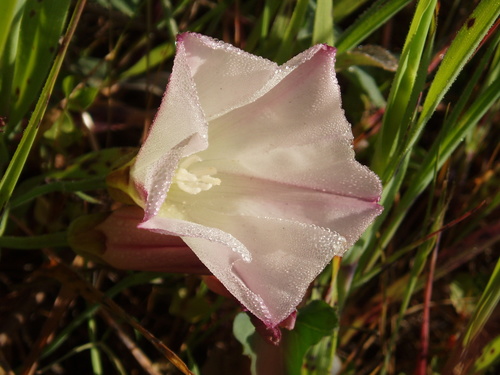
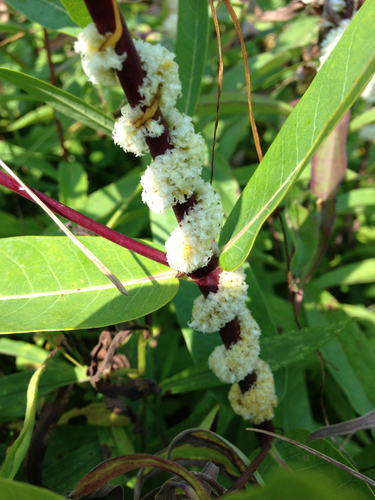
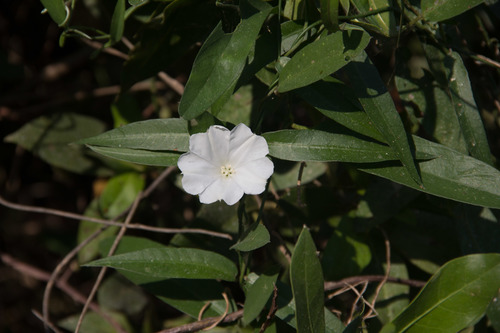
Aniseia martinicensis (Jacq.) Choisy grows as a vine with a herbaceous stem. The stem may be smooth or sparsely hairy. Its hairless leaves are narrowly lanceolate, 4-8cm long, with an obtuse to acute base, an obtuse mucronate apex, and an entire margin. Acuminate flowers are mostly solitary in leaf axils, borne on peduncles up to 5cm long. It has five broadly ovate sepals: the outer two are broader than the inner three, and measure 12-17mm long. The white corollas are campanulate and 25-30mm long. Fruits are ovoid capsular fruits about 2cm long, subtended by an enlarged calyx. The seeds are black and smooth. In Bangladesh, this species flowers from September to November.
This plant is native to tropical and subtropical America, and widely introduced and naturalized in other tropical and subtropical regions of the world. Its native range includes: northeast Argentina; North, Northeast, South, Southeast, and West-Central Brazil; Paraguay; Bolivia; Peru; Ecuador; Colombia; Venezuela; Guyana; Suriname; French Guiana; Panama; Costa Rica; Trinidad and Tobago; Nicaragua; Windward Islands; El Salvador; Honduras; Guatemala; Gulf, Southeast, and Southwest Mexico; Leeward Islands; Belize; Dominican Republic; Jamaica; Puerto Rico; Haiti; Cuba; and Florida, USA. It has been recorded as introduced and naturalized in: Tonga; Fiji; Solomon Islands; Queensland and Northern Territory, Australia; eastern New Guinea, Papua New Guinea; Caroline Islands; West Papua, Maluku Islands, Sulawesi, Kalimantan, Java, and Sumatra, Indonesia; Philippines; Nansei-shoto (Ryukyu Islands); Sabah, Sarawak, and Peninsular Malaysia, Malaysia; Thailand; Cambodia; Vietnam; Laos; Myanmar; India (including Assam); East Himalaya; Bangladesh; Nepal; Sri Lanka; Madagascar; Mozambique; Tanzania; Democratic Republic of the Congo (Congo-Kinshasa); Central African Republic; Angola; Chad; Republic of the Congo (Congo-Brazzaville); Cameroon; Niger; Nigeria; Gabon; Benin; Ghana; Côte d'Ivoire; Liberia; Guinea; Sierra Leone; Senegal; and Guinea-Bissau.
This species grows in a range of habitats from humid to dry and semi-arid environments, including flooded forests and grasslands, at altitudes between 0 and 499m. It is an annual plant that grows along marshy ridges in swamps and requires moist ground. It is often abundant in rice fields, tends to be more common near coasts, and can also be found in deciduous forests, grasslands, and marine intertidal areas. In Manikganj District, central Bangladesh, this taxon occurs in a small number of fallow homestead areas and is classified as critically endangered.
The leaves of this species are sometimes collected for use as a vegetable, particularly in Indonesia and Malaysia. Its seeds are used in a traditional medicine system. During the Khmer Rouge famine in Cambodia, the entire plant including the stem was cooked and eaten. It remains in use as a supplementary vegetable (for when food diversity is desired) in the flooded stilt-house village of Peam Ta Our, located in the Tonle Sap floodplain, Puok District, Siem Reap province, where it is eaten raw or cooked in soups.