About Anigozanthos manglesii D.Don
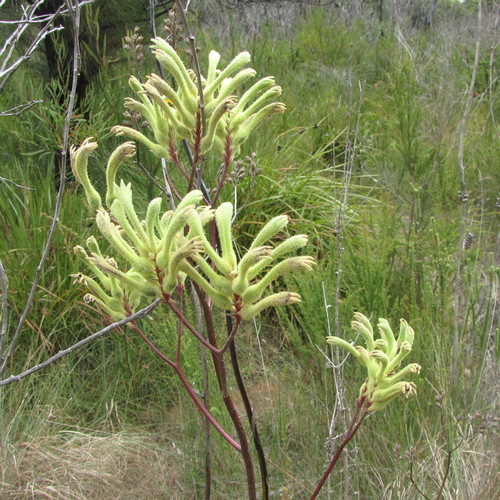
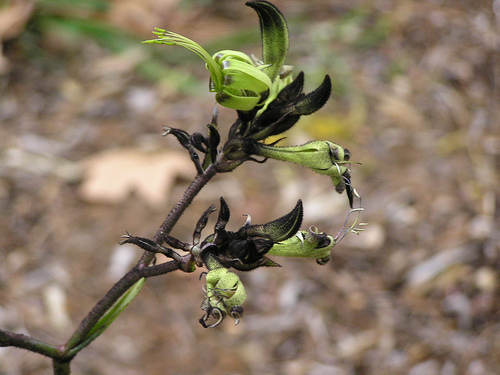
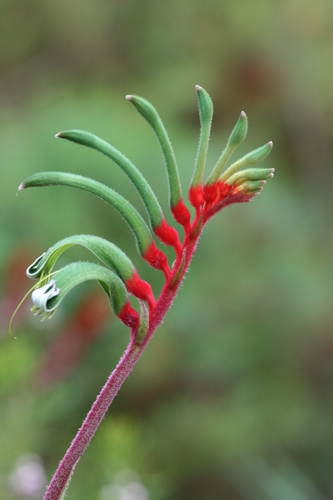
Anigozanthos manglesii D.Don is a member of the Anigozanthos genus. It is a rhizomatous perennial plant that produces long, grey-green linear leaves that measure between 30 and 60 centimetres (12 to 24 inches) long. These leaves grow out from a central point at ground level. Its flowers, which have red pedicels and green tepals, emerge at the end of long stalks between August and November. Flowers open in sequence starting from the lowest point on the stalk, with subsequent flowers following in a progression of development. Spent flower stalks can remain in place long after their flowering season ends. The total length of these stalks from the base can reach up to 1,200 millimetres (47 inches).
This species is widely distributed across biogeographic regions of Southwest Australia, where it prefers to grow in white, yellow, or grey sand, or sandy loam. Confirmed occurrences are recorded from the northernmost part of its range in the Geraldton Sandplains and the Swan Coastal Plain near Perth. Extensive records also document its presence in the Jarrah Forest and Warren region to the south, though it does not extend to the southern coasts. Its range extends inland as far as the Avon Wheatbelt.
In temperate regions, this plant is either grown under glass, or grown outdoors with winter protection provided by mulch. The species germinates easily from seed. Since plants generally decline after their second growing season, they are best treated as biennials. Watering should be withheld during the plant's dormant period. This species is susceptible to fungal ink spot disease, and its leaves are a favoured food source for snails. These plants are often used as cut flowers, thanks to their unique appearance and long-lasting qualities. This plant has been awarded the Royal Horticultural Society's Award of Garden Merit.