About Anhinga anhinga (Linnaeus, 1766)
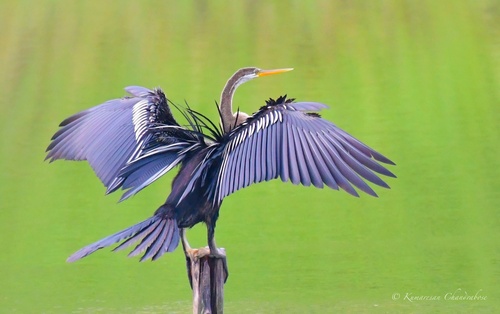
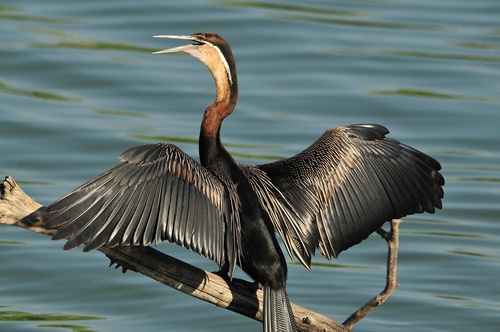
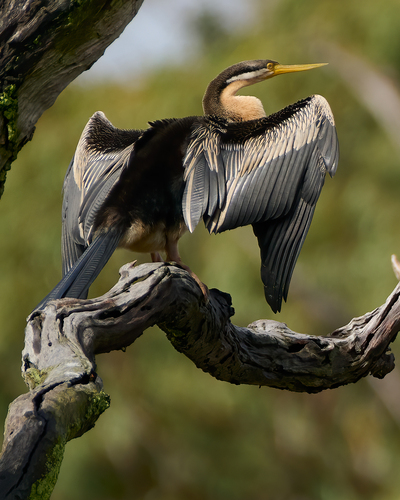
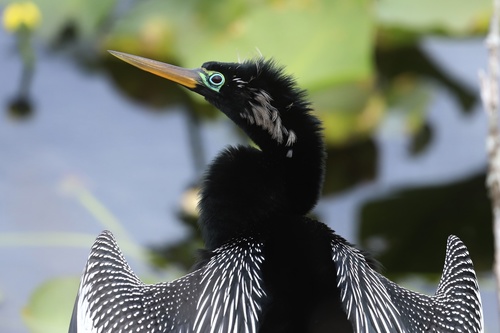
The anhinga (Anhinga anhinga (Linnaeus, 1766)) is a large bird, with an approximate total length of 89 cm (35 in), ranging from 75–95 cm (30–37 in), and an average wingspan of 1.14 m (3.7 ft). Average body weight is around 1.22 kg (2.7 lb), with a weight range of 1.04–1.35 kg (2.3–3.0 lb). The A. a. anhinga subspecies is larger than A. a. leucogaster and has broader buffy tail tips. Its bill is relatively long, measuring about twice the length of its head, sharply pointed, and yellow; its webbed feet are also yellow. Males have glossy black-green plumage across their body including the wings and wing bases, with a glossy black-blue tail and a white tail tip. Elongated feathers on the back of the head and neck are gray or light purple-white. The upper back and wings have white spots or streaks. Females are similar to males, but have pale gray-buff or light brown coloration on the head, neck, and upper chest. The female's lower chest or breast is chestnut, and her back is browner than the male's back. Newly hatched anhingas are bald, but grow tan down within a few days of hatching. This tan down is replaced by white down within two weeks. The first juvenile feathers emerge three weeks after hatching. Juveniles are mostly brown until their first breeding, which typically occurs after the second or third winter. Anhingas resemble double-crested cormorants in size, shape, and behavior. The two species can be told apart by their tails, bills, and flight patterns: the anhinga has a wider and longer tail, only the cormorant has a hook-tipped bill, and only the anhinga is able to glide during flight. Like other members of the Anhinga genus, anhingas have a "kinked" neck, caused by a unique hinge-like morphology at the joint between the eighth and ninth cervical vertebrae. Members of the Anhinga genus live in warm, shallow waters and swamplands across the world. The American anhinga is split into two subspecies, A. a. anhinga and A. a. leucogaster, which are separated by range. A. a. anhinga occurs mainly east of the Andes in South America, stretching east to the islands of Trinidad and Tobago. A. a. leucogaster is found in the southern United States, Mexico, Cuba, and the Caribbean island of Grenada. A fossil species, Anhinga walterbolesi, has been described from deposits dating to the Late Oligocene to Early Miocene of Australia. Only anhingas living at the extreme northern or southern edges of the species' range migrate, with movement driven by temperature and available sunlight. Migratory anhingas travel closer to the equator during winter, and their winter range is determined by the amount of sunshine available to warm chilled birds. American anhingas have been recorded as far north as the U.S. states of Pennsylvania, Wisconsin, and New York, despite these areas not being part of their traditional range. Migratory groups (called kettles) of anhingas often travel alongside other bird species, and have been described as resembling "black paper gliders".