About Anguispira kochi (L.Pfeiffer, 1846)
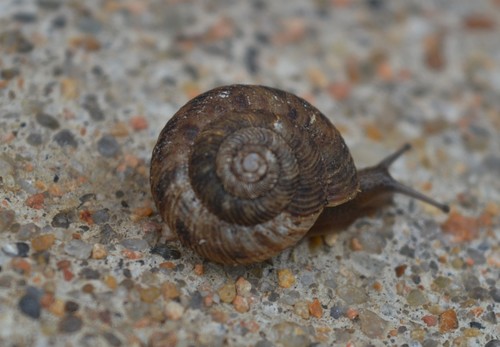
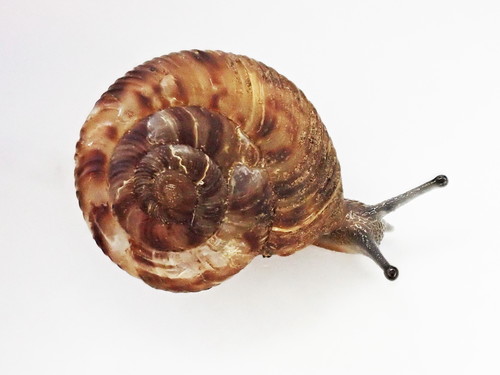
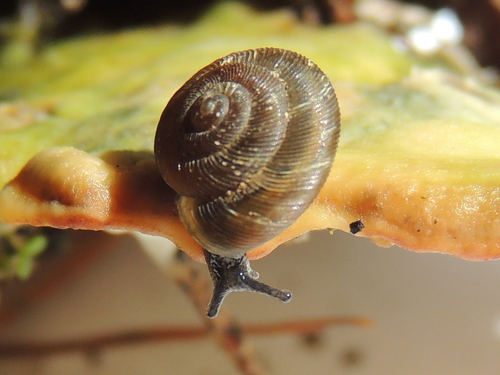
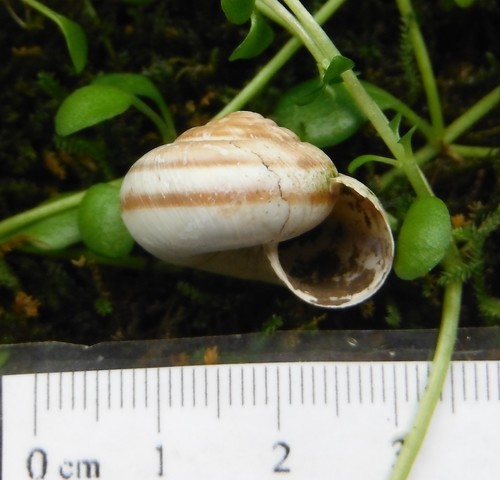
The banded tigersnail, scientifically named Anguispira kochi (L.Pfeiffer, 1846), is a fairly large land snail. Adult shells typically measure 2 to 2.5 centimeters across. Their shells are striated and heliciform in shape, and are usually yellow, chestnut, or light brown in color. A key defining feature of the shell is a light-colored band that runs along the shell's outer edge, bordered by a darker band on both sides. The banded tigersnail's head and tentacles are typically gray, and its foot is usually brown or orange. Morphology of this species can vary widely between different regions and populations, especially in isolated populations. The banded tigersnail is distributed across the United States and Canada, with a disjunct range split into two distinct western and eastern portions. The western banded tigersnail occupies the western part of the species' overall range, which extends from British Columbia to Oregon. The eastern banded tigersnail occupies the eastern portion of the range, which extends from Ontario south to Tennessee. In 2017, the eastern banded tigersnail was declared critically endangered in Ontario, where it is only found on a small number of islands in Lake Erie. The most robust, well-studied populations are on Pelee Island and Middle Island, after the species was extirpated from Middle Sister Island, East Sister Island, and North Harbour Island. The species is also listed as critically endangered, and possibly extirpated, in West Virginia and Michigan, and listed as vulnerable in Tennessee and Kentucky. By contrast, the western banded tigersnail is listed as secure or 'not at risk' across most of its range. Banded tigersnails live in mature mesic hardwood or mixed-wood forests, specifically old-growth forest, most often along river bluffs or ravines. They can also be found in upland woods near limestone cliffs. Research shows that while banded tigersnails will live in previously logged second-growth forest, they occur at much lower population densities in this habitat than in old-growth forest. They prefer areas with thick leaf litter, where they can hide during hot, dry weather.