About Anguilla rostrata (Lesueur, 1817)
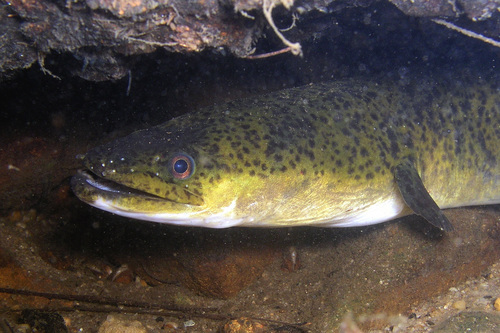
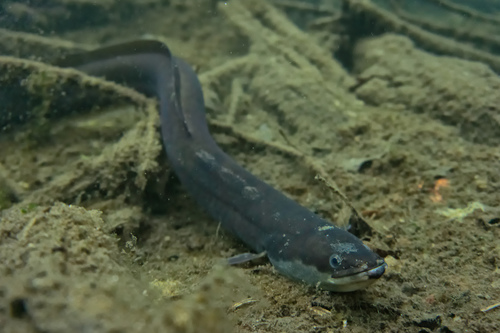
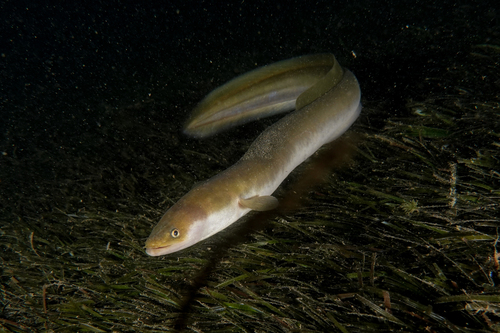
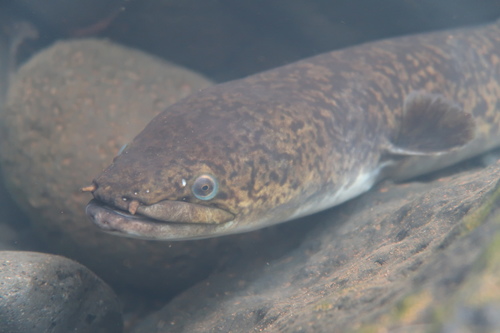
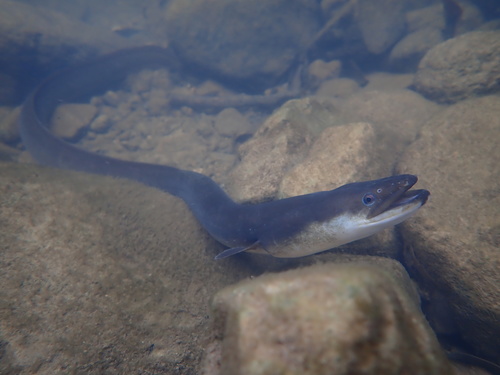
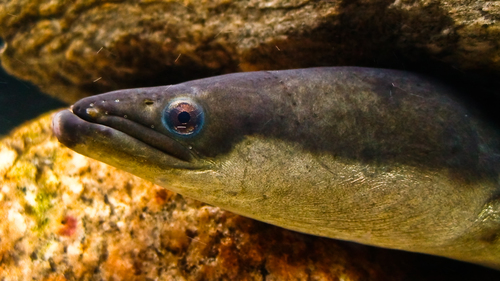
This species, the American eel, has the scientific name Anguilla rostrata (Lesueur, 1817). American eels can reach up to 1.22 m (4.0 ft) in length and 7.5 kg (17 lb) in weight. Females are generally larger than males, lighter in color, with smaller eyes and higher fins. Their bodies are elongate and snake-like. The dorsal and anal fins are confluent with the rudimentary caudal fin. Ventral fins are absent, but pectoral fins are present. The lateral line is well-developed and complete. The head is long and conical, with rather small, well-developed eyes. The mouth is terminal, with jaws that are not particularly elongated. Teeth are small, pectinate or setiform, arranged in several series on the jaws and vomer. Minute teeth are also present on the pharyngeal bones, forming a patch on the upper pharyngeals. A tongue is present, and thick lips are attached by a frenum at the front. Nostrils are located on the upper surface of the head and are well separated. Gill openings are partly below the pectoral fins, relatively well-developed, and well separated from one another, with wide inner gill slits.
Scales are small, rudimentary, cycloid, and relatively deeply embedded under the epidermis, so they are often difficult to see without magnification. Unlike scales of most other fish species, these scales are not arranged in overlapping rows; they are instead arranged irregularly, and in some areas are distributed like "parquet flooring". In general, one row of scales lies at a right angle to the next, though rows immediately above and below the lateral line lie at an angle of approximately 45°. Unlike in other bony fishes, the first scales do not develop immediately after the larval stage, and instead appear much later.
Several morphological features set the American eel apart from other eel species. Three morphological characteristics stay consistent across all life stages, from larvae to maturing eels: a mean total vertebrae count of 107.2, a mean myomere count of 108.2, and a mean distance between the origin of the dorsal fin and the anus equal to 9.1% of total body length.
The American eel's native distribution covers all accessible freshwater (streams and lakes), estuaries, and coastal marine waters between 5° N and 62° N latitude. Its natural range spans the western North Atlantic Ocean coastline from Venezuela to Greenland, including Iceland. Inland, the species extends into the Great Lakes and the Mississippi River and its tributaries, reaching as far upstream as Minnesota and Wisconsin.
Nonindigenous occurrences of this species in the United States have been recorded from Lake Mead on the Colorado River, along the Arizona border. It was stocked a few times in California's Sacramento and San Francisco Bay in the late 1800s, with no apparent evidence of survival from these introductions. It has also been stocked and unintentionally introduced in several additional U.S. states, including Illinois, Indiana, Nebraska, Nevada, North Carolina, Ohio and Pennsylvania. Stockings were also carried out in Utah in the late 1800s, but the introduced population disappeared soon after.
American eels are bottom dwellers that hide in burrows, tubes, snags, masses of plants, and other types of shelters. During their freshwater life stage, they are found in a range of habitats including streams, rivers, and lakes with muddy or silt bottoms. They also occupy oceanic waters, coastal bays, and estuaries. Individuals in the continental stage occasionally migrate between fresh, salt, and brackish water habitats, and have varying residence times in each. During winter, when water temperatures are below 5 °C (41 °F), eels burrow under mud and enter a state of torpor, though they may occasionally be active during this period. In spring, American eels move from freshwater to estuaries and coastal bays to feed. In fall, juvenile and immature adults return to freshwater to overwinter, while mature silver eels undertake a southward migration to spawning grounds. Continental phase American eels have highly flexible habitat use. They are extremely mobile, and can reach habitats that seem unavailable by traveling through small watercourses or moving across wet grasses. Small eels (under 100 mm total length) are able to climb, and can successfully pass over vertical barriers. Habitat availability for the species can be reduced by factors including habitat deterioration, barriers that block upstream migration for larger eels, and barriers to downstream migration such as turbines that can cause mortality.
The American eel's life cycle begins far offshore in the Sargasso Sea, with semelparous, panmictic reproduction. In 1926, Marie Poland Fish described a collection of eel eggs that she observed hatching into eels, and later expanded this work with a taxonomic description of larval egg development. After hatching, young eels drift with ocean currents, then migrate inland into streams, rivers, and lakes. This inland journey can take many years to complete, with some eels traveling as far as 6,000 kilometers. After reaching these freshwater bodies, they feed and mature for approximately 10 to 25 years before migrating back to the Sargasso Sea to complete their life cycle.
Eggs hatch within one week of being deposited in the Sargasso Sea. Fecundity for most individuals ranges from about 0.5 to 4.0 million eggs, and the largest individuals can release up to 8.5 million eggs. The larval form of the eel is called a leptocephalus. Leptocephali are transparent, with a small pointed head and large teeth. These laterally compressed larvae are passively carried west and north by Gulf Stream system surface currents to coastal waters along the eastern coast of North America, a journey that takes between 7 and 12 months. Once leptocephali reach the continental shelf, they metamorphose into glass eels, the transparent juvenile stage that already has the typical elongate, serpentine eel body shape. The term glass eel refers to all developmental stages between the end of metamorphosis and full pigmentation. Glass eels become progressively more pigmented as they approach the shore, and at this point they are called elvers. The melanic pigmentation process takes place while young eels are in coastal waters. During this life stage, eels are still sexually undifferentiated. The elver stage lasts about three to twelve months. Elvers that enter fresh water may spend most of this period migrating upstream. Elver influx is linked to increased temperature and reduced flow early in the migration season, and to tidal cycle influences later in the season. The sexually immature adult stage of the American eel is called the yellow eel. As maturation proceeds, yellow eels metamorphose into silver eels. This silvering metamorphosis produces morphological and physiological changes that prepare the eel to migrate back to the Sargasso Sea. The eel develops a greyish body color, with whitish or cream coloration on its ventral surface. Its digestive tract degenerates, pectoral fins enlarge to improve swimming ability, eye diameter increases, retinal visual pigments adapt to the oceanic environment, and the integument thickens.