About Anguilla marmorata Quoy & Gaimard, 1824
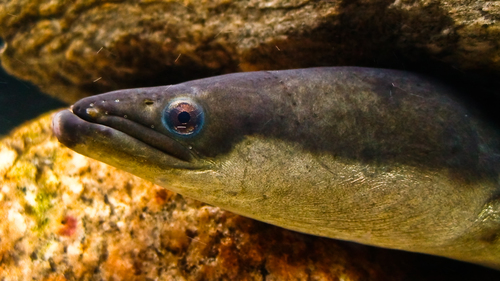
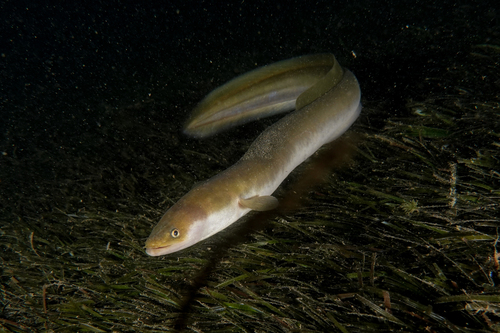
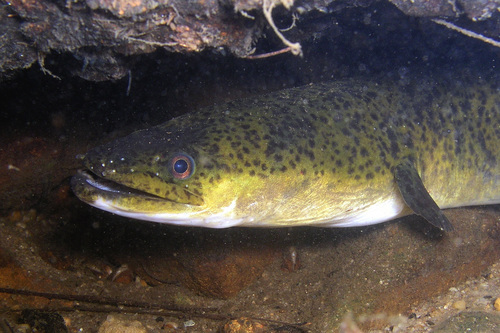
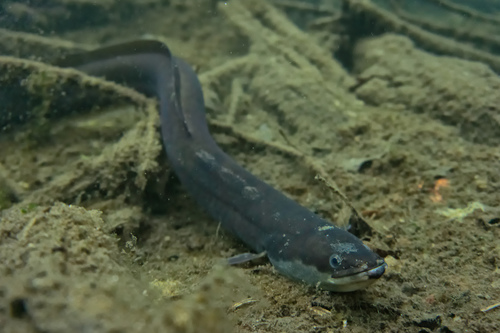
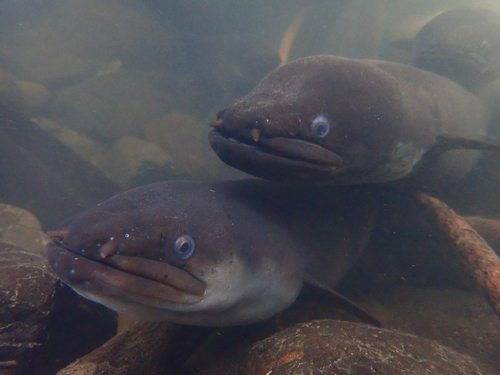
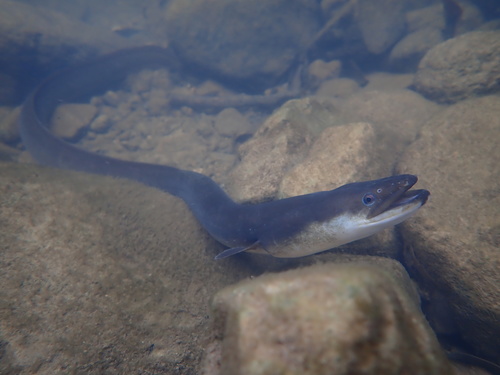
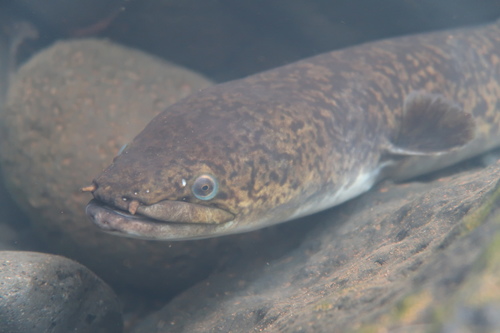
Like other anguillids, the giant mottled eel (Anguilla marmorata Quoy & Gaimard, 1824) has a cylindrical body, small well-developed pectoral fins, and a protruding lower jaw. It has thick, fleshy lips, and its dorsal and anal fins run continuously around the tail. The origin of its dorsal fin sits between the pectoral fins and anus, and it is positioned closer to the gill opening than the anus, making it more anterior than the dorsal fins of other Anguilla species. This species has small, oval scales embedded in its skin, and like all anguillid eels, it lacks pelvic fins. Its head is rounded, its snout is depressed, and its small teeth are arranged in bands. It has between 100 and 110 vertebrae total. Females can grow up to 2 meters (6.6 ft), males up to 1.5 meters (4.9 ft), and the species can reach a maximum weight of 20.5 kilograms (45 lb), making it the largest species of anguillid eel. Giant mottled eels can live up to around 40 years. Unlike many other anguillid species, this eel has a mottled color pattern. Adult eels are yellow with greenish-brown to black marbling on their back and a white belly. Young elvers have less visible marbling, and are grayish to yellow in color. This anguillid species ranges from East Africa to French Polynesia, and reaches as far north as southern Japan. In Africa, it occurs in Mozambique and the lower Zambezi River. It has the widest distribution of all Anguilla eels, and is typically found in tropical climates between 24°N and 33°S. It has occasionally been found in more distant locations such as the Galapagos, likely due to abnormal larval transport linked to El Niño-Southern Oscillation events. In 2002, one individual eel was captured from a pond near Kaupo, Maui, Hawaii, though the species is not indigenous to that area. It is not listed on the IUCN Red List of Threatened Species, but it is considered endangered in Taiwan. Adult giant mottled eels are demersal, meaning they live along the bottom of fresh to brackish waters in rivers, lakes, and tributaries. This species, like all anguillid eels, is catadromous: individuals sometimes migrate long distances out into the open ocean to spawn over deep water. One confirmed spawning area for this species is west of the Mariana Islands, in an area of the North Equatorial Current in the western North Pacific; researchers believe additional spawning areas exist in the western South Pacific and Indian Ocean. Marbled eels spend their adult lives in freshwater or estuarine habitats, then migrate to the ocean to reproduce. When eggs hatch, leptocephali (larval eels) drift in ocean currents for months, until they reach estuaries as glass eels, which then migrate upstream into freshwater to become elvers. After spending 8 to 20 years in brackish or freshwater, yellow eels mature into silver eels, which then return to the ocean to reproduce.