About Anguilla japonica Temminck & Schlegel, 1846
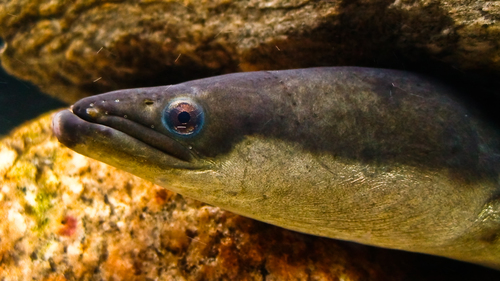
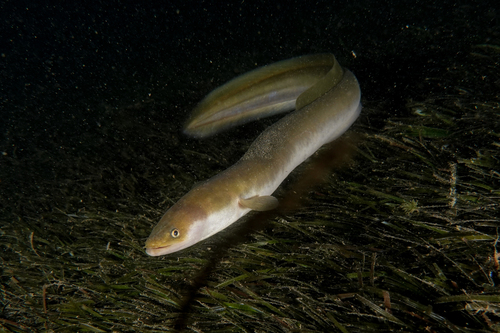
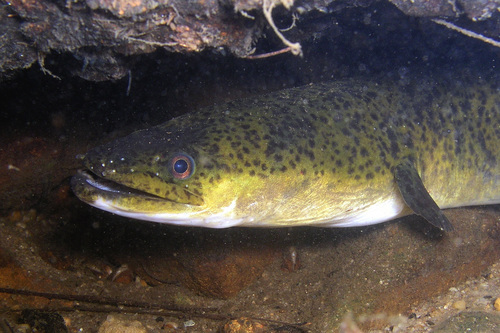
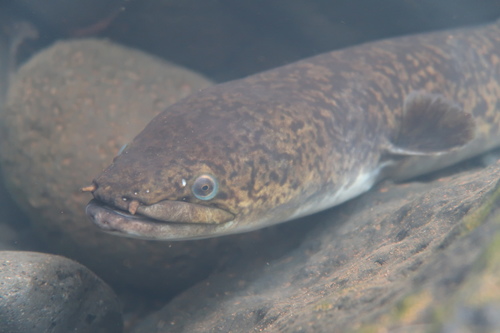
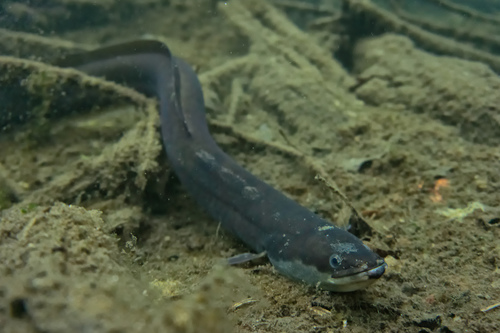
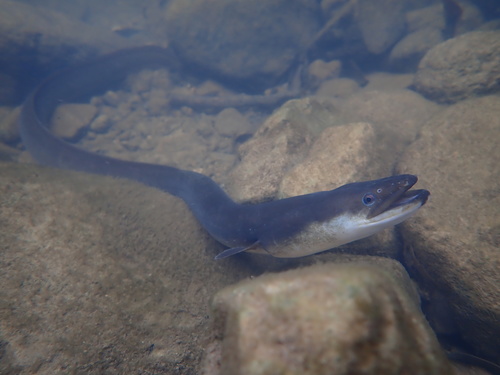
The Japanese eel, with the scientific name Anguilla japonica Temminck & Schlegel, 1846, is an anguillid eel species found in Japan, Korea, Taiwan, China, Vietnam, and the northern Philippines. Like all members of the genus Anguilla and family Anguillidae, it is catadromous: it spawns in the sea, but spends most of its adult life in freshwater. In Japan, it is called unagi, and it is a core part of local food culture, where many restaurants serve the grilled eel dish kabayaki. Currently, this species is classified as endangered, likely due to a combination of overfishing, habitat loss, and changing ocean conditions that interfere with spawning and the transport of its leptocephali larvae. Japanese eels and other anguillid eels inhabit freshwater environments and estuaries, the areas where freshwater rivers meet the ocean. Japanese eel eggs have been collected and genetically identified from a research vessel, with collections of eggs and recently hatched larvae made along the western side of the seamount chain of the West Mariana Ridge. In 2008, Japanese scientists from the Fisheries Research Agency captured mature adult Japanese eels and giant mottled eels using large midwater trawls. Based on recent catches of spawning adults, eggs, and newly hatched larvae, adult Japanese eels appear to spawn in the upper few hundred meters of the ocean. Data from catch timing of eggs and larvae, and the ages of larger larvae, shows that Japanese eels only spawn during the few days just before the new moon period each month within their spawning season. After hatching in the ocean, leptocephali larvae are carried westward by the North Equatorial Current, then northward by the Kuroshio Current to East Asia, before they metamorphose into the glass eel stage. Glass eels then enter estuaries, move toward river headwaters, and many travel further upstream. In freshwater and estuaries, yellow eels feed mainly on shrimp, other crustaceans, aquatic insects, and small fishes. Japanese eels go through five distinct metamorphic stages over their life cycle, each with a unique name. The first stage after hatching from an egg is the leptocephalus, which feeds on marine snow in the open ocean. Around 18 months after hatching, leptocephali metamorphose into "glass eels", a name that comes from their clear, transparent appearance. When glass eels reach their freshwater habitats between December and April, they become known as elvers. This species' migration timing lines up with the moon, which influences tides. Migration occurs during nighttime tides that simulate a flood, making it easier for elvers to survive the journey. Elvers are 6 cm long at this stage, and have a strong instinct to swim upstream that drives them to navigate any obstacles to reach their permanent habitat. This migration is generally nocturnal: elvers swim upstream during the night, and hide under rocks along river banks during the day, when they face few predators. Two weeks into migration, elvers develop black coloration and metamorphose into brown-stage eels (also called yellow eels) to continue their journey. The brown or yellow stage of the eel's life lasts 5 to 10 years. During this stage, the eel feeds on worms and insects. Individuals have dull pigmentation: a grey, brown, or greenish upper body and a white underbelly, and this pigmentation matches the color of the local water environment. Eels grow to their full adult size during this stage. Females reach up to 57 to 60 cm, while males reach up to 35 cm. When they reach 30 cm in length, eels develop sexual organs for the first time and begin preparing for their spawning migration. Once they reach adulthood, eels develop a silvery color under their skin. This appearance change signals they have entered the final life stage, the silver stage. During this stage, eels prepare to migrate to their spawning area by naturally producing extra body oil, which is stored in their muscles and makes up approximately 20% of their total body mass. Once they reach the required level of stored oil, the eels stop feeding. In autumn, typically during the last quarter of the moon, silver eels migrate downstream toward the spawning area in the central Pacific. Japanese eels are unique among vertebrates for their ability to produce the protein UnaG, which is only found in the muscles of this eel species, making it a rare resource. UnaG has proven useful in the life sciences: it can be used to fluorescently label cells and tag proteins when expressed exogenously. It has also been used in an experimental diagnostic test to evaluate liver function.