About Anguilla dieffenbachii Gray, 1842
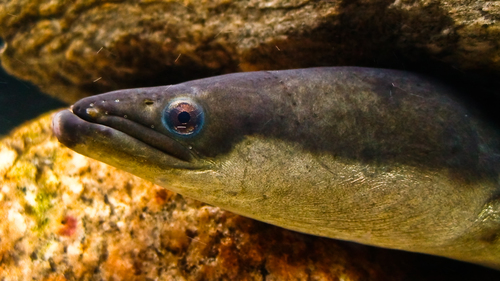
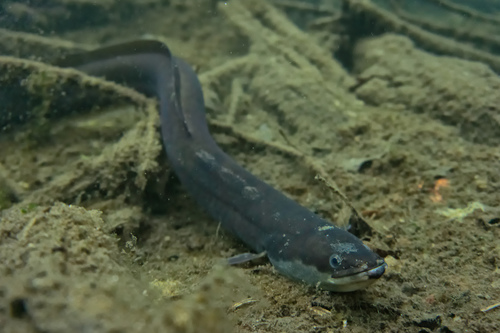
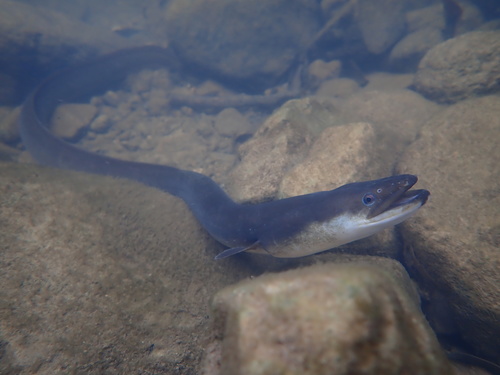
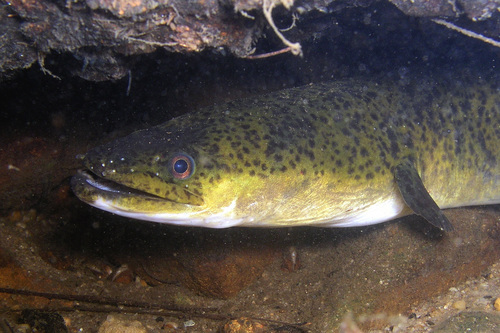
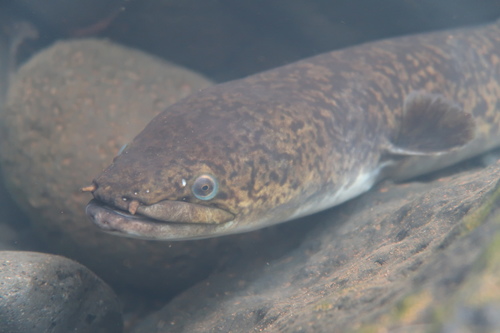
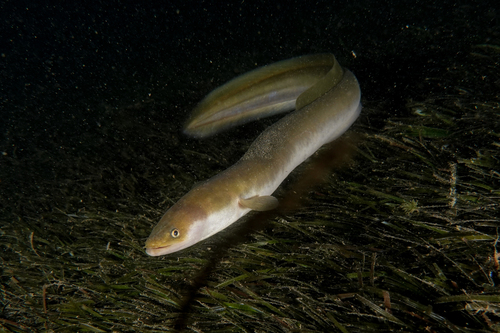
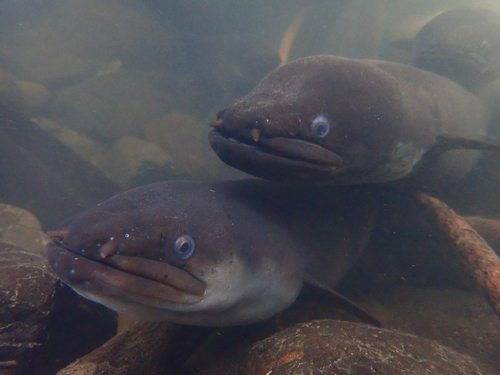
This species, commonly called the New Zealand longfin eel, has key identifying traits that distinguish it from the related shortfin eel. Its most defining feature is fin length: the dorsal fin on the top of the body runs for roughly two-thirds of the total body length, and begins much closer to the head than the anal fin on the bottom, while shortfin eels have fins of similar length. Other distinguishing marks include distinct wrinkles in the loose skin of the longfin eel when it bends, compared to the smooth skin of the shortfin eel, and the longfin eel’s mouth that extends further past its eyes than the shortfin eel’s mouth. Females are larger and longer-lived than males. Males average 66.6 cm in length, and can reach a maximum of 73.5 cm, with an average age of 23 years, ranging between 12 and 35 years. Females are much larger, with lengths from 73 cm to 156 cm and an average length of 115 cm. Females live between 20 and 60 years before migrating out to sea to breed. Longfin eels living in New Zealand’s North Island migrate at younger ages, and as a result have faster generation times. It is difficult to determine the sex of a longfin eel, because their sexual organs do not develop until the eel grows longer than 45 cm. The only method to confirm sex is internal examination, and sex can only be easily distinguished when eels reach maturity and begin migrating. Anguilla dieffenbachii is endemic to New Zealand, and is widely distributed across the country’s rivers and lakes, including the Chatham Islands. Longfin eels are often found far inland, up to 361 km inland along connected freshwater waterways and in high country lakes that connect to the sea. Their ability to spread this far inland relies on the climbing ability of juvenile elvers under 12 cm in length. Elver climbing migrations typically occur when temperatures are higher, water flow is increased, and light levels are low. At this small size, elvers can travel up to 130 km inland over the course of one summer, and have been observed climbing near-vertical surfaces as tall as 43 m. They accomplish this using a combination of water surface tension and friction. Preferred habitat within a waterway changes with life stage: juveniles prefer shallow water less than 0.5 m deep with a coarse bottom substrate and faster-than-average stream flow like that found in riffles, while adults most often live beside or under large debris and undercut river banks. Like all members of the family Anguillidae, longfin eels have an unusual catadromous life cycle: they grow and mature into fertile adults in fresh water, then migrate to the sea to breed. This breeding system results in random mating that creates a panmictic population. The New Zealand longfin eel is an extremely long-lived fish, with records of females reaching 106 years of age and weighing up to 24 kg. It has the slowest growth rate of any eel species studied, growing only 1–2 centimeters per year. Like other Anguillidae eels, the longfin eel has a complex life cycle divided into four distinct stages, which was unknown for many decades and is still not fully understood. New Zealand longfin eels breed only once at the end of their life, making a thousands-of-kilometers journey from New Zealand to their spawning grounds near Tonga. Each female produces between 1 and 20 million eggs. How these eggs are fertilized is not known, though it likely occurs in deep tropical water. After spawning, the mature adult eels die. Their eggs float to the surface and hatch into very flat, leaf-like larvae called leptocephalus, which drift with large ocean currents back to New Zealand. This drifting period is thought to take up to 15 months. No eggs or larvae of this species have ever been recorded captured. Once the larvae reach New Zealand, they undergo metamorphosis into small transparent glass eels that resemble tiny adult eels. Glass eels live in estuaries for their first year, as they develop pigmentation and become elvers, which look like small adult longfin eels. Elvers then migrate upstream to develop into mature adults. The number of glass eels that successfully enter New Zealand’s freshwater river networks varies greatly, a pattern thought to be influenced by El Niño and La Niña Southern Oscillations. This high variability was the main reason longfin eel aquaculture failed in the 1970s.