About Anguilla australis Richardson, 1841
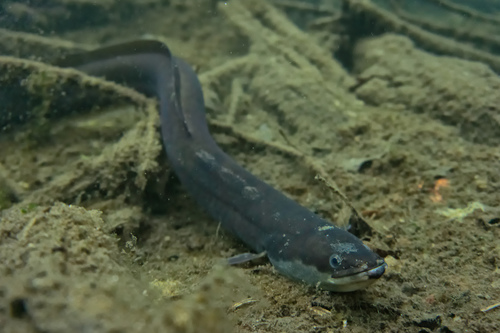
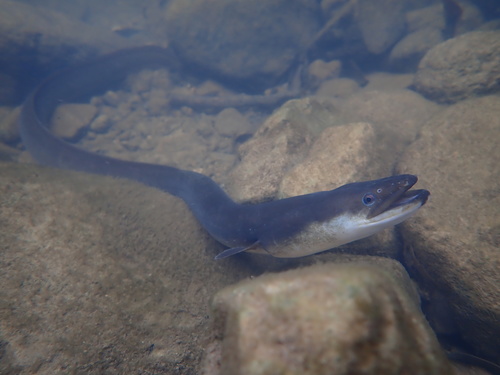
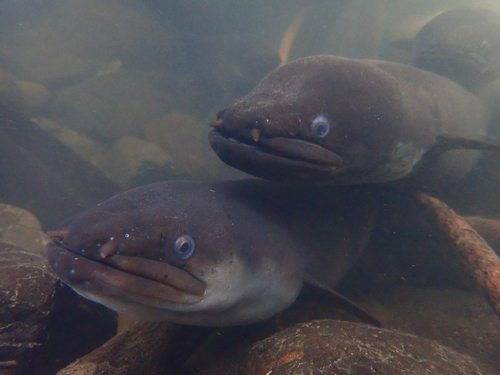
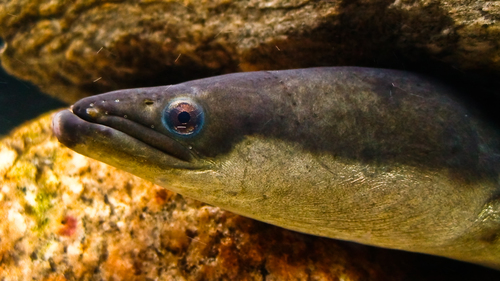
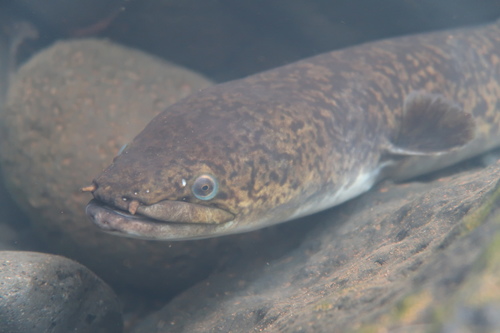
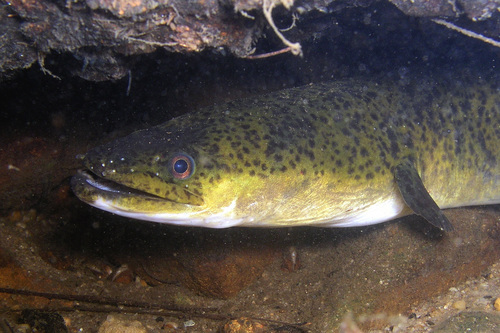
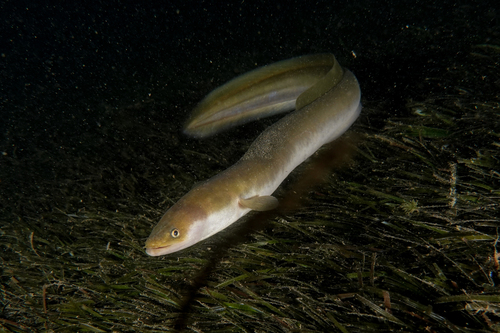
Adult short-finned eels (Anguilla australis Richardson, 1841) have long, snakelike, roughly tubular bodies with small heads, and their jaws extend back to below the eye or further. Their top dorsal and bottom anal fins are roughly equal in length. Body color varies widely between individuals: deep olive-green is typical, but individuals may be much lighter, golden, or rarely yellowish. There are no prominent markings; the underside is pale, often silvery, and the fins are greenish. Most fully grown individuals reach about 90 cm (2 ft 11 in). Females have a regeneration period of 15 to 30 years, and reach a maximum size of around 1.1 m (3 ft 7 in) and 3 kg (6.6 lb). Males grow more slowly and reach a smaller adult size than females.
Anguillid eels like this species are undifferentiated gonochorists. Their sex is not determined at the start; it develops from an initially undifferentiated gonad, with differentiation into male or female generally correlated to the eel's size (around 30 cm/12 in) rather than age. Sex is also dependent on population density once eels reach this length: high population density tends to produce males, while lower densities further upstream more often produce females. Puberty does not occur until eels reach this 30 cm length.
This species is common across all lowland areas of New Zealand, including Chatham Island and Stewart Island/Rakiura, but generally does not travel as far inland as the New Zealand longfin eel. In Australia, it is restricted to the seaward side of the Great Dividing Range, ranging from Mount Gambier in south-eastern South Australia through Victoria, Tasmania, and the Bass Strait islands, north along the eastern seaboard to the Richmond River in northern New South Wales. It cannot cross the Great Dividing Range, and does not extend as far west as the Murray River outlet, so it is absent from the thousands of kilometers of inland waterways draining eastern Australia. Of all anguillid eels, this species has the widest longitudinal distribution; its larvae can be found just south of Fiji, in the north-west of Australia's Southern Equatorial Current region, between 14.5–21°S and 154–179.5°E. Short-finned eels migrate very long distances during their life cycle to reach spawning grounds.
Like other anguillids, short-finned eels are catadromous: when they reach maturity, they stop feeding and migrate downstream to the sea, traveling up to three or four thousand kilometers to spawn in deep water in the Coral Sea near New Caledonia. A 2021 study from the Arthur Rylah Institute tracked one group of short-finned eels that traveled 2,620 km (1,630 mi) from western Victoria up the east coast to the Coral Sea. While the study did not pinpoint the exact spawning location, researchers concluded it is likely somewhere near New Caledonia. After spawning, larvae called leptocephali (meaning narrow head) drift on ocean currents (the South Equatorial Current off Australia) and eventually reach coastal waters, where they metamorphose into tiny, transparent, colorless young eels called glass eels. Glass eels cannot feed at this stage; they only begin feeding after they reach an estuary or river mouth, where they metamorphose again into darker-colored elvers. Elvers then migrate upstream, able to cross many obstacles by leaving the water to travel short distances over moist ground, as they can absorb some required oxygen through their skin.
Tropical eel species have year-round glass eel recruitment into new habitats, while the temperate short-finned eel has strongly seasonal recruitment. Recent microchemical analysis of eel otoliths suggests that short-finned eels are facultatively rather than obligately catadromous: there are separate populations that reside permanently in the ocean or estuaries, and these populations very rarely enter freshwater. After migrating upstream, mature ees settle in lakes, swamps, dams or rivers, typically occupying a home range about 400 m (1,300 ft) long. They remain in this home range until they reach full maturity: maturity occurs at around 14 years for males and 18 to 24 years for females. Once mature, eels undergo additional body changes to prepare for their spawning migration: their digestive system shrinks, their gonads grow larger to produce eggs and sperm, they stop eating, their eyes grow larger, and their heads become pointier, likely an adaptation for ocean swimming. Southeast Australian eels travel north up the east coast to reach Coral Sea spawning grounds.
Short-finned eels are considered excellent food, and have been valued as an important food resource for a long time. Their consumption is a longstanding tradition in many Pacific nations, including Japan, Australia, and New Zealand. Before European settlement, at least two Western Victorian Aboriginal Australian nations, the Gunditjmara and Djab wurrung, farmed short-finned eels on a large scale and traded smoked eel with distant communities for other goods. For Māori people of New Zealand, short-finned eel was a significant source of protein after the extinction of New Zealand megafauna. Māori refer to short-finned eel as tuna, grouping it with the endemic New Zealand longfin eel. One traditional Māori preparation method is cooking eels bound in rangiora or kanono leaves in an umu. Before European arrival, Māori had a well-developed freshwater eel fishery, extensive knowledge of eel ecology, and used a variety of harvesting techniques. Today, recreational anglers regularly catch and eat short-finned eels, and New Zealand has an established commercial eel fishery. Māori currently have concerns that commercial fishing reduces their ability to harvest short-finned eels for ceremonial purposes.