About Angophora costata (Gaertn.) Britton
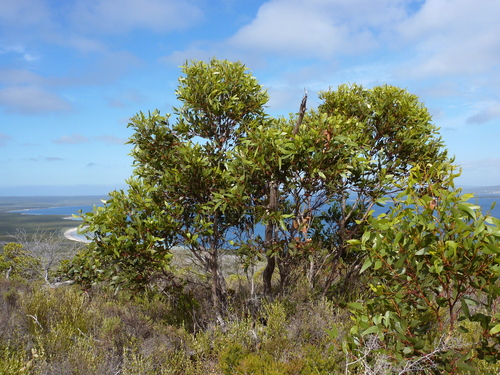
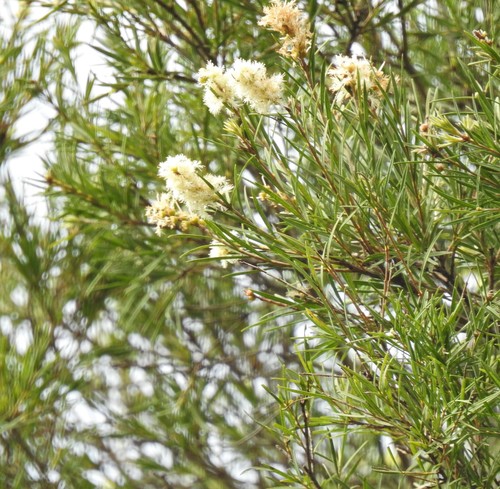
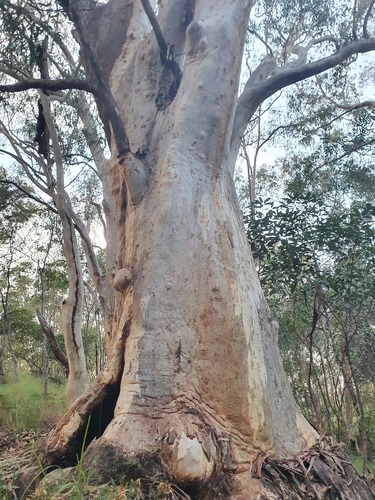
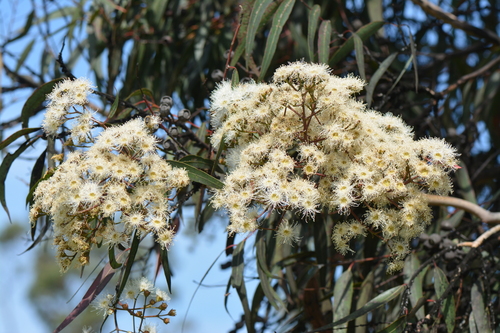
Angophora costata (Gaertn.) Britton is a tree that typically reaches 30 metres (100 feet) in height and forms a lignotuber. It has smooth pinkish or orange-brown bark that weathers to grey and is shed in small scales. Young plants and coppice regrowth have sessile, elliptical to egg-shaped leaves arranged in opposite pairs with a stem-clasping base, measuring 60–125 mm (2.5–5 in) long and 20–65 mm (0.8–2.6 in) wide. Adult leaves are also arranged in opposite pairs, and are glossy green with a paler lower surface. They are lance-shaped or curved, 70–190 mm (2.8–7.5 in) long, 12–35 mm (0.5–1.4 in) wide, and borne on a petiole 9–25 mm (0.4–1.0 in) long. New leaf growth has a strong red tint. Flower buds are arranged at the ends of branchlets on a branched peduncle 3–25 mm (0.1–1.0 in) long; each branch of the peduncle usually holds three buds, each on a pedicel 3–15 mm (0.1–0.6 in) long. Mature buds are oval to globe-shaped, up to 10 mm (0.4 in) long and 11 mm (0.4 in) wide. This species has five sepals up to 3 mm (0.1 in) long; its petals are white to creamy white with a green keel, and measure 3–5 mm (0.1–0.2 in) long and 3–6 mm (0.1–0.2 in) wide. Flowering occurs between October and December. The fruit is an oval or bell-shaped capsule that can grow up to 20 mm (0.8 in) long and wide. New seedlings have petiolate round cotyledon leaves 1.5 cm wide and 1.5 cm long.
This tree grows in sandy soil, often over sandstone, and occurs naturally in Queensland and New South Wales. It is widely distributed across south-eastern Queensland, and grows disjunctly in the White Mountains National Park. In New South Wales, it mainly occurs in coastal areas from Coffs Harbour south to Narooma, extending as far west as the Blue Mountains. It is found from sea level up to 300 m (1,000 ft) altitude, in regions with predominantly summer rainfall that receives 600 to 1,200 mm (25 to 45 in) of rain per year. Across its native range, maximum annual temperatures range from 25 to 35 °C (77 to 95 °F), minimum annual temperatures range from 0 to 8 °C (32 to 46 °F), and the region sees between 0 and 50 days of frost each year. In Victoria, it is a commonly planted ornamental tree and has become naturalised in some locations. It grows in open forest and woodland, in association with Sydney peppermint (Eucalyptus piperita), bangalay (E. botryoides), grey gum (E. punctata), blue-leaved stringybark (E. agglomerata), white mahogany (E. acmenoides), broad-leaved white mahogany (E. umbra), large-fruited red mahogany (E. scias), red bloodwood (Corymbia gummifera), yellow bloodwood (C. eximia), pink bloodwood (C. intermedia), lemon-scented gum (C. citriodora), turpentine (Syncarpia glomulifera), forest oak (Allocasuarina torulosa), and cypress pines (Callitris species). It also grows in hind dune communities alongside wedding bush (Monotoca elliptica) and burrawang (Macrozamia communis).
Angophora costata trees can live over 100 years. The species responds to bushfire by resprouting from epicormic buds and its lignotuber. On older specimens, new shoots develop on branches within a month after fire, while young plants produce new resprouts from the trunk and base within a month of a hot fire. New seedlings appear within 9 to 10 months after fire. This tree is parasitised by the long-flowered mistletoe (Dendrophthoe vitellina). Its flowers are eaten by the grey-headed flying fox (Pteropus poliocephalus) and little red flying fox (Pteropus scapulatus), and its seeds are eaten by the crimson rosella (Platycercus elegans). Although its bark is smooth, it hosts many invertebrates. Several jumping spiders in the family Salticidae, including Servaea vestita, and pseudoscorpions live under its loose bark. The flattened bug Stenocotis depressa evades detection by camouflaging against the bark, and cockroaches and huntsman spiders live under loose bark at the base of the trunk. Angophora costata is also susceptible to infection by the fungal pathogens Quambalaria pitotheka, Aulographina eucalypti and Cryptococcus neoformans.
In horticulture, this species (also called smooth-barked apple) grows well in a variety of situations, and can be easily grown from seed in a loose, well-drained seed-raising mixture. Some individual specimens have a straight trunk, while others have a more branching growth habit with twisted trunks. The tree sometimes sheds branches, so it should not be planted close to buildings.