About Anemonia alicemartinae Häussermann & Försterra, 2001
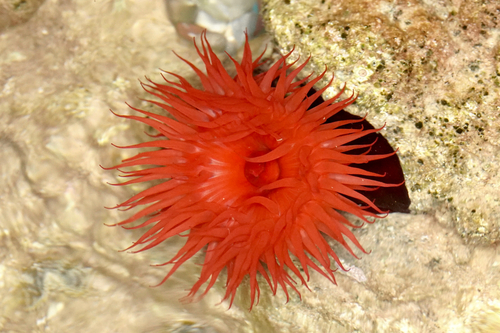
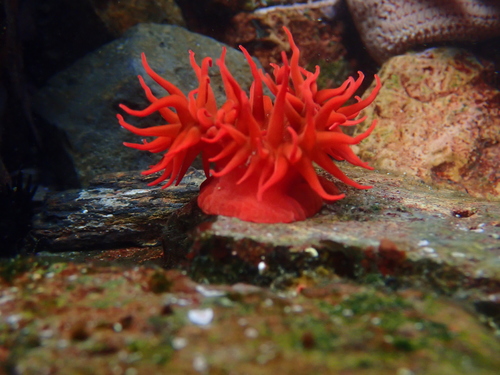
Description: Anemonia alicemartinae is easily spotted off the coast of Chile by its bright red color. When submerged, their bodies are covered in a layer of mucus. For medium-sized individuals, the pedal disc, which the anemone uses to attach itself to surfaces, has a diameter between 13–18 mm (0.51–0.71 in). Tentacles can reach up to 17 mm (0.67 in) in length. Normally, their tentacles are bent toward the center to cover the oral disc, the structure that holds the mouth used for eating and expelling waste.
Distribution and habitat: This species is distributed along the Chilean coast in intertidal zones, and it is one of the most abundant sea anemones in this region. It is generally found in groups of 5 to 10 individuals in areas with no direct wave surges. It can thrive at depths of up to 16 meters in tide pools, where it normally attaches to bare rock. Recorded habitat temperatures range from 13–23 °C, and salinity ranges from 33–36‰. Over the past 50 years, its distribution has increased by more than 1900 km along the coast of the Southeast Pacific Ocean, giving an expansion rate of around 38 km per year. Its latitudinal range has extended from 18°S to 36°S. While its exact original point of origin is unknown, scientific research suggests it may come from southern Peru. The highest population density is found off the coast of Arica. Because this potentially invasive anemone has spread rapidly, studies have been carried out to investigate its large-scale movements. A study by Arancibia Lopez concluded that colonization of new sites happens through two dispersal mechanisms: short distance displacement and long distance movement, driven by both abiotic stress and biotic factors. The anemone achieves movement through a process of detachment from a substrate followed by re-adhesion to a new one. Adhesion is done by the pedal disc, which does not create a very strong hold – the animal can be easily removed and re-attached, which suggests human activity is an additional factor contributing to its increasing abundance.
Life cycle: The life cycle of Anemonia alicemartinae starts with reproduction. This species reproduces mainly through asexual fission. In the original study led by Häussermann, multiple scars observed on individuals confirmed this mode of reproduction. Early life stages of A. alicemartinae do not include a larval phase, and males of the species have been shown to be infertile. Throughout the juvenile and adult stages, the species disperses across substrates via detachment and reattachment.