About Anemone virginiana L.
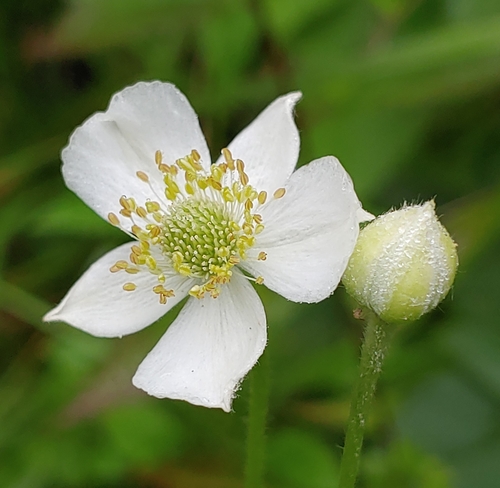
Anemone virginiana L. is an upright herbaceous perennial flowering plant in the buttercup family Ranunculaceae. It grows to a height of 30 to 80 centimeters (12 to 31 inches), and produces flowers from May through July. The flowers are white or greenish-white. After flowering, it bears fruits arranged in dense, rounded, thimble-shaped spikes that measure 15 to 35 millimeters (0.59 to 1.38 inches) long and 12 millimeters (0.47 inches) wide. The fruits, known as achenes, develop gray-white, densely woolly styles when ripe that enable wind dispersal. The plant has whorled leaves located halfway up the stem, and each individual leaf is deeply cut. It is native to eastern North America, where it grows in dry or open woodlands. It occurs in 38 of the 50 United States, ranging from Maine west to Minnesota, and south as far as Georgia and Louisiana. Common names for this species include tall anemone, thimble-weed, and tumble-weed. Note that multiple other plant species are also called "thimbleweed". Although Anemone virginiana is sometimes called a tumbleweed, it does not have the characteristic growth habit of true tumbleweeds. Its fruit is wind-dispersed and tumbles, an unusual seed dispersal mechanism, similar to tumbleweeds. It got the common name Thimbleweed because its pistil resembles the shape of a thimble. This plant is very hardy in different weather conditions, tolerating partial shade to full sun, drought, and cold. It prefers acidic soils but can tolerate liming, so it works well for garden cultivation.