About Anemone caroliniana Walter
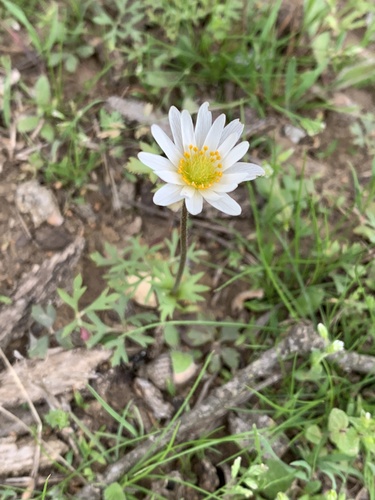
Anemone caroliniana, commonly known as the Carolina anemone, is a species of herbaceous flowering plant in the buttercup family Ranunculaceae. Individuals grow 10 (occasionally as short as 7) to 40 cm tall from short, tuber-like rhizomes that measure 10 to 30 mm long. The stem leaves of this plant lack petioles. It flowers from early to mid spring, producing one flower per stem. The flower is made up of 10 to 20 sepals, which are sometimes referred to as tepals; these are most often white or soft rose colored, but can also be purple. Sepals are 10 to 22 mm long and 2 to 5 mm wide. Fruits form in heads that are ovoid to subcylindric in shape, and measure 17 to 25 mm long. This species is native to central and southeastern United States, occurring primarily in the Great Plains and the Mississippi Valley, with scattered populations across the Southeast from Tennessee and Mississippi to the Carolinas. While it was once recorded in Vigo County, Indiana, it is now locally extinct in the state. It grows in dry prairies, barrens, and open rocky woods.