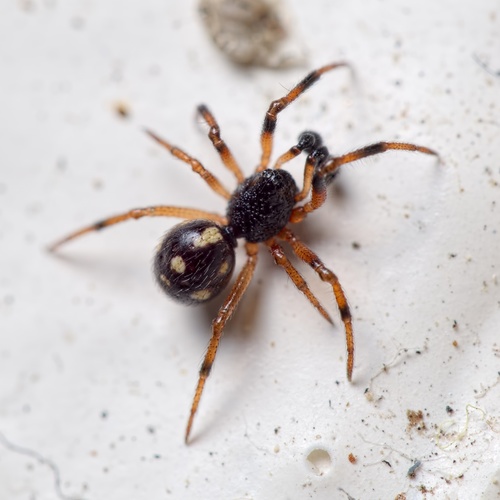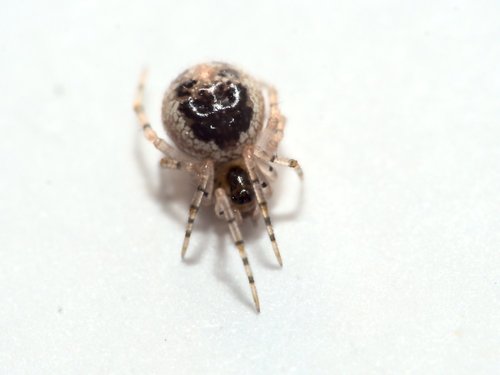
About Anelosimus eximius (Keyserling, 1884)
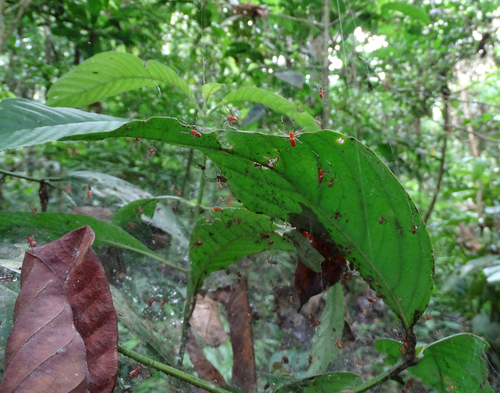
Anelosimus eximius is a species of social spider belonging to the genus Anelosimus, native to the Lesser Antilles and the region stretching from Panama to Argentina. Its colonies can contain up to several thousand individual spiders. Along a north-south axis, the species' natural range runs from Panama to southern Brazil, and along an east-west axis it extends from Trinidad and eastern Brazil to Peru. It lives in both rainforest and second-growth forest habitats. New A. eximius colonies are established through two processes: budding and dispersal. Budding happens when an existing colony splits into two or more separate independent webs. This split can occur after the original web is broken by falling debris or other accidents, or when a group of spiders builds a new secondary web near the original established colony. Dispersal takes place when large numbers of mated females leave their original colony and spread out individually, each building a new solitary web. These solitary founding females are often joined by other dispersing individuals, most commonly other females that have already failed to establish their own new colonies. New colonies with multiple founding spiders are usually found close to existing established webs, while new colonies founded by a single spider typically grow further away from established webs. Males and juveniles do not leave their natal webs during dispersal events. Newly founded webs have a high rate of failure, but survival chances improve if other females join the founding individual. The leading cause of new colony failure is predation, most often by other theridiid spiders or by wasps. Small webs, especially those that have no remaining adult spiders, are also vulnerable to damage from storms, as juveniles or solitary females have limited ability to repair storm damage. These colony establishment patterns result in A. eximius colonies often forming aggregations of two to forty separate webs. These aggregations can be separated from other similar clusters by distances ranging from a few meters to several kilometers. Colonies inside a single cluster are usually descended from budding events, while separate distinct clusters are most often originally established by dispersal founder events. Neighboring colonies are usually located very close to one another, and may share knockdown threads or be in physical contact. Gene flow between colonies within the same cluster is high, while gene flow between distinct clusters is low or completely absent, because individual spiders do not typically move between unrelated colonies. It is still possible for new colonies to be founded by a group of unrelated females. As a result, A. eximius populations exist as mosaics made up of geographically and genetically distinct groups of colony clusters. Reproduction in this species takes place year-round. Females lay egg sacs beneath leaf canopies, and tend the sacs while staying positioned close to a single sac. Extra females may move near an unattended egg sac to tend it. Tending females groom and clean the surface of their egg sacs, and occasionally remove silk from the sacs or move them to different leaves. After hatching, groups of spiderlings stay together for several days. Juveniles remain beneath leaf canopies until they reach their third instar, at which point they move to the upper strands of the colony web. Adult females feed young spiders through regurgitation, and will feed young spiders that are not their own offspring.