About Aneilema aequinoctiale (P.Beauv.) G.Don
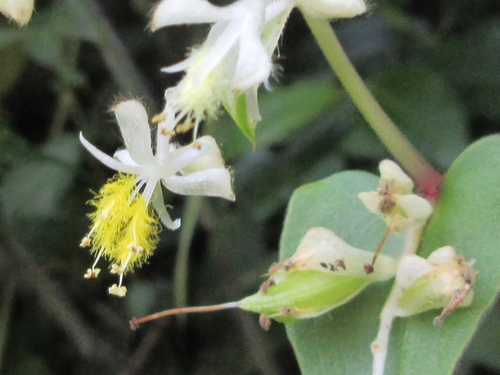
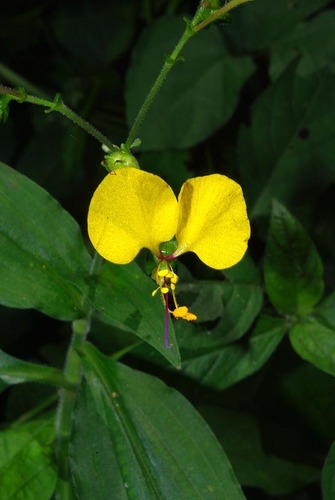
Aneilema aequinoctiale (P.Beauv.) G.Don is a perennial plant that may be classified as either a shrub or a herb, with a growth habit that is either scrambling or erect. It reaches a maximum height of two metres. Its leaves and leaf sheaths are arranged distichously along the stem; they are pale green, covered in fine hooked hairs that create a sticky texture, and can be ovate, lanceolate, or elliptic in shape. This species has thin, fibrous roots. Its inflorescences are typically terminal, with cincinni that can be whorled, opposite, or alternate. The flowers have a single pair of bright yellow petals, while the third petal is either absent or small and withered. Flowers are short-lived: they open daily from roughly 07:00 to 10:00 during the flowering season, which runs from September through June. Flowers may be perfect (bearing both male and female reproductive organs) or staminate only. The plant produces oblong to obovate capsules, with brown seeds. Aneilema aequinoctiale prefers moist, partially shaded locations, and commonly grows on forest margins and beside streams, though it can also be found in grassland, farmland, and roadside scrub. It is widespread across multiple regions of West and East Africa, and is more widely cultivated and used in Nigeria, Uganda, Kenya, Zanzibar, and Zimbabwe. Ungulates graze on this plant in grassland areas such as Kenya. Its main uses across Africa fall into medicinal, culinary, and domestic categories. In the Ondo region of Nigeria, infants are bathed in a wash prepared from the plant's roots. In other regions, roots are used as livestock feed, and leaves are cooked and eaten like spinach. In Zanzibar, the plant is used to relieve colds. Across the continent, the roots are used for a wide range of other medicinal purposes: treating skin disorders, eye diseases, constipation, leprosy, kwashiorkor, and amenorrhoea. It is also thought to help children with osteomalacia learn to walk. Substantial research has confirmed that chimpanzees self-medicate with Aneilema aequinoctiale by swallowing its leaves whole. This plant is not normally part of a chimpanzee's diet, and this behaviour is most often observed during rainy seasons, when chimpanzees are most likely to be infected by the parasitic nematode Oesophagostomum stephanostomum and other species of parasitic worms. Examination of chimpanzee faeces shows that whole-swallowed leaves remain intact, along with multiple expelled worms; one dung sample contained as many as 20 worms and 50 undigested leaves. The mechanism that causes worms to be expelled from primates after consumption of Aneilema aequinoctiale is not yet fully understood. However, a consistent trait in the whole-leaf swallowing behaviour of chimpanzees for this and other plants is the presence of trichomes on the leaves. Since trichomes are not easily digestible, the rough, unchewed surface of the leaves is thought to help physically remove worms from the intestines.