About Aneides aeneus (Cope & Packard, 1881)
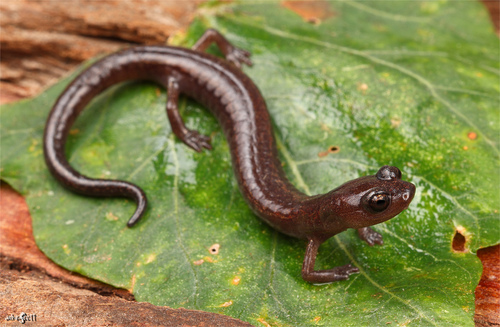
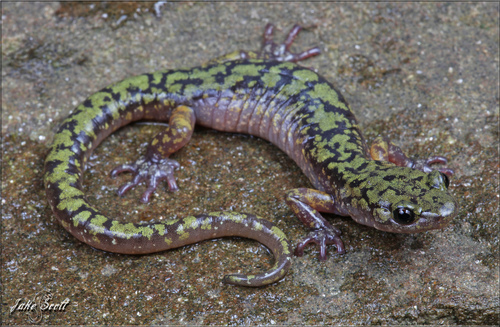
Description and taxonomy. The common name of Aneides aeneus (Cope & Packard, 1881) is green salamander. The genus name Aneides comes from Greek meaning "lacking form or shape", a reference to this species' flattened, elongated bodies. The species epithet aeneus is Latin for bronze or copper, referring to the species' dorsal coloration. Green salamanders are small and notably flat. Green, lichen-like blotches on a darker dorsum make Aneides aeneus the only salamander in North America with green markings. A. aeneus has squared toe-tips, large conspicuous eyes, and a light blue to yellow ventral surface. The square toe-tips and prehensile tail are morphological adaptations that help the salamander climb. Adult body length ranges from 8 to 12 cm (3 to 5 inches), with 14 to 15 costal grooves. Formerly, A. aeneus was considered the only species of the genus Aneides found in the Eastern United States. However, some researchers suggested there could be up to four separate Aneides species between populations on the Cumberland Plateau and Blue Ridge Escarpment. A 2019 study found that multiple populations of A. aeneus represent distinct taxonomic groups, which supports the existence of a possible species complex. At least one of these populations was confirmed to be a distinct species on its own: the Hickory Nut Gorge green salamander, A. caryaensis. The subgenus Castaneides was created to hold all eastern species of Aneides, and A. caryaensis is the most basal member of this complex. Castaneides diverged from the Aneides hardii lineage between 27.2 and 32.3 million years ago. Aneides aeneus is considered the most primitive species in its genus. Members of Castaneides are the only salamanders in North America with green markings. Combined with their highly specific habitat, they are almost unmistakable when encountered in the field. Geographic distribution. Aneides aeneus is known to live in both the Alleghenies and Cumberland Plateau, with a range extending from southwestern Pennsylvania to northern Alabama and northeastern Mississippi. It is also commonly found in south-central Ohio. Isolated populations are known from the Blue Ridge Escarpment at the junction of Georgia, North Carolina, and South Carolina. The range of the Alleghenies and Cumberland Plateau extends southwest from Fayette County, Pennsylvania through eastern West Virginia, eastern Kentucky, the extreme western portions of Virginia, Tennessee, and Alabama. The population discovered in 1930 in Great Smoky Mountains National Park has not been located since that discovery. Possible disjunct populations may exist on Clinch Mountain, Bays Mountain, the Appalachian Ridge and Valley, and in the Inner Central Basin of Tennessee (Redmond and Scott, 1996).